


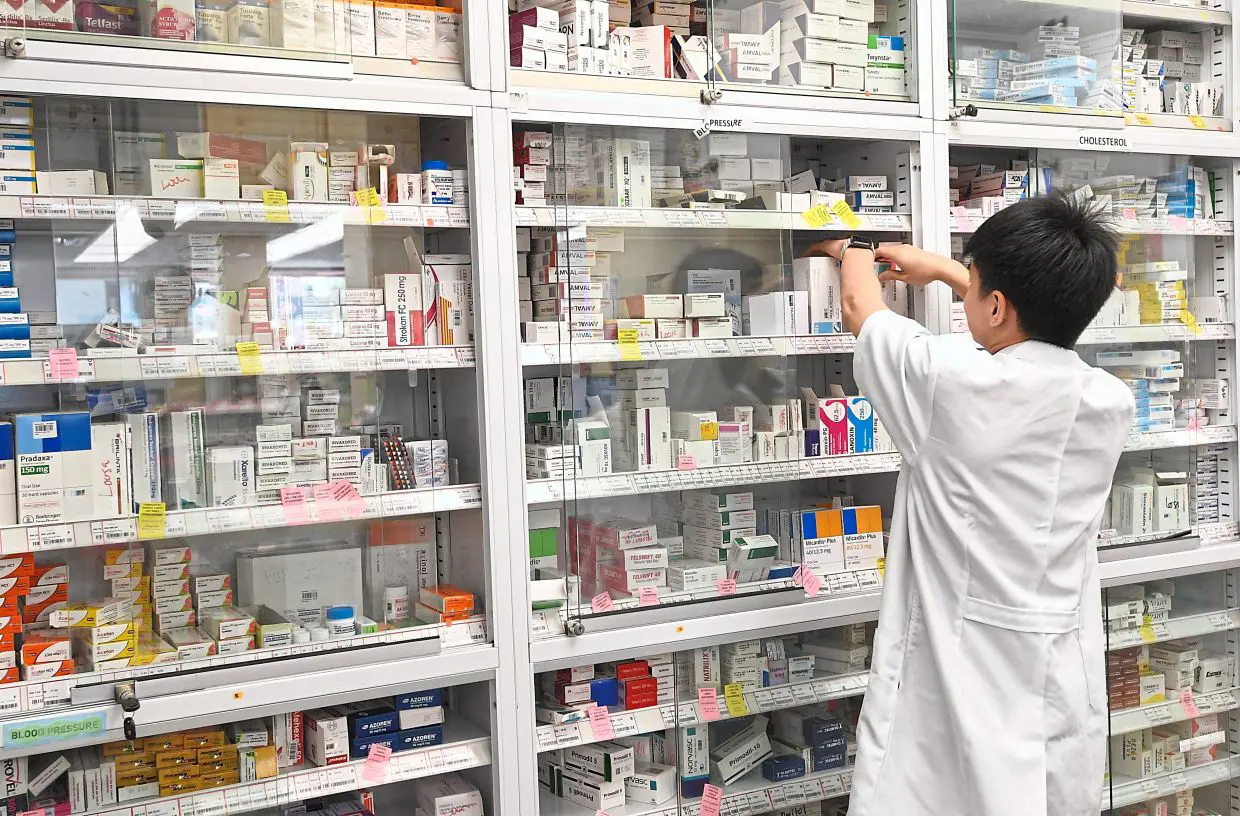
PETALING JAYA: The current supply of pharmaceuticals remains stable, whereby, on average, companies hold approximately three months of active pharmaceutical ingredients (APIs) and excipients and about two months of finished products.
The Malaysian Organisation of Pharmaceutical Industries (Mopi) said this provides a buffer that supports continued supply of locally-manufactured essential medicines in the near term.
“There are no significant supply disruptions or shortages reported. However, there are early signs of price increases of APIs and plastic packaging materials as well as diesel and logistics costs.
“There are also some challenges in logistics, particularly for exports to certain regions. At this stage, there are no specific medicines identified as being disproportionately affected,” Mopi said.
However, since the local pharmaceutical manufacturing industry mostly relies on imported raw materials like APIs and excipients, any long-lasting problems in global supply chains could impact many different medicines instead of just a few specific ones, Mopi added.
In March, the Health Ministry stated the supply of medicines in the country is currently stable and under control, whereby the short-term impact from the conflict in the Middle East is minimal.
It added that the stock levels of medicines in the Health Ministry’s facilities are kept between one and three months based on consumption needs, supported by additional buffer stocks of up to two months at the concessionaire level for medicines supplied through logistics concessions.
Asked what kind of measures are needed to mitigate this, Mopi said the industry is in the midst of taking precautionary steps, including increasing inventory where necessary and planning forward purchases of raw materials.
In addition, close coordination between industry and the Health Ministry will be important, including monitoring stock levels of essential medicines, ensuring flexibility in sourcing alternative raw materials where required and prioritising supply for the local market to ensure continuity of essential medicines.
Mopi is not a supplier to the Health Ministry, as it is a trade association that represents the local pharmaceutical manufacturing industry in Malaysia that works closely with the ministry.
Malaysian Association of Pharmaceutical Suppliers (MAPS) president Lim Teng Chyuan assured that supply remains diverse in terms of therapeutic category and sources, as members are mostly focused on generic sources which are wholly imported.
He said their 38 members collectively import from all five continents and 40 countries, for a total of 270 suppliers and around 2,000 products.
“India, South Korea, Thailand and Germany are the primary supplier nations we engage with. India accounts for 30% of our suppliers in terms of the number of companies and an even larger proportion when considering the variety of products.”
“Major concerns relate to cost escalations and the possibility of source countries limiting exports for the purpose of prioritising their own medicine security.
“So far, most of our members have experienced increases in freight costs and a small number have experienced increases in the cost of goods,” he said in response to medicine supply being affected by the US-Israel conflict against Iran and the closure of the Strait of Hormuz.
But Lim noted that pharmaceutical supplies are not merely limited to concerns over APIs, as many components are involved in the final product, including excipients and packaging.
He pointed out that hydrocarbons are also required for powering machines used in the manufacturing process and are used as materials in the production of APIs, including solvents.
Additionally, he said fuel is also required in the supply chain in powering transport, and if there’s a shortage, the impact will be severe.
“So far, the cost of freight has increased by around 20%, and in some cases, it has risen even higher, by 70% in cold chain transportation, according to feedback.
“Operation costs are also increasing. Most significantly, salespeople do not use Budi’s quota for travelling on company business, and the cost of fuel for companies is escalating very quickly.
“As for the drugs affected, the pharmacy services programme (PSP) is already working on getting a composite picture.
“Since the industry is represented by three associations, the central role of the PSP would be the most suitable point of coordination.
“The industry associations are supporting the data and information collection, which will prioritise national essential medicines and single-source products, according to the last consensus,” he said.
Lim assured that where possible, companies will work towards ensuring sufficiency in a coordinated manner with feedback from PSP helping towards this goal.
Measures will include building inventory, proper and timely communication to prevent panic buying, and, if need be, product rationing, he said.
Lim expressed hopes that the government will offer some form of relief for suppliers, noting that measures such as inventory holding can place significant strain on cash flow.
With the ongoing conflict in the Middle East, a meeting with stakeholders is expected to be held with Prime Minister Datuk Seri Anwar Ibrahim this week to discuss relevant matters. - Star

No comments:
Post a Comment
Note: Only a member of this blog may post a comment.