


Diesel in Peninsular Malaysia now costs RM6.02 per litre. In five weeks since the Strait of Hormuz disruption, it has nearly doubled from RM3.04.
Every business and household in the country is feeling this, and the effects are beginning to show up through the cost of everything that average Malaysians buy.
The question here is not whether diesel should cost more when global oil prices surge. Of course it should. The question is whether the government has given Malaysians the tools to understand, anticipate and plan around the price they are paying.
The government's targeted diesel subsidy system, SKDS 2.0, provides fleet cards to eligible logistics and public transport operators at RM2.15 per litre.
While that protection is real and appreciated by the industry, a 2024 survey found only 52.4 percent of businesses were eligible, and critical diesel-dependent sectors remain outside the system.
For example, agricultural smallholders in Cameron Highlands, who fall outside the fleet card system and rely instead on monthly cash assistance of RM300, pay full market price for their tractors, irrigation pumps and in-field transport.
For these businesses, the inability to anticipate next week's diesel price is a real business issue that impacts the bottom line. A construction contractor quoting a six-month project needs to price diesel into every cubic metre of concrete and every hour of earthworks.
Without knowing how the Automatic Pricing Mechanism (APM) formula works in practice, the contractor must either absorb the risk or pad their quotations with a safety margin while waiting for the government’s announcement every Wednesday.
That defensive pricing cascades into housing costs, infrastructure costs and ultimately the price of everything built in Malaysia.
Transparency would not prevent diesel from becoming more expensive, but it would replace uncertainty with predictability, and predictability is what separates orderly cost management from reactive price hikes that penalise consumers.
What the numbers reveal
To test whether the APM is genuinely automatic, the formula is reverse-engineered for each pricing week using the best available public data from the Australian Competition and Consumer Commission as proxy, the latest publicly known fixed cost components as disclosed in 2019 and estimated weekly exchange rates.
For the latest week, the Finance Ministry’s own stated figure of US$250 (RM1,010) per barrel for refined diesel is used.
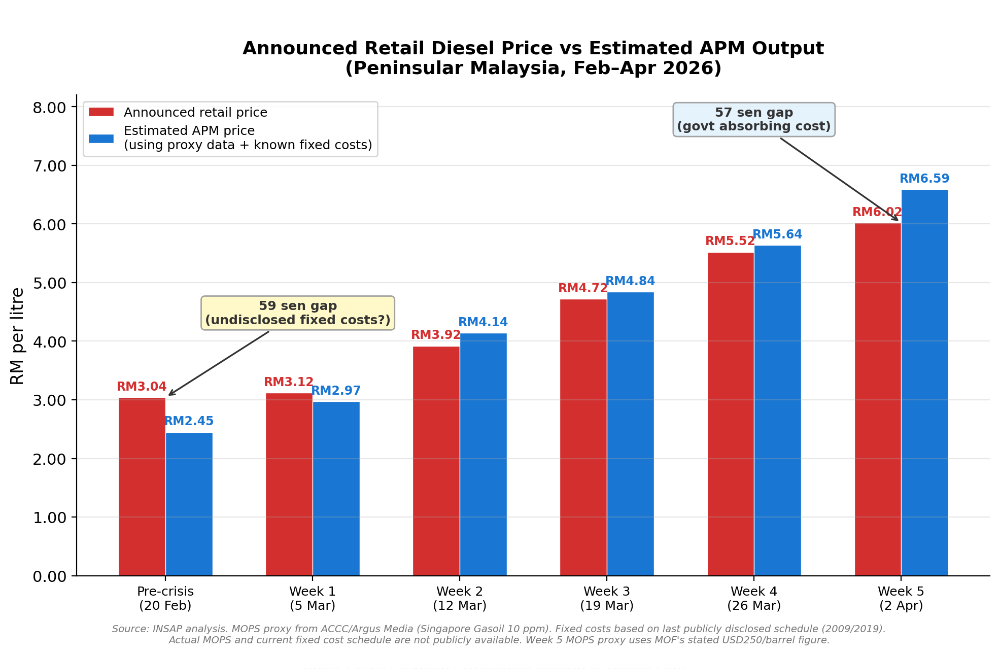
Two things stand out: First, before the crisis, the announced price of RM3.04 was 59 sen higher than what proxy data and the known fixed cost schedule produced.
This tells us the fixed cost components have either been revised substantially upward or undisclosed levies have been added since the last public disclosure. The public cannot know because the current schedule has never been published.
Second, by week 5, the estimated full APM price using proxy data was RM6.59, while the announced price was RM6.02, implying the government is absorbing roughly 57 sen per litre.
The government's own press release acknowledges partial cost absorption. The problem is not that the government is providing relief, but rather it is that neither the size of the relief nor its basis can be independently verified.
This matters when we want to discuss the government’s fiscal sustainability.
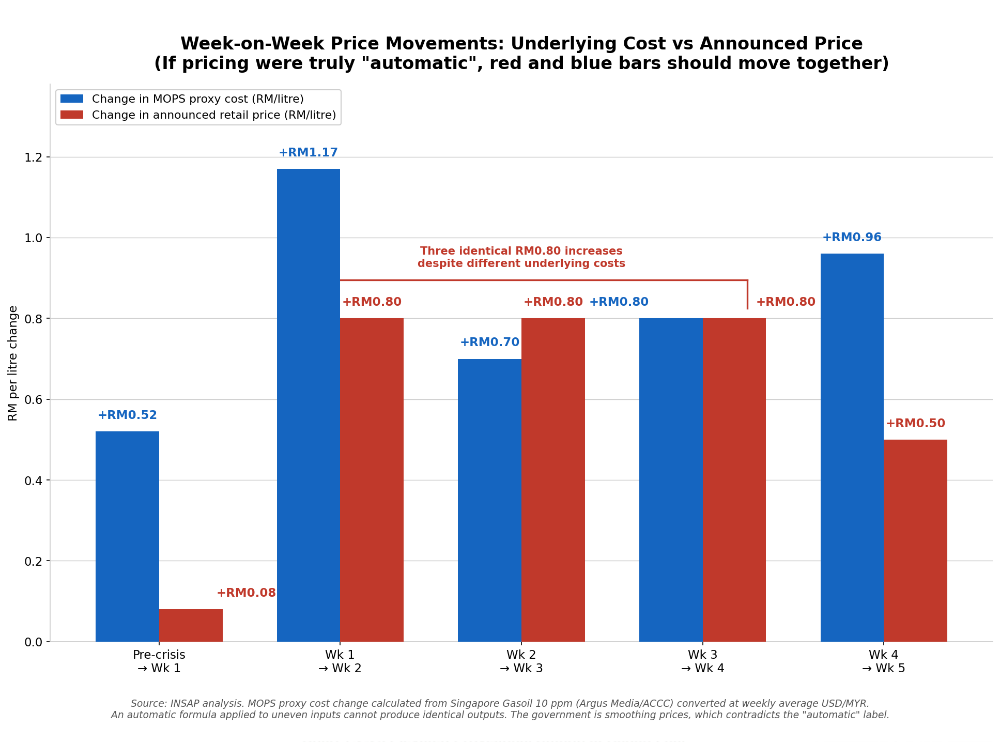
The more striking finding is the pattern of weekly increases.
The underlying Mean of Platts Singapore (Mops) - which is a benchmark price for refined gasoil set daily by S&P Global Platts based on actual trading transactions in Singapore - proxy cost moved by sharply different amounts each week: 52 sen, then RM1.17, then 70 sen, then 80 sen, then 96 sen.
Yet the government announced three identical 80 sen increases in a row for Weeks 2, 3 and 4.
An automatic formula applied to uneven inputs cannot produce identical outputs. The government is smoothing the price, which may be a defensible policy, but it is not what the word "automatic" means.
There is a revealing contrast within this week's own announcement. RON97 petrol went down by 20 sen, exactly as an automatic formula should behave when global petrol prices ease.
That the government let RON97 track the market while smoothing diesel demonstrates that it applies the APM transparently when it chooses to. The selective application of automaticity is itself a policy choice the public deserves to understand.
A step forward, but not enough
The Finance Ministry press release on April 1 broke with previous practice by disclosing that refined diesel was at US$250 (RM1,000) per barrel and Brent crude above US$100 (RM402).
This is welcome but insufficient because it does not tell businesses which specific Mops assessment was used, what averaging period was applied, what exchange rate converted it into ringgit, or what fixed cost components were added to arrive at RM6.02.
The government had also reduced the Budi95 petrol subsidy cap from 300 to 200 litres per month and imposed diesel filling limits in East Malaysia.
Combined with the monthly fuel subsidy bill having surged from RM700 million to RM3.2 billion, these interventions paint a picture of a government managing multiple subsidy commitments under serious fiscal strain.
The avoided fiscal question
According to available data, the goods and services Tax (GST) collected RM60.5 billion in 2017 at a flat six percent rate across 76 percent of goods and services.
Even with the service tax increase to eight percent in 2024 and expanded sales and services tax (SST) scope from July 2025, the estimated SST revenue has just about crossed the average collection during GST-era levels, but this nominal convergence is not the right measure of fiscal adequacy.
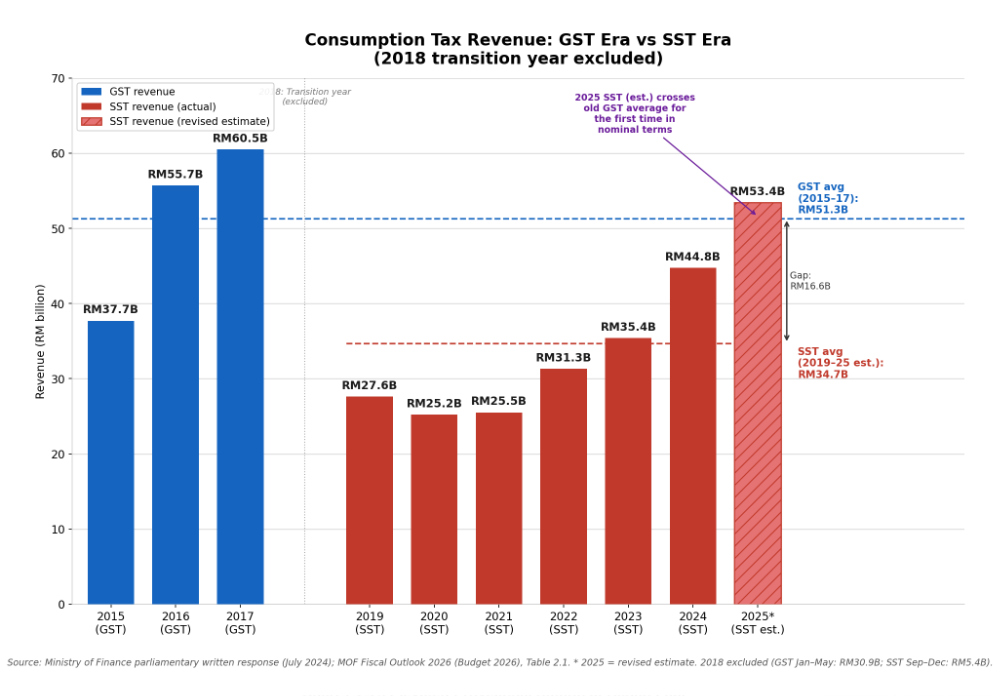
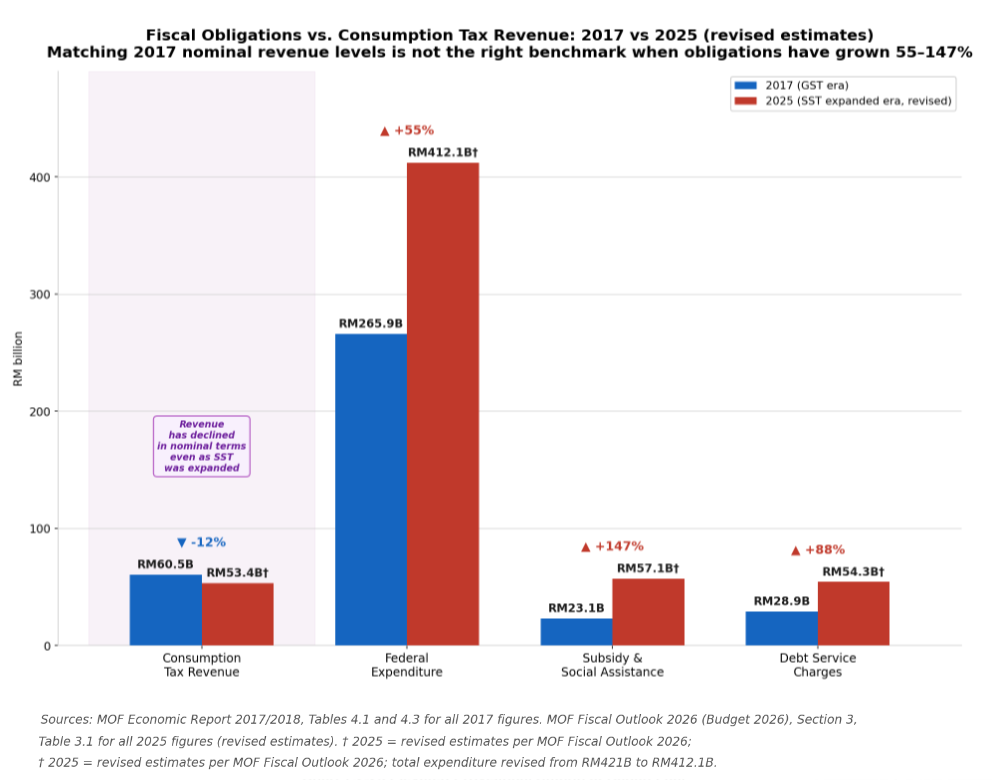
A tax regime like SST, which has required successive rate hikes, scope expansions and nearly eight years of incremental adjustment just to match GST’s 2015–2017 average figures, is structurally insufficient when federal expenditure has grown 55 percent, subsidy and social assistance obligations have surged 147 percent, and debt service charges have increased 88 percent over the same period.
The relevant benchmark is not whether collection in 2026 matches a number from 2017 in ringgit terms, but whether the revenue base can keep pace with the obligations the government carries.
GST was abolished in 2018 as an electoral promise that it was driving up the cost of living. Eight years later, the cost of living has continued to rise, driven by supply chain cascading under SST, administered price adjustments, and the fiscal constraints that prevent adequate mitigation during global shocks.
The promise was that removing GST would make life cheaper, but the evidence suggests it made the government poorer without making Malaysians better off.
It is time for an honest conversation about revenue reform, whether a lower initial GST rate with a broader base, guaranteed fast input tax credit refunds backed by published KPIs, dedicated small and medium enterprises transition support and clear accountability for how the revenue is spent.
For now, the immediate ask is modest: Publish the Mops reference prices, the exchange rates, the averaging methodology and the current fixed cost schedule each week alongside the retail price.
Let Malaysians see the arithmetic, and while the arithmetic is on the table, put the revenue reform there too. - Mkini
WOON KING CHAI is the director of the Institute of Strategic Analysis and Policy Research (Insap). He previously served in senior roles in the federal government and private sector.
The views expressed here are those of the author/contributor and do not necessarily represent the views of MMKtT.

No comments:
Post a Comment
Note: Only a member of this blog may post a comment.