


First came Zohran Mamdani, now here comes Abdul El-Sayed.
The newly elected senator for the state of Michigan has sparked fascination worldwide for his fitted black tees, straight talk, and being unashamedly Arab and Muslim American.
Every possible aspect was brought up as a weak point, including his name, possible allegiances to foreign groups, and his opposition to the war in Iran and military aid to Israel.
His win in the US midterm elections, alongside the Democrats’ "blue wave" and takeover of the House of Representatives and the Senate, indicates the widespread dissatisfaction felt by voters.
But it was not an easy win, and it was the combined massive grassroots efforts by volunteers and campaigners who were outspent by their opposition by almost US$100 million (RM405 million).
I had the pleasure of being in Michigan in the final week of the campaign to observe the El-Sayed campaign and speak to voters and volunteers.
It’s still the (micro)economy
While it's not true that people don’t care about foreign policy, they care a lot about the downstream effects of those policy decisions.
Voters I spoke to frequently shared similar complaints: petrol prices are way up, the price of everyday items is becoming unaffordable, jobs are hard to find, and it doesn’t seem the government cares about addressing these concerns.
Polls before and after the midterms show that the economy, cost of living, wealth distribution, as well as Iran and corruption were key concerns that contributed to widespread voter dissatisfaction.
Yet, these concerns have either been ignored or dismissed by official reported economic numbers that say things are going great.
In our K-shaped global economy, these concerns aren’t exclusive to American voters. Similar concerns are shared the world over, including in Malaysia.

Positive investment and inflationary figures do not connect with people, yet officials would still trot them out to show that the government is working hard (something I’ve learned the hard way).
Both things can be true: the government can try its best to improve the larger economy, but things are not immediately improving at the individual level. If anything, middle-power governments would have to work harder at making policy decisions that would mitigate some of the effects of global trends, while also correcting existing local imbalances.
When it comes to politics in the US or in Malaysia, how households fare will set the tone. Overemphasising institutional and international efforts, when individuals find their salary buys them less and less, adds to existing dissatisfaction.
Beyond, or even before, the ballot box, we can see examples of these expressions in heightened anti-migrant rhetoric and action. The worst thing sitting politicians could do in this environment is try to co-opt xenophobic sentiments and over-correct in that direction.
Knock every door, get every vote
Often, we think of the US as a pole of sophisticated democracy that's driven by rational policy discussion and debate. While there is definitely a lot of that within elite political circles, rhetoric alone does not build movements or win elections.
The beating heart of campaigns is still communities and relational connections that enable bases to be built, and thereafter expand them. These local circles of influence become the base for finding support at the wider state and federal levels. Movements, as some may successfully turn into, draw a lot from this well of local support.
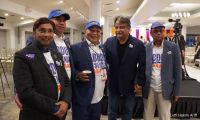
In observing El-Sayed’s campaign, this deep tissue connectivity within communities was instrumental in creating the conditions for success. Involvement from community groups that banded together to work towards creating necessary awareness and effective support for El-Sayed on fairly simple campaign promises: money out of politics, money in your pocket, medicare (healthcare) for all.
They worked tirelessly, first to get the word out, and as exhaustively, to get the vote out. The platform resonated strongly with voters, despite the barrage of negative ads directed towards El-Sayed.
The campaign’s grassroots mobilisation led to over 46,000 volunteers helping out and 1.3 million contributions averaging US$44 each.
Volunteers and campaign staff knocked on over 300,000 doors and made more than a million phone calls to voters, friends and family, to ensure that the maximum number of voters turned out by election day.
Over 60 percent of Michigan's voting-age population voted, with significantly higher turnout across the board than the 2022 midterms, and higher than the 2024 elections in certain areas.
Shifting away from identity politics
El-Sayed’s identity and religious background remain a focus in conversations, especially outside the US. This is despite the senator running on a progressive platform that focused on health and economic wellbeing for all.

This shift towards clearer policy direction that affects daily lives over identity politics or institutional reform was also shared by other candidates, including those who lost.
This clarity seems to be spreading more slowly on Malaysian shores, where only a few candidates like Pakatan Harapan's Jason Nathan are making specific policy promises in the ongoing campaign for the Malacca state election.
That presents an attempt to solve concerns that constituents have, which can only come about if candidates and parties are familiar with them and have invested in building the relationships prior to nomination day.
It is also a much-needed shift to wean ourselves of racial and religious issues that can compound rather than solve problems, as many Americans have realised leading up to the midterms.
Those issues may never disappear completely from our political radar, but they can become less important compared to clear-eyed policies aimed at improving everybody’s quality of life. - Mkini
LUTFI HAKIM ARIFF works at the intersection of media, policy, and politics. Currently on an education sojourn in the US.
The views expressed here are those of the author/contributor and do not necessarily represent the views of MMKtT

No comments:
Post a Comment
Note: Only a member of this blog may post a comment.