


After a lengthy delay, the long-awaited Sarawak redelineation exercise finally entered its first public display yesterday.
Persatuan Pemangkin Daya Masyarakat (Rose) and Persatuan Bertindak Pilihan Raya Bebas dan Saksama (Tindak Malaysia) acknowledge several positive steps taken by the Election Commission in presenting its first proposal.
However, we are deeply disappointed that these improvements are accompanied by serious regressions in the proposed boundaries, particularly in relation to equality of voting power, malapportionment, and local ties.
In short, the EC has taken one step forward in transparency, but two steps backwards in the substance of fair representation.
Positive steps
1. Better communication and access to redelineation information
We commend the EC for developing a dedicated website for the Sarawak redelineation exercise.
The website provides useful tools to assist Sarawakian voters in assessing and studying the proposal, including dedicated sections for:
Proposal display
Representation qualification
Representation/objections
These are significant improvements in the way the EC communicates the redelineation exercise to the public.
For the first time in the modern era, the EC has published detailed constituency-level maps with clear indications of which polling districts have been moved into or out of a particular constituency.
This represents a huge leap forward compared with the coarse-resolution Sarawak maps used during the 2015 redelineation exercise, as well as the maps used for Malaya and Sabah during the 2016–2018 exercises.

Previously, the EC largely published state-level maps without sufficient detail to show polling district-level changes. This effectively made it extremely difficult for potential redelineation objectors to identify precisely how constituency boundaries had changed.
The new level of detail gives voters, civil society organisations, and other stakeholders a much better opportunity to scrutinise the proposal.
Another significant improvement is the representation qualification tool, which allows individuals to determine whether they qualify to participate in the redelineation objection process. This is particularly important for forming an objector group of 100 or more voters from an affected constituency.
Previously, it was largely guesswork whether all members of a proposed objector group would meet the qualification requirements or whether some individuals might later be disqualified.
Similarly, clearer forms and procedures for submitting representations and objections make it easier for members of the public to participate meaningfully in the process.
We welcome these improvements and hope that the EC will maintain this level of transparency throughout the remainder of the redelineation exercise.
2. Reducing the gap between the largest and smallest state constituencies
One of the fundamental principles underlying the 13th Schedule of the Federal Constitution is equality of voting power among constituencies, subject to the constitutional considerations applicable to rural areas.
Immediately before the commencement of this redelineation exercise, the most populous state constituency was Senadin in Miri, with 74,501 voters, while the least populous was Gedong in Batang Sadong, with 10,481 voters.
This meant that the voting power of a voter in Senadin was approximately one-seventh that of a voter in Gedong.
While Gedong is a rural constituency, it is not as remote as some of the constituencies in the interior, such as those in Kapit and Baram. The extent of this disparity therefore raised serious questions about the existing distribution of voters.
Under the EC’s first draft, the most populous state constituency becomes Piasau in Miri, with 34,546 voters, while the least populous becomes Pelagus, with 10,372 voters.
The ratio between the largest and smallest state constituencies has therefore been reduced from approximately 7:1 to 3:1.
We acknowledge this as a positive development.
However, this headline improvement masks significant problems that remain underneath the overall distribution of constituencies.
Regression in some aspects
While we acknowledge the EC’s progress in certain areas, several aspects of the proposal undermine the prospect of achieving a genuinely fair outcome.
The following issues require serious public scrutiny.
1. Electoral roll used for the redelineation
The electoral roll is one of the fundamental bases for a redelineation exercise.
Under the 13th Schedule, the electoral roll used for redelineation should reflect the current electoral situation as closely as possible.
Some of us had anticipated that the Sarawak redelineation exercise would begin as early as April or May 2026. Instead, the exercise was delayed until Sept 1.
The electoral roll used for the Sarawak redelineation is the principal electoral roll of 2015, which was gazetted on Jan 29, 2026, containing 2,037,648 voters.
The Sarawak electoral roll for April 2026 contained 2,047,842 voters.
While the difference of approximately 10,000 voters may not, by itself, materially alter the overall outcome, the EC should have clearly explained to the public why the redelineation exercise was delayed and why this particular electoral roll was selected as the basis for the exercise.
Rather than leaving stakeholders to speculate about the reasons for the delay, the EC should provide a clear explanation.
This is particularly important because the public is entitled to understand why an electoral roll gazetted in January 2026 is being used for a redelineation exercise commencing in September 2026.
2. Unaddressed malapportionment
While we commend the EC for reducing the gap between the most and least populous state constituencies, a detailed study of the proposal shows that it has failed to adequately address the inequality of voting power and the historical malapportionment that we have previously raised.
We previously proposed to the EC that a deviation of about 20 percent from the average Sarawak constituency electorate should be the target for a substantially fairer distribution.
This is not an unreasonable expectation.
Indeed, during the first delineation of Sarawak in 1968, the EC voluntarily adopted a deviation of about 30 percent from the average.
Yet, under the present proposal, Pelagus remains approximately 50 percent below the average Sarawak constituency electorate.
Our analysis using the 20 percent threshold illustrates the extent of the problem.
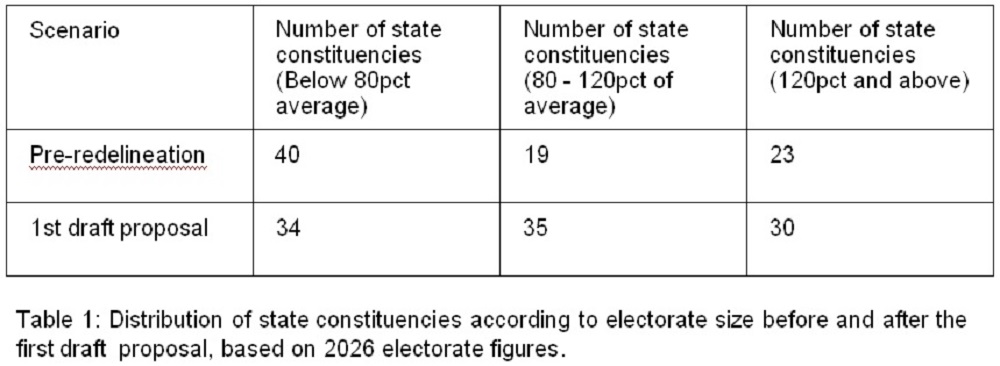
The first draft has certainly moved more constituencies into the 80-120 percent range.
However, the fact that 30 constituencies remain at 120 percent or more of the average, while 34 remain below 80 percent, demonstrates that the problem of malapportionment remains substantial.
The modern EC, particularly after the democratic reforms and institutional expectations that emerged after 2018, should have aimed considerably higher.
Bandar Kuching
The proposed changes in Bandar Kuching demonstrate the problem particularly clearly.
Following boundary alterations and the creation of one additional seat, all four constituencies in the area, including the newly created Tabuan Jaya, have electorates at 140 percent or more of the Sarawak state constituency average.
In effect, the EC has failed to resolve the longstanding overloading of urban constituencies.
Instead, the proposal takes only a tepid step towards reducing their oversized nature. This is especially troubling because Bandar Kuching is one of the areas where population growth and urbanisation have been most pronounced.
Sibu
The situation in Sibu raises similar concerns.
The number of state constituencies in that parliamentary constituency increases from three to five. Previously, two of the three Sibu constituencies were oversized. Under the first draft proposal, three of the five constituencies remain oversized.
The creation of two additional constituencies therefore does not translate into a proportional distribution of voters. Indeed, the new constituencies themselves appear to have been designed with electorates that are already too large relative to the Sarawak average.
Aggravated malapportionment
There are also cases where the EC’s proposal appears to make existing disparities worse.
Demak Laut, previously part of the Santubong parliamentary constituency and now proposed to be placed within Kota Samarahan, moves from an approximately average-sized state constituency to an overloaded one under the first draft.
Similarly, Piasau in Miri, which was already an oversized constituency, becomes even more oversized under the proposal.
Gedong, although no longer the smallest constituency, is now the second-smallest.This is significant because Gedong is not geographically comparable to the remote interior constituencies.
Yet voters there continue to enjoy substantially greater voting power than voters in interior constituencies such as Murum and Bukit Goram.
Parliamentary-level inequality
We recognise that Sarawak’s electoral structure creates particular challenges at the parliamentary level.
Sarawak does not currently practise a simple multiple relationship between the number of state and parliamentary seats. Consequently, we do not expect the EC to achieve perfect equality at both levels. However, this does not justify allowing the voting-power gap to widen.
Before the redelineation, Miri had 150,924 voters while Igan had only 29,509 voters. That represented a gap of approximately 5.1 times.
Under the first draft proposal, Miri grows to 158,411 voters, while Lubok Antu becomes the least populous parliamentary constituency with 28,458 voters.
The gap therefore increases to approximately 5.6 times.
We have to ask: why is the EC actively aggravating the inequality of voting power?
The proposed boundaries continue to penalise Sarawak’s urban voters despite the state’s demographic reality having increasingly shifted towards urban areas. The EC has therefore failed to adequately uphold the basic tenet of the 13th Schedule: respect for equality of voting power.
Disregard for local ties and communities of interest
We are also concerned that several constituencies in the first draft arbitrarily group together voters and communities that have limited community, geographical, or administrative ties.
Kota Samarahan is already an unusual parliamentary constituency because it spans three divisions:
the bulk of the constituency is in the Samarahan division
its southern portion is in the Serian division
a smaller portion is in the Kuching division
Under the proposed boundaries, Demak Laut is moved from Santubong into Kota Samarahan.
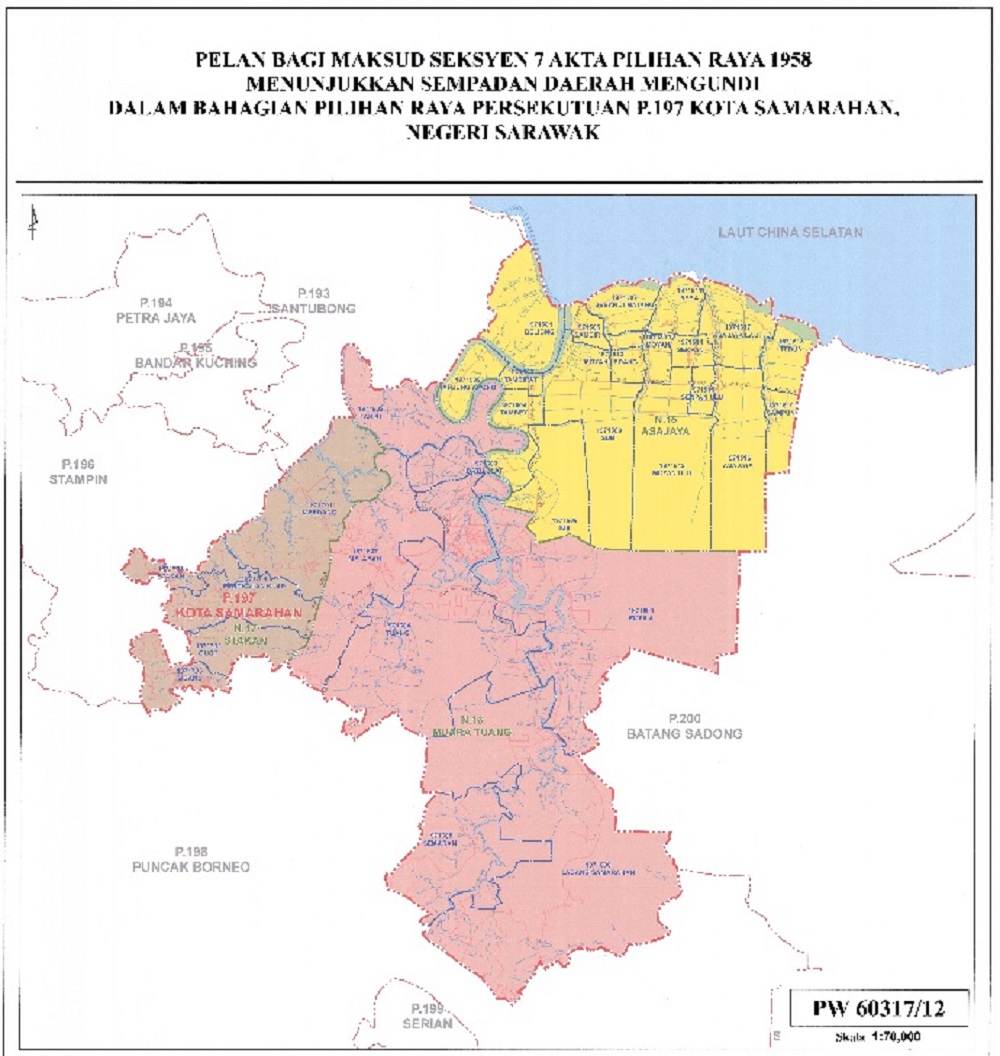
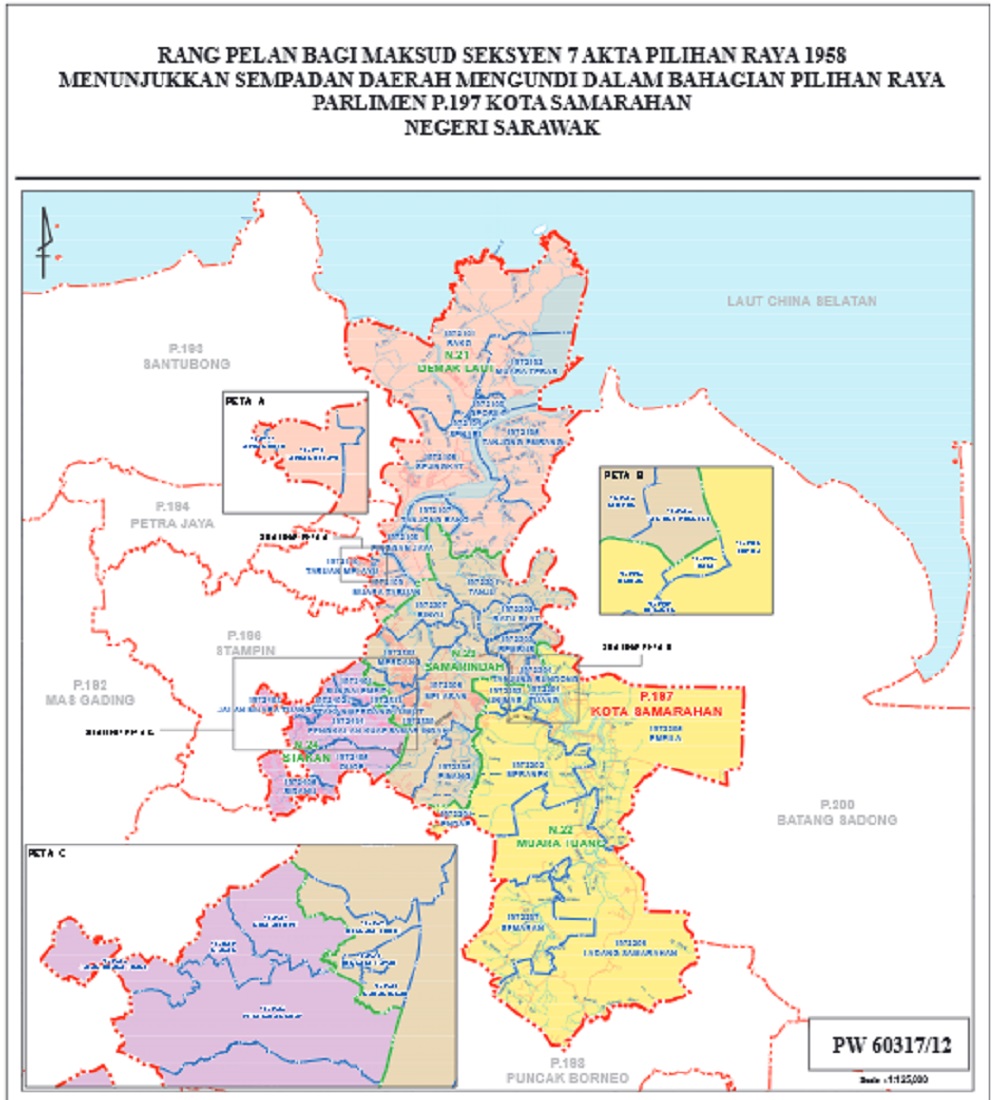
This means that the future Kota Samarahan MP would have to deal with a larger area of the Kuching division, including its associated government offices and local councils, despite the constituency otherwise being centred around Samarahan.
More importantly, Demak Laut’s connection with the newly created Samarindah area appears limited, with the two areas essentially connected by one principal road.
At the same time, Asajaya, which has stronger connections with the Kota Samarahan area, was removed from this constituency and transferred to Batang Sadong. The unusual shape of Stakan also remains largely unaddressed.
These changes raise serious questions about whether the principle of preserving local ties and communities of interest has been adequately considered.
Redelineation should not merely be a mathematical exercise in moving voters between boxes on a map. Constituencies represent real communities, with shared administrative structures, economic relationships, transportation networks, and social ties.
Serious problems remain
The EC’s first draft contains genuine improvements.
The new website, detailed constituency maps, eligibility-checking tools, and clearer representation procedures represent important progress in transparency and public participation. The reduction in the headline gap between the largest and smallest state constituencies is also a positive development.
However, these improvements cannot obscure the serious problems that remain.
The proposal continues to exhibit:
substantial malapportionment,
significant inequality in voting power,
continued overloading of urban constituencies,
insufficient consideration of local ties and communities of interest,
troubling similarities between several proposed boundaries and a previously leaked political proposal.
We therefore call upon all Sarawakian voters to act quickly.
Voters should visit the EC’s redelineation website, examine the proposed boundaries, check their eligibility to submit representations, and identify areas where they can make endorsements or objections.
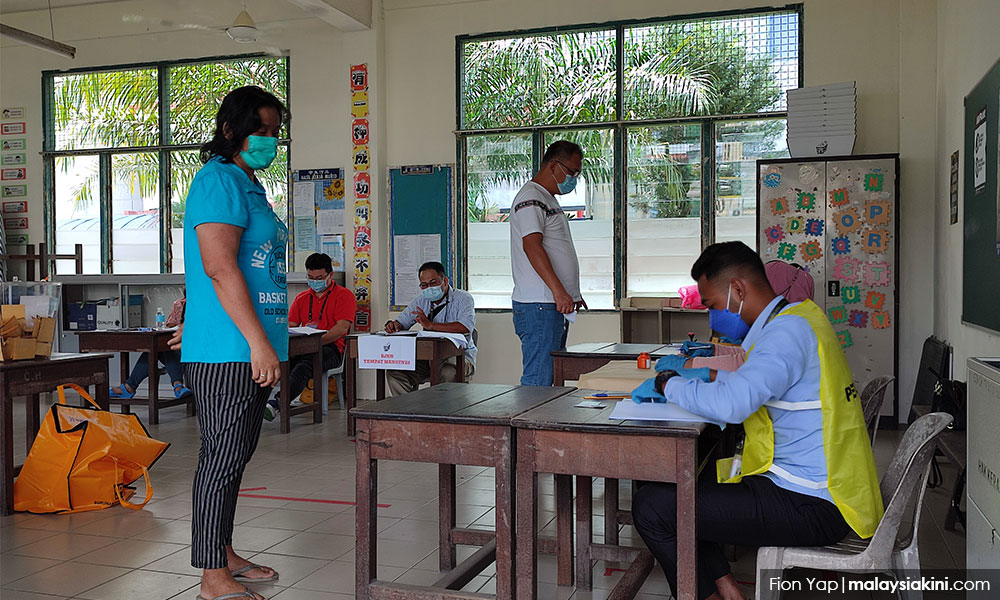
With substantially better access to information than during previous exercises, we hope public participation can exceed the level of mobilisation achieved during the 2015 redelineation exercise, when access to detailed information was considerably more difficult.
We particularly call upon voters in Mas Gading, Puncak Borneo, Lanang, Bintulu, and Miri to scrutinise the proposed boundaries carefully and, where appropriate, form qualified objector groups to challenge boundaries that undermine fair representation.
Tindak Malaysia and Rose will collaborate to provide information and assistance to communities that are capable of submitting representations.
Register as an objector
Sarawak voters who wish to participate in the redelineation objection process can register with us through this form.
The redelineation exercise will determine how Sarawakians are represented for years to come.
This is not merely about drawing lines on a map. It is about determining the value of every Sarawakian’s vote.
The future of Sarawak politics starts today. - Mkini
TINDAK MALAYSIA is a citizen-driven civil society organisation and movement dedicated to achieving free, fair, and transparent elections.
ROSE is a non-partisan and citizen-driven civil society organisation based in Kuching, Sarawak, dedicated to empowering ordinary citizens to build a more participatory democracy.
The views expressed here are those of the author/contributor and do not necessarily represent the views of MMKtT.

No comments:
Post a Comment
Note: Only a member of this blog may post a comment.