`


THERE IS NO GOD EXCEPT ALLAH
read:
MALAYSIA Tanah Tumpah Darahku

LOVE MALAYSIA!!!


31 AUGUST 2026

Thursday, June 30, 2011

I’ll wear a yellow baju raya

I’ll wear a yellow baju raya

Semakin lara kita didera bara,
kita laungkan juga pesan merdeka,
demokrasi sebenderang mentari,
sehasrat hajat semurni harga diri

– A. Samad Said.

Yellow symbolises wisdom.

July 9th is just around the corner, and talks get heated up in every corner, from Facebook urbanites to long house foyers. Thanks to RTM and Utusan Malaysia for the free publicity.

People may differ. However, one thing in certain, all eyes are set on the upcoming saga.

Suhakam, as a custodian of human rights in Malaysia, has called on the authorities to allow the planned peaceful assemblies to be held, and on the parties intending to hold these assemblies to exercise their rights in a peaceful and responsible manner. Yet, we hear the “threat to national security” excuse to cordon the march.

“The gathering would not only disturb the peace but also cause traffic chaos”, says a senior police officer.

Yet, you have KL folks stranded in traffic jams following days of rehearsal and actual parade at Dataran Merdeka. I am one of them, stranded at Jalan Loke Yew while listening to the morning radio show. As a responsible citizen, we do not complain. And please, no road-block rehearsal prior to July 9th.

“Democracy attracts FDIs. Freedom attracts tourists.” But says another, “Investors will shy away because of the domestic chaos”. Well, investors are smart enough in assessing the investment viability, political transparency being the key.

“Organisers of the Bersih 2.0 rally should consider the effects such an event will have on traders and consumers along the route of its march”, says one minister. A Bersih spokesman then assures, “At least RM30 million of cashflow will be generated within the 3 hours march, counting on possible 300,000 participants with cash in pocket of RM100 each.”

Adding-up the ticketing revenue accrued by PLUS, MAS, AirAsia, KTMB and bus operators over the weekend, let’s get PEMANDU to bring their spreadsheet.

Demonstration is un-Islamic? Not part of Malay culture? Yet, Muslim scholars note, “It is obligatory upon every Muslim to support whatever actions, words or stand taken in defence of truth”, plus "It is forbidden for the demonstrators or police to provoke anyone, resulting in riots. The police should realise that the demands are good for the country and not only for the betterment of the people but also the police". Also, “Many were imprisoned as a result of their criticisms against authorities of their time. We are the inheritors of this tradition, which provides today’s Muslims with a storehouse of democratic ideas".

William E. Simon famously said, “Bad politicians are sent to Washington by good people who don't vote”.

I then find no excuse for me not to support BERSIH 2.0 Walk For Democracy. It calls for 8 immediate demands, namely 1) Clean the electoral roll 2) Reform postal ballots 3) Use of indelible ink 4) Minimum 21 days campaign period 5) Free and fair access to media 6) Strengthen public institutions 7) Stop corruption 8) Stop dirty politics.

SUHAKAM, in its statement reiterates that “it is the right of members of the public to assemble and to express their views in a peaceful manner, as provided under Article 10(1)(b) of the Federal Constitution, as well as Article 20(1) of the Universal Declaration of Human Rights (UDHR).”

Still, wearing a yellow shirt is an offence in this country, at least until July 9th

Nevertheless, yellow is the colour of preference for my baju raya this year. Hopefully, I won’t be arrested while carrying my kids, wearing yellow baju melayu complete with sampin and songkok, in queue for duit raya and ketupat, at the Raya open house organised by our Pak Menteri.

My intention is sincere, only to shake hands with my democratic leader. A courtesy visit, that is.

* Harakahdaily reader Mohd Syahir Sulaiman, and his two kids, see yellow as symbol of wisdom, and advocate 'Negara Berkebajikan'.


- Harakahdaily

PM hints general election ‘round the corner’

PM hints general election ‘round the corner’

KOTA KINABALU - Datuk Seri Najib Tun Razak gave the strongest hint yet that the general election may be around the corner on the first day of his visit to Sabah yesterday.

Hinting it might be his last visit to the state before the election, the Prime Minister asked leaders of Barisan Nasional component parties to clear the problems of the grassroot.

In an hour-long closed door meeting with state Barisan leaders, Najib, who is also Barisan chairman, reiterated the importance of zero problem in the constituencies as the coalition was keen to field winnable candidates to ensure victory.

According to leaders who attended the meeting, Najib spoke of unity and also explained to them about the opposition's tactics to use the July 9 rally to wrest political momentum from Barisan which has been winning a string of by-elections.

PBS president Tan Sri Pairin Kitingan said the message was for every party in Barisan to be prepared and work on the ground for the election.

“In fact, the prime minister said this might be his last visit to the state (before the election).”

“It may or may not be this year but it is still possible it will this year,” Pairin said.

He said the Prime Minister stressed on the need for winnable candidates, adding that as far PBS was concerned, it was ready for the election anytime.

Sabah Barisan secretary Datuk Abdul Rahman Dahlan said the Prime Minister's key concept for the coalition was to field winnable candidates and reminded the wakil rakyat to continue to be close to the people.

“He reminded us about the need to work hard to win the hearts of the people,” he said.

Parti Bersatu Rakyat Sabah (PBRS) president Tan Sri Joseph Kurup also said Najib had stressed on the need for component parties to be prepared for the election.

“As far as my party is concerned, we are prepared even if the election is called next week,” he said.

Najib later attended a 1Malaysia dinner at the historic Padang Merdeka where he was joined by various community and business leaders.

- The Star

Private broadcasters told to ignore Bersih, warn people against protests

KUALA LUMPUR, June 30 — The Najib administration has warned private broadcasters against mentioning the planned Bersih rally or the protest date but wants them to warn people against taking to the streets to ask for free and fair elections, media executives say.

The Malaysian Insider understands that the Malaysian Communications and Multimedia Commission (MCMC) called in media executives in the past week to inform them of the new regulations apart from Home Minister Datuk Seri Hishammuddin Hussein declaring Bersih T-shirts as illegal.

“We can’t mention Bersih, the July 9 date for the rally in our broadcasts but we must warn people against demonstrating. How to do that?” a senior media executive asked The Malaysian Insider.

Putrajaya runs Radio Televisyen Malaysia (RTM) that offers television and radio broadcasts but also licenses private broadcasters like Astro or the Astro All Asia Network which is a cross-media group, The Star Publication which operates radio stations, Media Prima Berhad which runs TV and radio stations, and the Bfm radio station.

“We have to submit our radio scripts too for checking. It’s a bit ridiculous,” another executive told The Malaysian Insider.

It is understood the orders came from the Information Ministry in tandem with a crackdown on the Bersih movement which is calling for a protest on July 9 to press for free and fair elections.

Hishammuddin said yesterday that Bersih T-shirts are illegal just hours before police raided the Bersih secretariat in Petaling Jaya on suspicion of carrying out illegal activities. Seven activists held in the raid were later freed on police bail.

Police also seized T-shirts and banners during the raid carried out by a phalanx of policemen, including one carrying an assault rifle.

Inspector-General of Police Tan Sri Ismail Omar also said the police will not only arrest those sporting Bersih T-shirts but may also take action against anyone using any medium to promote the illegal rally.

“Not just T-shirts but shoes, cars, buses. If these are the tools used to encourage people to gather (illegally), this amounts to sedition,” he told reporters at Bukit Aman police headquarters here yesterday.

“Based on PDRM (Royal Malaysian Police) intelligence ... if this rally is held, tension, chaos, the destruction of property, injury and even loss of life may occur,” he said.

“PDRM will not allow any individual or certain parties to do anything that could trigger chaos and anarchy.”

He said the police have received information that foreign elements were poised to exploit the chaos that would “very likely” result from the rally but declined to reveal their identity or if they were working with opposition parties.

Police have arrested 30 people, including Sungai Siput MP Dr Michael Jeyakumar Devaraj, for campaigning for Bersih.

Activists under Bersih and Pakatan Rakyat (PR) component parties are gearing up for the rally this July 9, the second such gathering calling for electoral reform.

The first rally, also organised by Bersih, was held in 2007 and saw some 50,000 people take to the capital’s streets. The gathering eventually descended into chaos when the police deployed tear gas and water cannons on demonstrators.

The event has been partly credited for PR’s record gains in Election 2008, when the opposition pact swept to power in five states and won 82 parliamentary seats. - Malaysian Insider

KTMB Land Issue: The last Train into Tanjung Pagar

by Din Merican

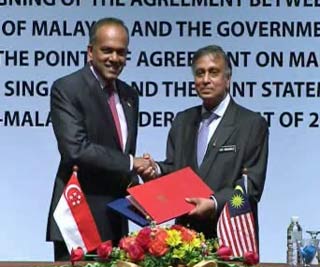
In signing the Points of Agreement (POA) on Malayan Railway (KTM) Land with Singapore on June 27, 2011 Minister in the Prime Minister’s Department, Nor Mohamed Yakcop said, “It’s a very happy day. It’s a new beginning for us in cooperation in attracting investment. It’s excellent for both countries. We are confident this is a new beginning for good cooperation and plenty of investments. Certainly, not only Iskandar will do well but the whole of Malaysia will do well because of confidence factor in attracting foreign investment.”

In reciprocation, Singapore Foreign Minister K. Shanmugam said: ”It really takes the relationship to a different level. It’s win-win….for both countries and promises much more. In that sense, in every sense, it’s historic moment.”

As a long time friend of Singapore who had the privilege of living and working there in late 1980s, I join Malaysians and Singaporeans in supporting and welcoming this enhancement in bilateral relations between our two countries on a mutually advantageous basis, one that could be continuously strengthened in the future.

But I am of the view that to sustain this positive momentum in bilateral relations, cooperative efforts and other confidence building measures cannot be undertaken in an opaque manner. There is, therefore, a need for our government to keep Malaysians informed on vital issues like the KTMB Land issue.

Murkiness, obfuscation and mystery have unfortunately overshadowed the so-called “win-win” deal in respect of a land swap deal in Singapore involving KTMB (Keretapi Tanah Melayu Bhd), which was agreed to between Prime Minister Datuk Seri Najib Razak and his Singapore counterpart, Lee Hsien Loong, in Kuala Lumpur May 24 and September 20, 2010.

Six rounds of talks have been held between Heads of Foreign Ministries of both countries, even if the main negotiators have been our Khazanah National Bhd and Temasik Holdings, the respective government’s investment arm.

To-date, no details on the definitive outcome of the deal have been made public by either government even after the conclusion of the sixth and final talks, which were held in Singapore on December 31 last year.

Instead, out of the blue, The STAR newspaper ran a story on June 9, 2011 under the caption “Party plans on track for last train ride to Tanjung Pagar”. And on June 14, 2011, The New Straits Times in a front page report said “Tickets snapped up for KTMB’s final Tanjung Pagar service”.Apparently, KTMB had recently taken some of our journalists on a tour/special trip down to Tanjung Pagar (picture above right).

Historical Significane of June 30, 2011

It would appear that KTMB as well as some in our media tend to treat the pending closure of the nearly 100-year old Tanjung Pagar Station and the historic building as something merely nostalgic. Seeking out and keeping our public informed regarding details on the outcome of the six rounds of official talks by the two countries or on related issues of the railways service or its history seems unimportant to them.

Singaporeans must have been in glee over KTMB’s idea of entertaining our history-deficient journalists, who do not seem to know that our country could have taken for a ride by Singapore over tens of billions of KTMB real estate in Singapore without adequate compensation.

A rather perceptive member of the public, a certain Karim Mahsood, on June 13, 2011 wrote to The STAR newspaper, reminding readers that June 30, 2011, the date of the last train to Tanjung Pagar “… is not a joyous affair, but a heartbreaking episode in the history of KTMB in Singapore… “

Karim Mahsood attributed this development to “… a series of unfortunate steps…” that were taken by our own leaders, which began in 1990 with a lopsided agreement between Malaysia and Singapore called the Points of Agreement (POA), and culminating in the 2010 deal for KTMB to relocate its services from Tanjung Pagar to Woodlands on June 30, 2011.

The Najib-Lee Hsien Loong Deal

Under the Najib-Lee Hsien Loong deal, the Singapore Government would vest four tiny land parcels in Marina South and two parcels of land in Ophir-Rochor in MS Pte Ltd. (a joint-venture company set up by Khazanah National Bhd. and Temasik Holdings in a 60-40 % equity arrangement respectively, for the development of the said six parcels when KTMB vacates the Tanjung Pagar Railway Station), in lieu of the three parcels of so-called POA land in Tanjung Pagar, Kranji and Woodlands and three pieces of land in Bukit Timah. The long and short of the deal is that KTMB’s Tanjung Pagar Station will be closed on or by July 1, 2011 and relocated to Woodlands temporarily.

And on June 26, 2011, there was yet another bolt out of the blue: that Nor Mohamed Yakoop (and not Foreign Minister Anifah Aman) and Singapore’s Minister of Foreign Affairs and Law, K. Shanmugam, would sign “the instrument containing details of the implementation of the POA on KTMB land in Singapore” on June 27. It was couched innocuously that Tanjung Pagar would be closed down by or on July 1, 2011. Perhaps, both governments want this momentous event to pass off unnoticed.

Nor Mohamed and Shanmugam also confirmed that Malaysia and Singapore have agreed to open a “rapid transit system (RTS) link” between the two countries by 2018 and, secondly, that yet another joint-venture company had been established – in addition to MS Pte Ltd – known as Iskandar JV Co. , held 50-50 by Khazanah Bhd and Temasek Holdings to undertake two development projects in Iskandar Malaysia involving 87 hectares of land.

Despite the above, the public in both countries, particularly in Malaysia, remain uninformed especially as to how the Najib-Hsien Loong deal would contribute to mutually advantageous relationship between our two countries in the future and, specifically, how the deal would safeguard Malaysia’s “national interest”. Indeed, there are wider political implications that our Government leaders must face.

The KTMB Land saga(and other properties in Singapore) does raise several important points:

a) The move by KTMB to Woodlands will signal the beginning of the transfer to Singapore, not only the historic railway station building in Tanjung Pagar, but also some 175.7 hectares of KTMB land, in exchange for joint development of six parcels of land in Marina South and Ophir-Rocher whose total value is also not known to the public.ASIAWEEK magazine in its March 31, 1995 issue estimated the 32 hectares of prime property of Tanjung Pagar alone to be worth USD 2 billion, making KTMB “… the republic’s second-biggest land owner after the local government”.

b) When KTMB vacates Tanjung Pagar Railway Station to “tumpang”(squat) at Singapore CIQ building in Woodlands by July 1, 2011, it would actually mean that all KTM land in the Island nation, south of Woodlands, will revert to Singapore. This Malaysian real estate in Singapore – some 175.7 hectares in all – will be gone forever without adequate compensation to Malaysia. Again based on ASIAWEEK’s estimate in 1995 of the 32 hectares of Tanjung Pagar property, KTMB’s entire 175.7 hectares of real estate in the island Republic could today easily be worth between USD 0.25 to USD 0.5 trillion.

c) The Woodlands checkpoint is not a railway station in the normal sense but a Customs, Immigration and Quarantine (CIQ) checkpoint belonging to Singapore. It is indeed difficult to imagine how KTMB can effectively use the Woodlands checkpoint as its new terminal in Singapore. It does look like KTMB will be compelled to retreat further north to Johar Bahru, sooner rather than later. When that happens, a glorious chapter in the history of KTMB operations to and from Singapore would be forced into an early closure.

d) The 1990 POA was Lee Kuan Yew’s strategic move to subtly uproot the KTMB Railway line which literally divides the Island State into two halves from North to South. Therefore, the move by KTMB from Tanjung Pagar to Woodlands is also the beginning of the fulfillment of Lee Kuan Yew’s dream since 1990.

e) The injection of the so-called “development charges” by the Prime Minister of Singapore at the eleventh hour into the negotiations in Kuala Lumpur is seen as one made in bad faith.

As a matter of fact, Singapore’s insistence that Khazanah will have to pay certain “development charges” might mean that in reality Singapore would get KTMB’s entire 175.7 hectares in Singapore as well as Khazanah’s investment in joint development projects in Singapore practically for free.

f) And, in the meantime, the dispute over the so-called “development charges” has still not been resolved. There is absolute silence over the status of the matter, which both countries agreed in Kuala Lumpur in 2010 to be brought up to the Permanent Court of Arbitration.

g) No less serious are real concerns here that not only will KTMB lose 175.7 hectares of its land and even Khazanah’s investments in Singapore but, more importantly, that Malaysia, as a whole, over the longer haul, would effectively lose control of large chucks of Johor and even land as far as Malacca to Singapore through the Iskandar- Malaysia ventures and other similar plans.

How some Singaporeans look at the Najib-Hsien Loong Deal? Many Singaporeans who are friends of Malaysia are puzzled why the Malaysian negotiators agreed to such a deal in the first place? They ask what possible quid pro quo benefits Malaysia could have. Surely, they say Malaysia does not need the money.

Is maintaining KTMB’s assets in Singapore a burden to Malaysia? If this is not the case, then Malaysia has the upper hand. So, what and why the rush and why the bending-backwards? Why so eager to close the deal? Worse still, friendly Singaporeans ask why “so cheap”?Many Singaporeans believe Malaysia is “incompetent” and, as a result, gets short-changed. That Malaysia is always ill-prepared and that it is not thorough enough. They attribute this to a number of factors:

i) partly due to interference by our politicians and that our civil servants have been marginalized;

ii) structurally, Malaysia does not have and fails to attract the brightest brains into the Civil Service, people with the long-term interest of the country at heart;

and iii) politicians and civil servants with too much personal, short-term interests to fight the kiasu, no-holds-barred, win-all, no tolak ansur (no give and take) Singapore’s Team. This, Singaporeans say, is at the root of the problem, one that is most unfortunate.

Why Nor Mohamad, not Anifah Aman

Singaporeans are also generally puzzled as to why Nor Mohamed Yakoop represented Malaysia at the recent signing ceremony in Singapore? They expected Foreign Minister Anifah Aman to have accompanied Nor Mohamed and do the honours for Malaysia.

But as proud Singaporeans, they say the deal is okay – after all it is Malaysia’s loss and Singapore’s gain. As Singaporeans they feel proud of their Team, who got the best deal for Singapore. As for Lee Kuan Yew, getting such a deal from Malaysia makes the outcome even sweeter.

Need for Transparency

All told, transparency is crucial in ensuring positive, forward movement in bilateral relations as well as in winning the hearts and minds of the public. One can try to mask underlining problems of any deal by words and promises of future infrastructural development and consequent economic growth. But good intentions can produce bad results.

Foreign policy should be concerned with a country’s “national interest”. Diplomacy as an instrument of Foreign Policy is the art of negotiation, of getting deals that serve the national interest. In other words, “national interest” should dictate Foreign Policy.

Unless “national interest “is firmly embedded in the minds of government ministers, it is not likely that the making of foreign policy will return to its proper, central place at the Ministry of Foreign Affairs (in our case, Wisma Putra). In this regard, Singaporean diplomats and their political masters are stark realists, always serving their country’s national interest.

In conclusion, there is a need for proper national debate in Malaysia on the Najib- Hsien Loong deal– in the media, in intellectual and business circles and, indeed, ultimately in Parliament. Perhaps, a White Paper should be presented to our legislators in Parliament.

ANOTHER GRAVE YARD IF TOO LATE?

DANGEROUS…..Edward being shown the unprotected hill slope and shallow drain.

By : DAP MEDIA

THE RESIDENTS at Kg. Malawa in Sepanggar were here faced with constant flooding and mud slide into their homes here due to a massive earth works project on a hill just adjacent to their ten houses.

In spite of many complaints to the developer, the DBKK and other authorities by the house owners, there were no actions and responds from them. The developer had only come to clean up the mud that flown into the houses. This has caused much difficulty, anger, and inconvenience to the house owners.

The Sabah DAP vice chair cum the Local Government and Housing Bureau chief Edward Ewol Mujie was brought on to the site to inspect the situation. He was shocked when he saw the size of the earth work which stood just next to the houses.

He asked why such a massive earth works project which is so near to the residential houses and having an earth fill up to 30 over feet high be allowed to be carried out without proper drainage and protective retaining walls built.

The rain water is just spilling over bring mud along and flowing through the houses below. The reclaimed earth slopes were not protected from erosion and covering with closed turf, and it is just being left exposed to rainfall and severe erosion.

The house owners told Edward that they lived in fear and worried that the whole reclaimed hill slope may come down onto them during heavy rain. Then it will be real disaster and they will lose everything. The rain water brings a lot of mud and they have to clean every time whenever it rains, and who is helping them from all these agony?

Edward feels that it is under the law that any earth works to be carried out must first obtain the consent and approval from the local authorities. This case happened in the DBKK area, and he wonders whether there is an earth work plans submitted for approval to DBKK and any approval granted.

By the look of the site situation, it is doubtful that the developer has followed the standard requirement laid down by the authority for the earth work carried out. He urges the DBKK to come immediately to inspect, check and advice the developer on the necessary work to remedy the situation. The developer must first consider the well being of his neighbor before the profit on his project. He should act before any disaster strike.

The house owners can also put up a legal suit against the developer if any serious damages to their properties caused by the flooding and mud slide arising from the earth works next door, and this is their basic rights.

Edward urges the local authorities to be very careful and be alert on all this earth work projects which involved earth filling and hill cutting, and must ensure that all works are carried out with a high consideration of not to affect nearby properties and human lives.

- Sabahkini

COMMUNAL TITLES BENEFIT MAJORITY

SABAH Land and Survey Department (JTU), Director Datuk Osman Jamal defended the issuance of communal titles, saying they were introduced with the noble intention to expedite land alienation to natives and to ensure they develop their land at the same time.

Commenting on a recent statement by the Human Rights Commission of Malaysia (Suhakam) that the beneficiaries of the communal titles had not been briefed or engaged in discussions earlier, Osman said this was not the case because the Government had talked to them before they agreed to sign the document.

He said it was, therefore, not practical to simply delay or stop the process of issuing communal titles just to satisfy some non-governmental organisation's plea, because the issue was to see that the majority benefited from the programme.

"We accept any suggestion, as long as it is constructive and sincere for value-addition. But why must we delay, when there is more advantage than disadvantage?

"In fact, there is only a lack of understanding on the part of the villagers. They have not rejected the programme. As in most new programmes, we tend to face challenges. So, we will have to continue but, at the same time, we will continue giving information to beneficiaries. And the public can also come to JTU for more information on communal grants," he said.

At a national inquiry held in Penampang last week, Suhakam commissioner Jannie Lasimbang said many rural people in Sabah who were recipients of communal titles were still vague about how these grants worked.

She said a community-based NGO, Partners of Community Organisation (Pacos), had proposed that the government consider delaying the issuance of upcoming communal titles to allow for all the issues to be ironed out first.

Among the issues she mentioned was the clause in the communal title that says the Land and Survey director can remove and add any of the beneficiaries.

Osman explained: "There is no such thing as the Director simply changing the beneficiaries. The Director may be the middle person but there are a lot of instruments and laws involved here. One can't simply do what one likes.

"And, furthermore, 'tertakluk kepada kelulusan pengarah' (subject to the approval of the director), that term has been used since the Sabah Land Ordinance started in the 1930s. It was not an issue before.

As I have told Jannie, there are mechanisms and people should not make such comments unless they have studied all the conditions first."

On civil servants earning more than RM1,500 a month not entitled to become beneficiaries of the programme, Osman said this was more than justified as they wanted to help the hardcore poor and poor people first.

"It is unfair to give to people who have jobs and a salary. Of course, we put the poor and hardcore poor first as priority. If there is extra (land), the civil servants who are interested may apply, but they still have to get approval from the directors of their respective departments first," he added.

Osman explained that the communal title was not actually a new concept but something that had already existed in the State Land Ordinance.

"In this ordinance, government issues four types of title, namely Town Lease, Provisional Lease, Native Title and Communal Title. This means the communal title we are issuing, it was already there since that time, but rarely applied, usually the first three types," he added.

However, in 2006, JTU received a memorandum from Pacos saying that the state government had discriminated against Sabah natives in terms of land allocation, and that was when JTU started looking at the best alternative to expedite land issuance to the people.

"As I've mentioned before, due to the limited manpower of 56 staff around Sabah, we only have a capacity of processing 15,000 to 16,000 land applications a year.

"With 248,000 outstanding land applications flooding the department now, we can't rely 100 per cent on normal methods. That's why we had to amend the law, which was gazetted on Dec 2009," he said.

He said that when the chief minister proposed that a site be developed, he could sanction the communal titles without the need for applications or the filling of forms.

"I would like to stress again that these communal titles are being issued not because of elections. We have been thinking of this approach since 2007," he said.

He said a government-linked agency was included in a joint venture to develop the land under communal titles because, from previous records, only 40 per cent of owners of Native Title (NT) land in the state had actually developed their land.

"To date, we have issued NT to 169,729 natives, totalling 64,584 hectares. But why do the researchers say there are still a lot of poor and hardcore poor people here. It is because 60 per cent of these NT holders did not develop the land.

"Also, some of the areas do not have infrastructure such as roads, so that makes it difficult to bring development there. That is why we find a government agency which has a proven track record in the joint venture," said Osman.

He said that within a year of the issuance of communal grants in the middle of last year, the state government had issued 33,600 hectares to 7,000 beneficiaries.

"So I do not see why we must stop. It will be a loss, because we have targets (to meet). Right now, the figure of natives owning land in Sabah is only 23 per cent. The target is 30 per cent by 2020, so we can't stop. We need to use both the land application process and communal grants to achieve this (target)," stressed Osman. (DAILY EXPRESS)


‘NO-PARKING’SIGN CAUSE TEACHER IN ICU?

ERECTED…..The dangerous sign board pole erected on road surface

By : DAP MEDIA

A ROAD-SIGN pole erected on the road surface in Damai, Kota Kinabalu is the cause of a fatal accident that put a kindergarten teacher into hospital Sunday night.

The young teacher in her thirties was admitted to the hospital with serious head injury and now she is still in the ICU (Intensive Care Unit). The signage is believed to be a ‘No-Parking’sign.

According to people who saw the accident, a truck passed by the corner of the shop where the driver did not see the pole planted on the road corner, ramped and knocked against it.

She was knocked head on instantly by the sign-board pole. She and two other teachers were walking along the pavement (Kaki-Lima) near the shop a few feet away from the road side. The identity of the lorry was not known, because he fled from the scene.

Her condition is critical and due to the serious head injury, she is put under closed observation in the ICU.

Kota Kinabalu Member of Parliament Hiew King Cheu was informed of the accident and some photos were forwarded to him in Parliament.

Hiew said he felt very angry because such a case should not have happened, and a good teacher now became a victim of the wrong doing of the authorities. How can the authorities erect a road sign pole right on the road surface and around a blind corner?

What is the logic and who should be responsible? We want to know who did this. Of course the Kota Kinabalu City Hall (DBKK) cannot discharge from the first responsibility and to be held liable.

Is Kota Kinabalu becoming a city full of danger, and accident can happen anytime? Just imaging she just walked along the pavement and yet can be knocked down by a pole erected on the road surface. This is not acceptable at all.

We urge the KK City Hall to immediately set up an investigation team to prop into the matter, and give us an answer. DBKK should compensate the victim on all medical expenses and cost involved.

There are many other similar danger areas in the City where at anytime can cause accident. These can be simply sign boards erected blocking the drivers’ views, lamp post too closed to the road sides, broken pavements with big holes, dangerous road junctions, dark streets, dead trees and many other aspect which can cause unexpected accident.

We want a safe city and some immediate work must be put in to rectify all potential danger areas. The authorities have to act without further delay. The KK MP office will forward the public complaints and suggestions to the DBKK and other authorities for their perusal and action.

- Sabahkini