


Agreeing with a MIC leader who claimed that Najib Abdul Razak did more for the Indian community during his tenure, Urimai chairperson P Ramasamy also took a swipe at both the former premier’s predecessors and successors.
“To his credit, Najib was not perceived as a racist or a political chameleon like some of his predecessors or successors, who often say one thing publicly but act differently in private.
“He respected the Indian community’s need for representation in the cabinet. However, whether MIC-appointed leaders effectively championed the rights of the community is another matter altogether,” he added.
The former DAP leader was responding to MIC central working committee member P Kamalanathan, who claimed that Najib had demonstrated genuine concern for the Indian community through his actions.
He noted that during Najib’s tenure as prime minister, from 2009 to 2018, nearly RM1 billion was allocated for the development of Tamil school infrastructure nationwide.
Najib, he added, never hesitated to approve additional funds for the advancement of these schools.
“No former prime minister, and no prime minister after Najib, has ever done this,” he told FMT.
Better treatment
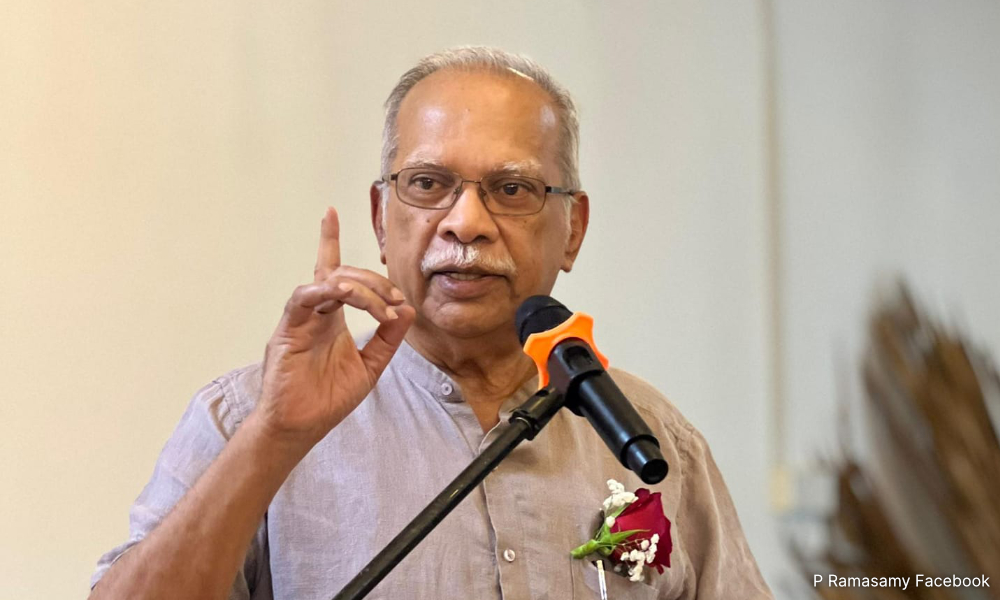
Concurring, Ramasamy (above) said it is true that under Najib’s leadership, financial assistance to Tamil schools increased, the number of Tamil schools grew, and student admissions to the matriculation programme improved.
Furthermore, he said the former premier was also known to be approachable and open to mediation by MIC, which played a key role in advocating for the Indian community.
“Whether the allocated funds effectively reached the intended beneficiaries remains a matter of debate,” he added.
The Urimai leader said that while Najib was relatively better in his approach, this does not mean he managed to dismantle the entrenched racial structures that have long shaped Malaysia’s political and social landscape.
“While Najib was perhaps more sympathetic - particularly toward subaltern groups within the Indian community - he was far from a reformist or maverick. He did not undertake significant measures to address systemic racial or religious discrimination.
“In Malaysia’s deeply polarised ethnic and religious environment, even minor deviations from the norm can appear significant. Najib’s gestures towards the Indian community, though relatively modest, may have been magnified in this context.
“MIC, being historically aligned with Umno and a beneficiary of Najib’s policies, has every reason to highlight and perhaps exaggerate his contributions,” he added.
Ramasamy said In the rigidly stratified Malaysian political landscape, even a slight shift in favour of marginalised communities can be seen as extraordinary.
“Najib’s relative deviation in favour of the Indian community might well be perceived this way. But the larger structural issues remain unresolved,” he noted.
Support for Najib’s pardon bid
On Friday, Malaysiakini reported that a Merdeka Center survey found a majority of Indians supported Najib’s pardon bid.
The survey, commissioned by Projek Sama, found that 62.2 percent of Indians surveyed supported Najib’s bid, followed by Muslim bumiputera (50.5 percent) and Malays (43.0 percent).
However, a whopping 95 percent of Chinese opposed it, followed by non-Muslim bumiputera at 51 percent.
The survey was conducted between March 27 and April 17 this year, involving 1,210 respondents aged 18 and above.
In August 2022, the Federal Court upheld Najib’s one count of abuse of power, three counts of criminal breach of trust, and three money laundering charges.
The court then sentenced the former Pekan MP to 12 years’ jail time and slapped a RM210 million fine on him.
However, in February last year, the Pardons Board slashed the jail time to six years and reduced the fine to RM50 million. - Mkini

No comments:
Post a Comment
Note: Only a member of this blog may post a comment.