Prime Minister Anwar Ibrahim must be commended for calling the special parliamentary sitting today to debate Malaysia’s response to Donald Trump’s trade war against the world.
The debate, which would involve eight government backbenchers and eight opposition MPs, should be the first step of something bigger: a memorandum of understanding (MOU) 2.0.
The MOU signed between Ismail Sabri Yaakob’s Keluarga Malaysia government and the Pakatan Harapan opposition gave Malaysia 13 months of political stability at the tail end of Covid-19. We need something similar between the Madani government and the Perikatan Nasional opposition because the US president’s trade war may pose a greater threat to Malaysians.
More threatening than Covid-19
ADS
Trump’s tariff does not just affect Malaysia’s export to the US, the second largest export destination, which accounted for 13.2 percent of Malaysia’s total export in 2024. It can cause goods from China and other countries turned away from the US to be redirected to Malaysia, and destroy our small and medium enterprises (SMEs).
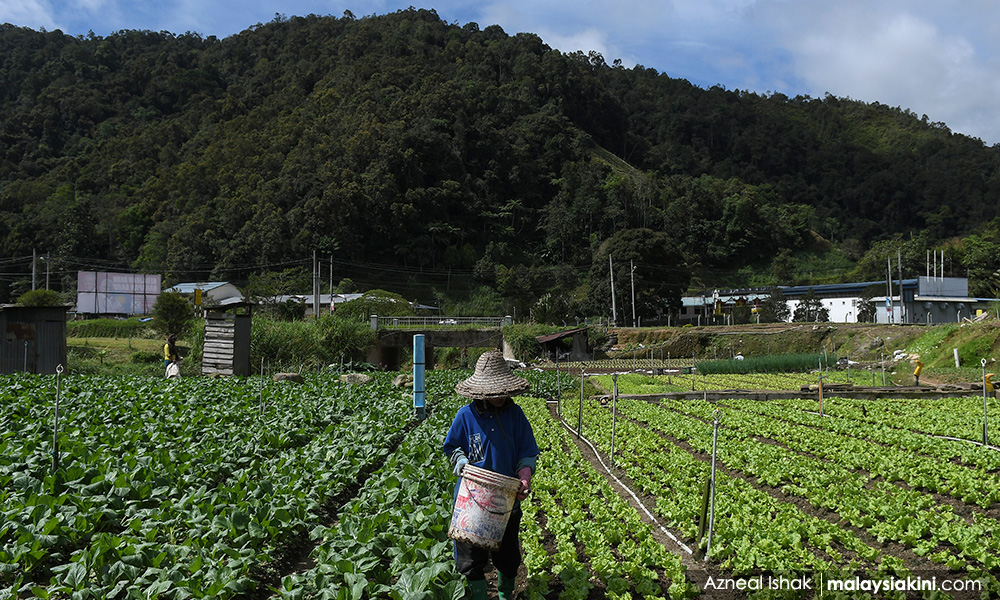
A recent news report from Cameron Highlands: local vegetables are rotting because wholesalers prefer to buy imported vegetables. The local farmers cannot sell because their production costs are higher than the price of imported vegetables.
Cameron Highlands
The overall threat is “an economic slowdown in 2025, if not a recession, because its income is highly dependent on exports, which accounted for 77 percent of GDP in 2022 and 68 percent in 2023, which are substantially higher than private consumption which was 57 percent and 60 percent respectively”, reminded economist Woo Wing Thye.
A recession, or worse, depression, would hurt everyone, not just because we cannot sell goods to the world and cannot attract foreign direct investment. Our tourism industry, which contributed 10.5 percent of our GDP in 2024, will be badly affected with far-reaching ripple effects.
In the worst scenario, not just SMEs will close down and workers laid off, but even e-hailing drivers and food deliverers may be out of work. This is why Japan, which is hit by 24 percent of Trump tariffs, the same percentage as we are, calls it a “national crisis”.
Because of uncertainty and reactions, the economic chaos caused by Trump can be worse than Covid-19, even though it does not take lives directly.
For one, economic recession may hurt different segments of society differently, worsening inequalities, fueling discontent and distrust, and providing a fertile ground for conspiracy theories and fake news. Instead of “rakyat jaga rakyat” solidarity, we may see people turning against each other in frustration and desperation.
Crisis demands political ceasefire
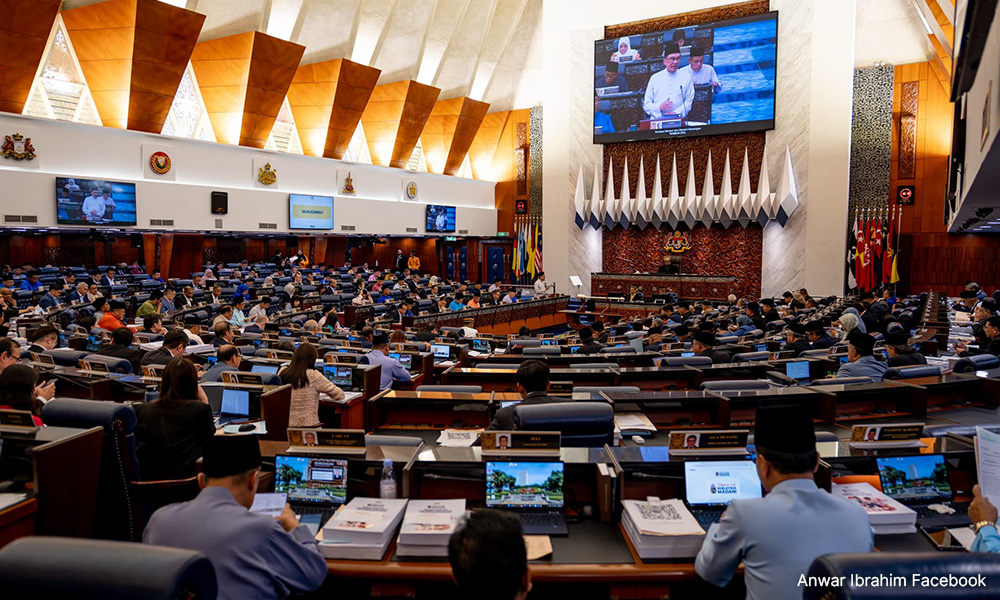
All these call for a well-thought-out, comprehensive, and effective safety net. This is why the special parliamentary sitting today is important. Hopefully, the 13 parliamentarians who debate and the ministers who respond would focus on problems and solutions, speaking up for their respective sectors and constituencies, rather than engaging in partisan bickering.
Dewan Rakyat session in Parliament
To avoid worse bickering when the crisis deepens, as in wartime, there must be some sort of political ceasefire. This does not necessarily require a national unity government which includes every major party and leaves no effective opposition.
Much less complex, a ceasefire only requires enough pragmatism to recognise three facts.
First, policies required to deal with a crisis are often painful and unpopular. With scarce resources, it is impossible for the government to adequately help everyone, hence, discontent is inevitable.
ADS
Second, when the best policies may not even work fast, political turmoil and social unrest would only make it harder.
Third, you can exploit public discontent to overthrow the government and install a new one, but the new government will face the same problems and may resort to some unpopular policies it criticised when in opposition.
How Madani may secure MOU 2.0
The Madani government has wanted an MOU 2.0 with PN but has made no inroads so far. How would it persuade PN to sign it now?
Madani can make it by offering a real deal. The MOU 2.0 draft offered to the opposition in 2024 was not a real deal, but a one-sided offer of constituency development funds (CDFs) for political surrender. Had PN accepted it, the Bersatu Six would be vindicated for their foresight in defecting.
Madani can now offer a real deal: involving PN in crisis policy making, such that PN can share credit when such policies work, in exchange for PN not attacking the government before they work or if they fail.
In the 2021 MOU, the National Recovery Council (NRC) consisted of 50 percent experts, 25 percet government MPs, and 25 percent opposition MPs. We may not need such a mechanism yet, but the point is bipartisanship.
Anwar should take a leaf from his Japanese counterpart, Shigeru Ishiba, who met heads of government and opposition parties the next day (Japan time) after Trump’s tariff announcement, to forge a cross-party consensus as his government prepares for negotiations with Trump.
While Anwar commands a two-thirds majority while Ishiba heads a minority government, Anwar’s two-thirds has not been able to shield his government from relentless ethno-nationalist attacks and state-nationalist demands. Anwar can be more vulnerable than Ishiba when the crisis lands in full force.
Why PN should go for MOU 2.0
While PN’s rejection of the government’s MOU 2.0 draft was reasonable, it has failed miserably in making a counterproposal. If it does not turn the Trump crisis into an opportunity, but hopes to bring down the government, such calculations may simply backfire.
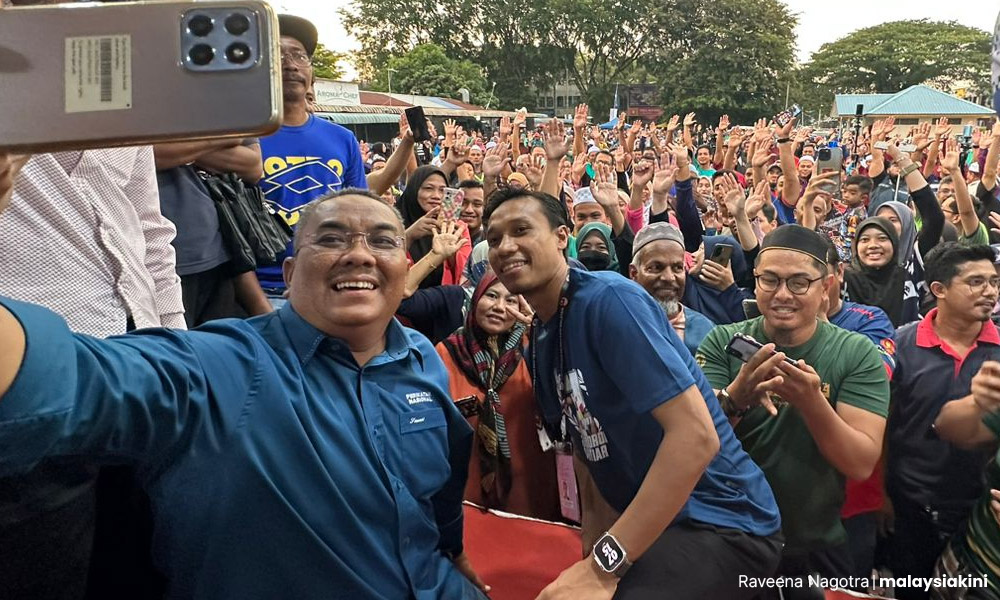
While many incumbent parties from BN to America’s Democrats were punished by voters after Covid-19, the recent elections in Canada, Australia, and Singapore suggest that the Trump crisis may rally voters to keep the incumbents. With Trump-like populists like Kedah Menteri Besar Sanusi Nor, can PN win the middle-ground Malays if Anwar is forced to call an early election?
Kedah Menteri Besar Sanusi Nor taking a selfie with supporters
What would clearly hurt PN parliamentarians in the 16th general election (GE16) is their denial of access to CDFs, driving needy voters to Madani-tentative candidates propped up as “constituency coordinators”.
What should be in MOU 2.0?
For MOU 2.0 to be viable, it must treat both sides as equals, as MOU 1.0 did. In this sense, it might be better for Dewan Rakyat speaker Johari Abdul to invite both sides to the negotiation table.
Taking a leaf from 2021, MOU 2.0 should cover policies, institutional reforms, and money matters. Here are the five thingsthat can be considered to make it evenly beneficial for both the government and the opposition:
Inclusive decision-making - this can start with parliamentary reform, by establishing more parliamentary select committees, recognising PN’s shadow cabinet, and having regular meetings between ministers and their shadow counterparts.
Federal and state laws to ensure equitable constituency allocation to all elected representatives regardless of political affiliation.
Other institutional reforms such as the prime minister’s term limit, separation of powers between the public prosecutor and the Attorney-General Chambers (AGC), and a political finance act with public finance for political parties.
A national council on ethnic relations with government, opposition, and civil society representatives to deliberate and forge consensus on red lines and penalties on issues concerning ethnicity, religion, language, and lifestyle, to defuse allegations of state partiality.
A Fixed Term Parliament Act, at least to allow the 15th Parliament to go for a full term till Dec 18, 2027. A certainty in the electoral schedule can allow political parties, elected representatives, and most importantly, ministers, to focus on the political crisis instead of election preparation. To keep electoral moves at bay till the first half or at least Q1 of 2027 would allow better responses to Trump before the US mid-term election in November 2026. To have GE16 before or during this time may deprive us of the best responses when American politics is turning a page.
Hopefully, we would see visionary, professional, and magnanimous leadership in Parliament today. - Mkini
WONG CHIN HUAT is a political scientist at Sunway University and a member of Project Stability and Accountability for Malaysia (Projek Sama).
The views expressed here are those of the author/contributor and do not necessarily represent the views of MMKtT.
No comments:
Post a Comment
Note: Only a member of this blog may post a comment.



No comments:
Post a Comment
Note: Only a member of this blog may post a comment.