


A husband-and-wife duo allegedly at the heart of a notorious “counter setting” syndicate that smuggled foreign nationals into Malaysia are believed to have their hands in something far bigger.
Their arrest last month peeled back the curtain on an empire worth millions with RM1.5 million stashed across personal and family accounts, and another RM1.4 million in glittering jewellery tied to their jewellery shop business.
But it is believed the couple’s reach allegedly extends beyond the smuggling ring - into a sprawling network connected to the Malaysian Labour Recalibration Programme (RTK).
The RTK is a special Immigration Department initiative that allows employers to legalise overstaying foreign nationals and undocumented workers.
RTK 1.0 was launched on Dec 28, 2020, as a special programme to regularise undocumented migrants. RTK 2.0 was then introduced on Jan 27, 2023, and ran until Dec 31, 2023.
The upgraded RTK 2.0 came with tighter controls to curb abuse, such as cases involving workers who ran away from their original employers.

According to media reports, within just the first seven months of RTK 2.0, a total of 720,099 undocumented migrants registered under the scheme, involving 51,753 employers.
The recalibration fee for RTK 2.0 is RM1,500 per worker, while the levy ranges from RM640 to RM1,850 depending on the sector, in addition to a RM60 pass fee and RM125 processing fee.
‘Additional payment to immigration officers’
However, Malaysiakini’s investigation found that some parties have made hundreds of millions through this programme.
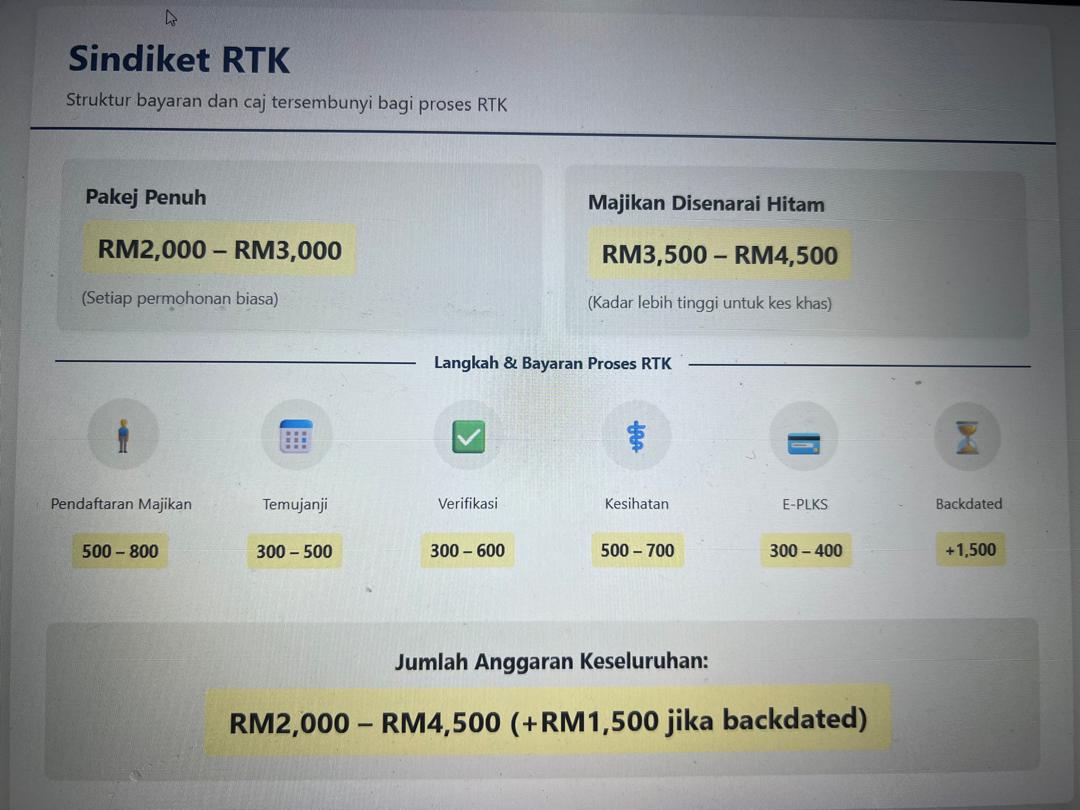
Several local and foreign agents claimed that they paid an additional RM3,000 to immigration officers for each application.
That sum, they claimed, was a “complete package” that guaranteed approval.
“You can also do it separately (without the package),” said one local agent who requested anonymity. It depends on what services you need. For example, fingerprint verification alone costs RM600. There are other dealings, each with its own price.
“From getting a token (queue number), data entry, approval processing, and issuance of the temporary work pass sticker - everything has a fee,” he alleged.
He added that he and his fellow agents had “helped” about 15,000 undocumented migrants secure approvals, charging between RM2,000 and RM7,000 per person.
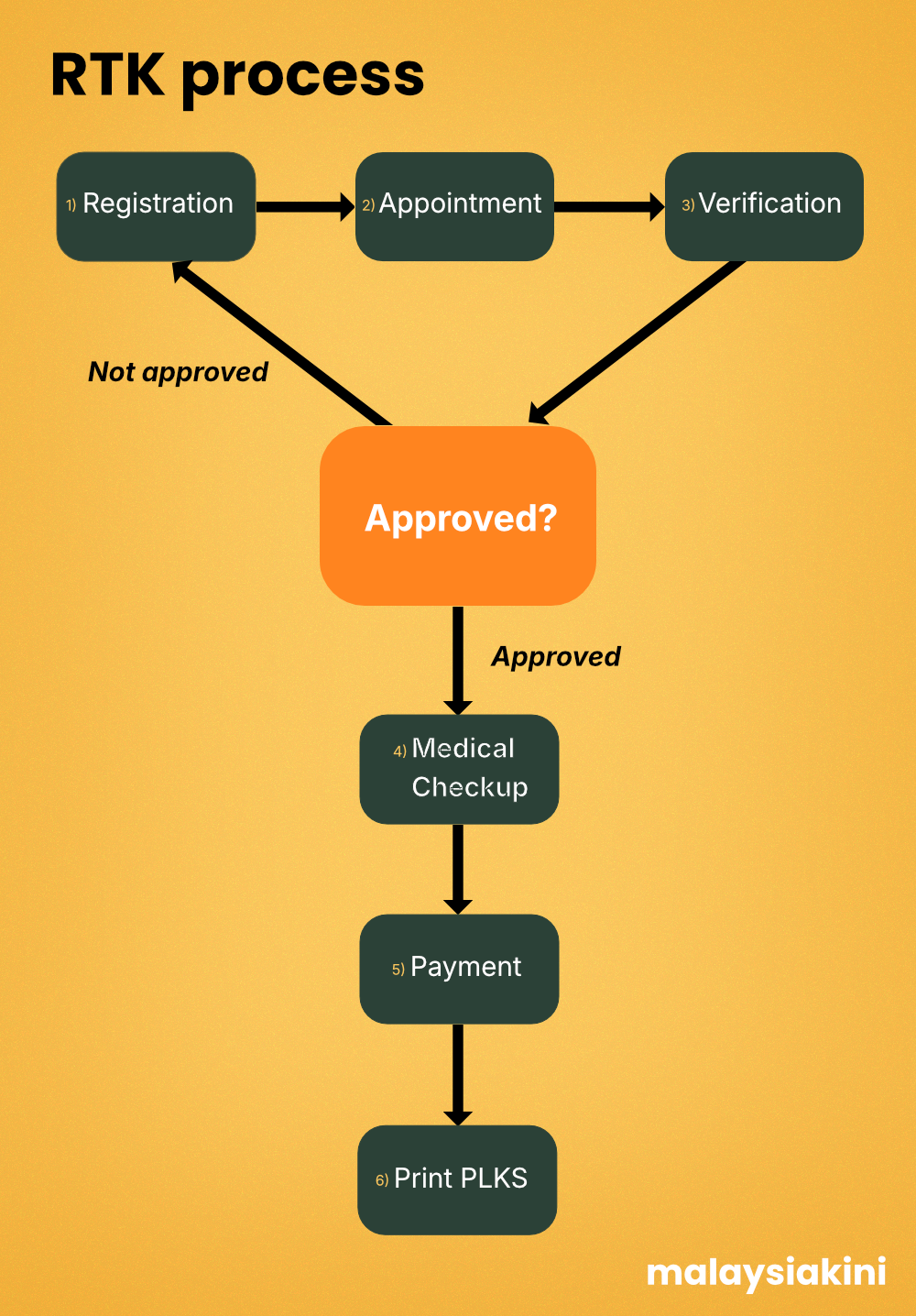
Another agent, a foreign national, said they charged employers starting from RM3,000, but only if the employer did not have a blacklist record.
“I mean, if the employer had been blacklisted before, then the fee for approval would be higher,” he explained.
“Another thing - RTK 2.0 only applies to migrants who entered Malaysia before December 2022. So, if someone entered in 2023 but still wants to join RTK 2.0, they’d need to pay an extra RM1,500 to ‘backdate’ their entry,” he claimed.
Process ‘not as straightforward’
Still, questions remain as to why agents are needed - even by employers with clean records.
Sources claimed the process is not as straightforward as it seems.
They alleged that counter officers often gave various excuses to push employers toward hiring agents to obtain approvals.
Another agent from Bangladesh said that the RTK syndicate was far more profitable than “counter settings” and “fly” (exit-entry record manipulation) schemes.
He said fees were higher than in other rackets because the RTK programme was time-limited, making it a golden opportunity for undocumented migrants to “cleanse” their records after years of illegal work.
Asked how long it would take to make RM1 million through these schemes, he replied that the fastest way was through selling foreign worker quotas.
“To make RM1 million, I might need a year doing counter settings. With RTK, I could do it in three months. But with worker quotas, one month is enough.
“It all depends on who you know in the government and who helps you,” said the agent, who has since returned to Bangladesh after being detained by the department for his involvement in a foreign worker quota syndicate.
He also confirmed that he knew the couple detained by MACC mentioned in the article, saying the husband and wife operated in the Klang Valley.
“But I never worked with them. When I read the news that they owned a gold shop, I immediately knew they were involved in the RTK syndicate.
“Running a gold shop requires a lot of money - you can’t earn that much from counter settings alone. But with RTK, you can,” he said, adding that the couple were not the “main players” in the RTK syndicate.
MACC had also disclosed issues related to the gold shop and jewellery on Sept 13, 2025.
‘There are bigger players’
The foreign agent further claimed that the biggest players were not the couple but two other immigration officers.
However, he declined to elaborate, saying the officers were highly influential among several enforcement agencies.
A retired immigration officer also confirmed this information.
He claimed he personally knew the 50-something man while working at an immigration office in Kuala Lumpur.
One of them, he claimed, had previously been detained by MACC for document forgery but later returned to work at the department.
One officer, he added, had a special advantage - being assigned to handle the RTK programme.
“They made a lot of money. A huge amount. Millions. After the RTK programme ended, they just returned to their regular divisions,” he said.
He claimed one officer made around RM3 million and invested it in three nasi kandar restaurants in the Klang Valley. That officer has since applied for early retirement.
Another officer is still serving in the department.
“You could say he’s the cartel boss when it comes to foreign workers,” the source said.
Malaysiakini contacted the department and MACC for comment more than two weeks ago and is still waiting for a response. - Mkini

No comments:
Post a Comment
Note: Only a member of this blog may post a comment.