


In many ways, Dagat’s story is Sabah’s story.
Just as these river villages sit at the farthest edge of the state’s concern, Sabah itself sits at the edge of federal power, rich in resources but short on returns.
For decades, decisions about the state’s oil, electricity, and development funding have been made far from here, in ministries that view Sabah the way Kota Kinabalu views Dagat: distant, small, and statistically insignificant.
Deep inside the Lower Segama River basin, Kampung Dagat, a tiny, off-grid settlement, endures life without gazetted roads, hospitals, or steady power, clinging to a hope that never quite arrives.
The villagers are connected to the world by a fragile internet signal, yet remain cut off by road, their lives unfolding beyond the reach of asphalt and attention.
At dawn, the village wakes to the sound of engines and prayer.
The tide is still low, and the men are already pushing their wooden boats into the dark water, heading for fishing grounds where the catch has shrunken each year.
It’s a rhythm as old as the river itself, repeated by families who have lived here for generations amid one of Sabah’s last thriving mangrove frontiers.
The nearest town, Kota Kinabatangan, lies roughly three hours away by four-wheel drive.
Villagers rely on power generators that run for a few hours each evening.
Today, 20 homes are powered by a 30kWh solar energy system installed by the NGO Forever Sabah, the first time the village has known nights without the noise of engines.
“All our energy comes from solar, but it’s not strong enough, only for lights, a TV, and charging phones.
“We just got an internet tower this year, but monkeys always climb and break the wires,” said Rosnah Kasim, the group’s field coordinator, who is also a Kampung Dagat native.
The villagers are mostly from the Tidung ethnic group, whose ancestors were forced to move into the area around the 1940s due to constant flooding in the plains.
Today, around 40 families are living in Dagat.
After the sun sets, the village glows faintly.
Children do their homework by torchlight; their parents sit on wooden verandas, listening to the hum of insects and distant laughter from the riverbank.
It is quiet, but never still.
The debt that begins before dawn
Here, the river provides for most of the men, but the profit goes elsewhere.
Fisherfolk borrow from local wholesalers known as towkays, who supply them with fuel, ice, and bait on credit.
The repayment comes later, when the catch is sold, but always at a price set by the same towkays.
“By the time we pay for fuel, there’s almost nothing left,” said Halima Bisan, 49, who leads the Dagat women’s economic group.
“The towkay makes four times what we get. We only have enough for rice and for the next trip,” she said.
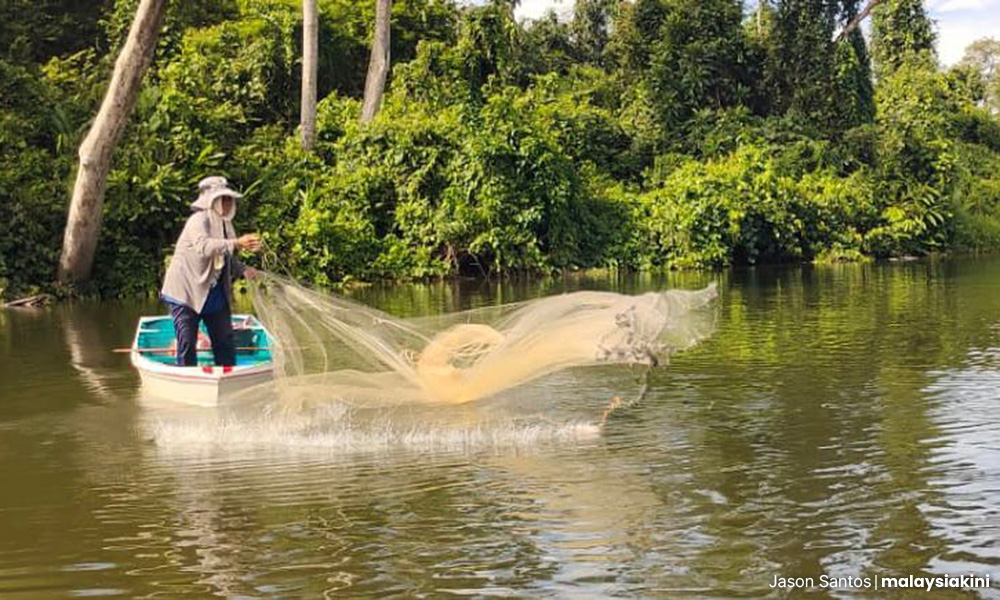
A kilogram of siakap that sells for RM8 in Dagat can fetch more than RM30 in Kota Kinabalu.
A small fishers’ association once tried to bypass the middlemen, but without cold-storage facilities, proper roads, or government support, the initiative collapsed.
Further downstream, fishers from Mumiang, Pitas Laut, Litang, Sri Ganda, and Tundun Bohangin tell the same story, also trapped in the same web of credit and control.
Every weekday morning, around 10 four-wheel drives line up outside the village.
They form a convoy, ferrying about 20 children to Sekolah Kebangsaan Kampung Tidung, an hour away through muddy plantation roads.
There is no school bus; only parents taking turns to drive.
“When the road floods, we can’t go,” said Nurin Jafar, 34, a mother of four.
“Sometimes the children miss class for days.”
For secondary school, the children live at SMK Bukit Garam 2, five hours away. They come home only during festive breaks.
“We want them to have a better life. But it feels like sending them away from us,” Nurin said.
Birth, death and the waiting in between
Most babies here are still born at home.
The bidan kampung, the village midwife, assists using herbal remedies and decades of experience.
Government mobile clinics, meant to reach places like Dagat, rarely arrive.
Visits are months apart and often cancelled once the river floods or it is the rainy season.
“When it rains, they don’t come. So most of us rely on the bidan and traditional medicines,” said Rahima Lajim, 62.
The air-medic helicopter service stopped in 2017.
“After that, nothing,” another mother said.
“Now, if you’re sick, you wait. If you die, you die here,” Nurin added, recounting several deaths that occurred while the sickly were on their way to the hospital from the village.
“The journey is just too taxing and long.”
During the Covid-19 lockdown, one of the women had to stay at the hospital for two months to give birth.
Politics that never arrives
Dagat and its neighbouring villages - Mumiang, Pitas Laut, Litang, Sri Ganda, and Tundun Bohangin, all fall under the Sukau state constituency and the Kinabatangan parliamentary seat.
Both are currently held by Umno: Jaffry Ariffin serves as the incumbent Sukau assemblyperson, while Bung Moktar Radin is the long-time Kinabatangan MP.
Together, these riverine settlements account for fewer than 2,000 voters, a fraction compared with town-based electorates.
“Whoever we vote for, it doesn’t change anything. Politicians only come when the road is dry,” Rosnah said.

They still vote, out of duty more than belief - hoping the promises of rural development will one day reach them.
But experience has taught them that numbers determine attention, and theirs is too small to matter.
The irony is that Dagat’s helplessness mirrors Sabah’s own struggle with the federal administration.
Just as Dagat’s voice is too faint to be heard in Kota Kinabalu, Sabah’s demands are too weak to echo in Putrajaya.
The imbalance repeats itself at every level, a village overlooked by the state, a state overlooked by the nation.
Sabah contributes billions in oil, timber, palm oil, and taxes, yet much of that wealth returns as allocations decided elsewhere, sometimes late, sometimes missing.
Federal policies promise shared prosperity, but for families in these remote wetland villages, even basic access remains a dream.
Sabah holds just 25 seats out of 222 in the Dewan Rakyat - never enough to tip the balance of power, though often enough to play kingmaker.
And still, little of that leverage has reached the six villages scattered within the Sukau constituency, where roads remain unpaved and promises unfulfilled.
Like the 2,000 voters along the Lower Segama, Sabah votes faithfully, yet its weight is too light to move the scales.
The villagers may be invisible to the state, but the state, too, often finds itself invisible to the federation.
Despite everything, Dagat survives.
“We help each other without payment because we are all family,” said Marina Ida Matin, 53, whose husband sells fish directly in town markets to escape the towkay system.
Others, like Halima Bisan, run small cooperatives that process dried prawns and fish crackers, earning just enough to buy fuel or school supplies.
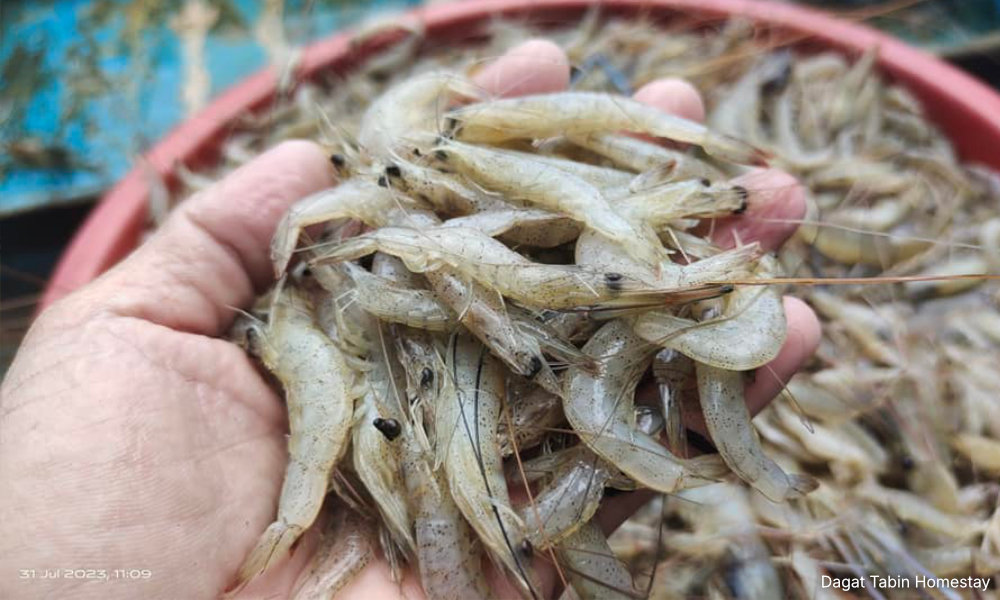
The mangroves that once sheltered young fish are thinning under pressure from upstream clearing.
Yet the villagers continue to cast their nets, trusting the tides, the river, and each other.
“We need to coexist in harmony with nature,” Marina said softly. “But what will happen to us if we have no fish, no power, no help anymore?”
The question drifts down the Segama River like the current itself, unanswered, as most things in Dagat are. - Mkini

No comments:
Post a Comment
Note: Only a member of this blog may post a comment.