


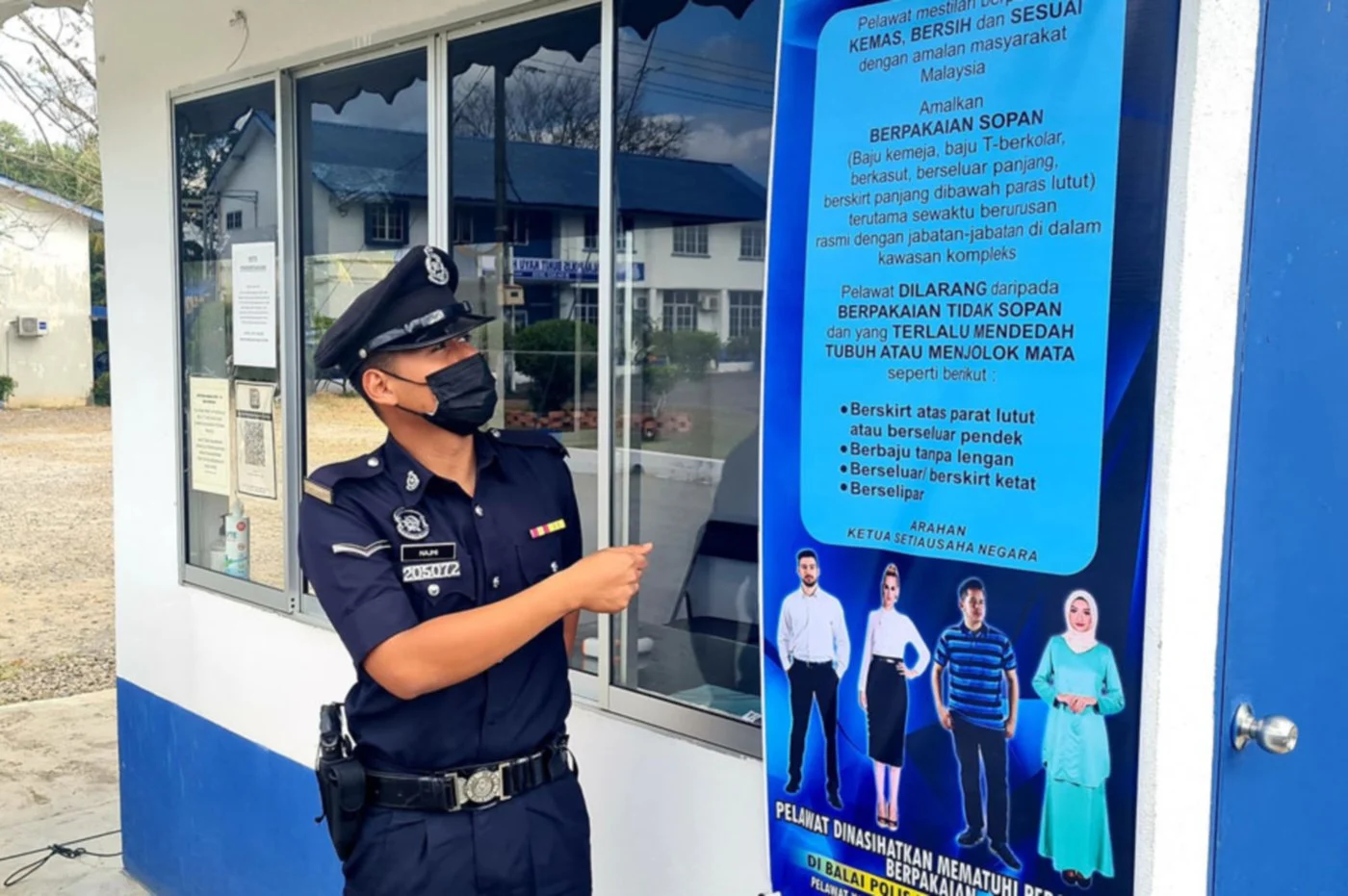
THE government’s decision to relax dress code requirements during emergencies as announced by Chief Secretary to the government Shamsul Azri Abu Bakar, is a necessary, expedient and a pragmatic step.
However, recent incidents including the case of a woman denied entry to the Jasin police headquarters over a skirt slightly above the knee highlight that the term “retain discretion to determine appropriate and respectful attire for routine matters” remains vague, inconsistently applied, and vulnerable to misuse.
For this reason, Wanita MCA urges the Home Ministry, Royal Malaysia Police (PDRM), and the Chief Secretary to clearly define what “discretion” and “routine” mean, particularly at police stations and critical frontline agencies.
Dress code rules must never impede access to justice, emergency reporting, the safety of victims or halt crimes. Any delay in accepting police reports or initiating investigations can have serious consequences.
It may allow perpetrators valuable time to flee, give scammers the opportunity to disappear with or stash away looted funds, or complicate evidence collection. These are risks that the public should never bear because of subjective interpretations of attire.
It is also illogical, and deeply insensitive, to expect victims of physical assault, sexual violence, immolation attempts, or those who have been forcibly stripped, to “dress appropriately” before seeking help.
In many cases, forcing a victim to change clothing may destroy crucial forensic evidence, including the perpetrator’s DNA. Guidelines that ignore this reality will only embolden abusers, attackers, and predators.
Victims in distress need immediate assistance, protection, and empathy, and certainly not humiliation, judgement, or being turned away at the door.
We acknowledge that in predictable, non-urgent scenarios, for example, lodging a report after a foreseeable death at home due to old age or prolonged illness—it is reasonable to expect next-of-kin to observe standard attire guidelines.
But in crisis situations such as domestic violence, stalking, sudden assault, or when a victim is fleeing a dangerous environment, expecting them to “dress up” before approaching a police station is both unrealistic and unsafe.
Clear, unified, and public security-centred directives are urgently needed to ensure that no one is ever denied police assistance because of clothing. Justice and safety must always come before attire.
Tee Hooi Ling is the Wanita MCA national deputy chairperson.
The views expressed are solely of the author and do not necessarily reflect those of MMKtT.
- Focus Malaysia.

No comments:
Post a Comment
Note: Only a member of this blog may post a comment.