

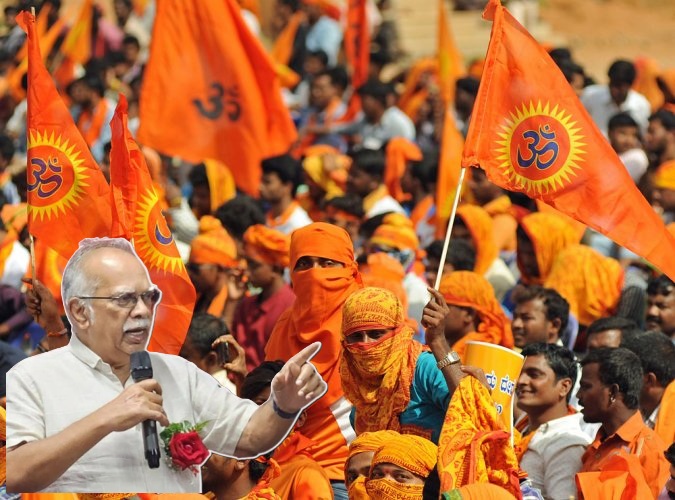
HINDUTVA is a nationalist political ideology that intends to render Hinduism as a hegemonic political force in India.
The current ruling party in India – Bharatiya Janata Party (BJP) – is said to be associated with the political ideology of Hindutva.
As a nationalistic force of the Hindus in India, it is said to be against other non-Hindu religions such as Islam and Christianity.
Little wonder that some so-called religious and political experts in Malaysia are claiming that the Hindutva nationalist ideology has seeped into in Malaysia among certain Hindu segments in the country.
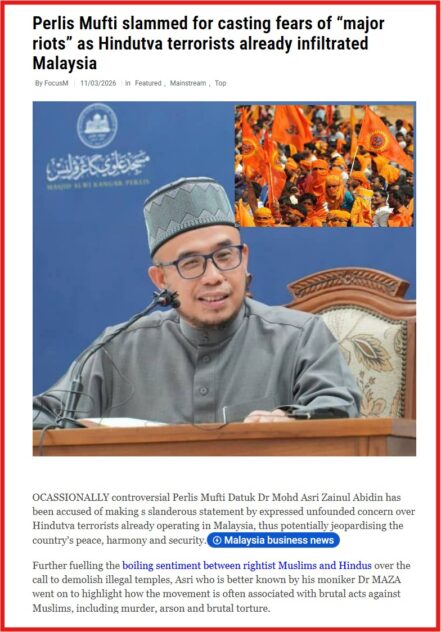
A religious expert in the service of a state government in Peninsula Malaysia (Perlis mufti Datuk Dr Mohd Asri Zainul Abidin a.k.a. Dr MAZA) has urged the country to keep track of the religious activities of the Hindutva elements especially those who manage and operate Hindu temples in the country.
No influence in the south
This statement is made by the Islamic religious expert on the grounds that the recent spate of vigilante attacks against the so-called Hindu temples seems to be motivated by the urgent need to curb the activities of the Hindutva groups in the country.
Unfortunately, those who raising the red flag of Hindutva in Malaysia seem to have no understanding of the political religious movement in India.
In India itself, the political religious movement is a phenomenon associated with those in north India – the Hindi belt.
Given that the Hindutva ideology is associated with the northern religious and political forces, it has not been accepted in the Dravidian belt of Southern India.
This would explain why the BJP cannot make any political inroads into states like Tamil Nadu and others.
Hindutva might be presented as an over-reaching political and religious ideology but its impact is not on the whole of India.
Tamils in the state of Tamil Nadu have been the fierce opponents of the political, religious and linguistics ideology of Northern India.
This explains why there are no takers for Hindutva philosophy in Southern India especially in the state of Tamil Nadu.
Complexity of Hinduism
Well, if the political ideology of Hindutva has no major impact on the linguistic states of Southern India, it is foolish to state that the Hindutva ideology is rearing its ugly head in Malaysia among the demographically numerical small Hindu Tamil community in Malaysia.
Although the majority of the Indians are Hindus, it must be remembered their religious worship is a complex blend of worship incorporating elements of both ancient Tamil worship and the Brahminical influences over the past few centuries.
It is too simplistic to hegemonise Hindutva in Malaysia with one’s inability to understand the complexity of the Hindu religion, its different civilisation influences, the political difference between north and south India in linguistic and cultural terms.
I am sure the authorities are keeping tabs on religious extremism of the Malay-Muslims in the country. However, this does not mean the Malay-Muslims are religious extremists in the country.
While the Hindutva ideology might have impacted a small segment of Hindus in the country, Malaysia’s Tamil Hindus are on the whole opposed to any forms of religious extremism in the country.
Safeguarding their temples from vigilante attacks is not equivalent to protecting the hegemony of Hindutva.
Those who are raising the red flag of Hindutva presence in Malaysia should not impose their own extremist views on the society.
Former DAP stalwart and Penang deputy chief minister II Prof Ramasamy Palanisamy is chairman of the United Rights of Malaysian Party (Urimai) interim council.
The views expressed are solely of the author and do not necessarily reflect those of MMKtT.
- Focus Malaysia.

No comments:
Post a Comment
Note: Only a member of this blog may post a comment.