


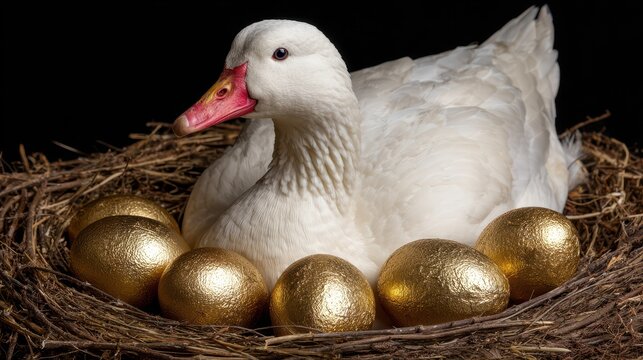
A VILLAGER in China received an unexpected surprise while preparing a duck for dinner after discovering several small gold nuggets inside the bird’s stomach, reportedly worth about 20,000 yuan (RM6,860).
The man, known only by his surname Liu, made the unusual discovery in Longhui county in Hunan province.
The duck was one he had personally raised in a free-range environment before slaughtering it for a meal.
According to a report by the South China Morning Post, Liu noticed the unusual objects after cutting open the duck and examining its stomach, where the nuggets were mixed with partially digested food.
Local reports indicated that the pieces weighed around 10 grams in total, which would place their value at roughly 20,000 yuan.
To test his suspicion, Liu reportedly carried out a basic heat test, a simple method sometimes used to tell gold apart from other metals.
When the particles showed no colour change after being exposed to heat, he became more convinced they might indeed be gold.
Officials from the Longhui County Natural Resources Bureau said further testing by a specialised authority would be required to confirm the nature of the particles.
On another note, what is the possibility of gold developing in an animal.
A separate story developed in India where scientists at the Junagadh Agricultural University analysed urine from 400 Gir cows, a distinctive breed of cow originating in the Gir forest region of India.
Researchers examined urine samples to identify various metabolites and toxins.
Using gas chromatography combined with mass spectrometry (GC-MS), they detected traces of gold ranging between 3 and 10 milligrams in one litre of urine.
The metal was present in ionic form, specifically as gold salts.
Scientists then attempted to determine how the gold ended up in the cows. According to current scientific understanding, living organisms cannot produce metals internally.
Instead, both humans and animals obtain metal ions through the food or water they consume.
One possible explanation is that the cows ingested tiny quantities of gold through their feed.
Plants can absorb trace elements from the soil, meaning the fodder eaten by the cows may have contained minute amounts of gold that had accumulated in the vegetation.
In other words, cows and ducks can lay golden eggs, well not literally. — Focus Malaysia

No comments:
Post a Comment
Note: Only a member of this blog may post a comment.