



Letter to Editor
THERE is a saying that ‘justice is blind’ meaning that the law should be applied equally without fear or prejudice for all citizens regardless of ethnicity, religion or any other superfluous categorisations.
That very notion is under close scrutiny in Malaysia as there is a perception that justice is NOT being dispensed equally.
This is in relation to recent tragic accidents that have sparked outrage among the public – not just because of the senseless (and avoidable) fatalities – but also because of the lack of consistency from the public prosecutor’s office.
I refer to two cases which highlight the discrepancies. The first involved a driver – believed to be under the influence of alcohol and drugs – whose dangerous driving caused a father-of-three to be killed in Klang on March 29.
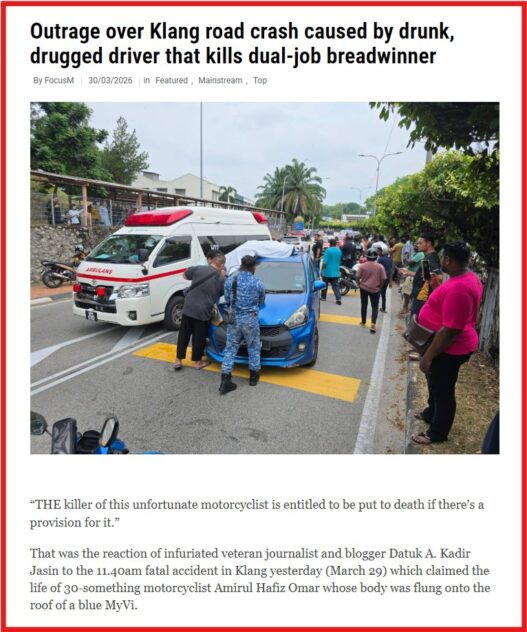
Public outcry was loud and shrill as dash cam recording of the incident went viral, detailing how the driver’s recklessness led to the motorcyclist’s tragic demise.
A 28-year-old man, Saktygaanapathy Ravichandran, has been charged with murder under Section 302 of the Penal Code which carries the mandatory death penalty or 30-40 years jail plus whipping.
The Attorney-General defended the murder charge, citing Section 300(d) of the Penal Code, arguing the accused knew his actions (drinking + drug use + driving wrong way) were so imminently dangerous that they would likely cause death.
Compare and contrast this with another accident that claimed the life of a Form I pupil in Kota Bahru on Sunday (April 12).

In this incident, a 57-year-old ustazah (female religious teacher) allegedly ran over the pre-teen when she accidently pressed on the accelerator of her vehicle in the vicinity of a surau at SMK Tanjong Mas in Kelantan and hit the pupil identified as Nur Fatimatul Hawa Mohd Azaudin.
The father of the victim has since declared that he has forgiven the teacher and will leave the matter to the police.
The perpetrator was remanded for two days for further investigations for offences under Section 41(1) of the Road Transport Act 1987. According to Kelantan Police Chief Datuk Mohd Yusoff Mamat, further investigations into the case are being conducted with the ustazah liable for a fine of RM20,000 to RM50,000 and imprisonment of between five and 10 years.
There was no mention whether the teacher was subjected to a urine test or that she was intoxicated.
The question is why the different charges and different protocols in procedure? Both are traffic offences and both have led to innocent parties losing their lives.
As highlighted by prominent lawyer and human rights activist Siti Kassim on her Facebook page, both are road accident cases which involve either incompetent drivers or those driving under the influence. Both should NOT be driving.
The worrying trend here is that the laws does not appear to have been uniformly applied.
Firstly, the teacher in the Kota Bahru case should have been subject to urine and/or breathalyser tests to ensure she was NOT under the influence. It should be a matter of procedure.

Just because one case involves an Indian youth while the other a 57-year-old religious teacher should NOT make any difference.
It may seem distasteful to equate the two cases as the teacher has admitted to fault. But the crux of the matter is that the accused for very similar offences have been treated rather differently.
As highlighted by online commenters, there seems to be two sets of laws to be applied, depending on public sentiment. As one observer succinctly remarked, “when an Indian kills someone in accident, it is NOT God’s will. But when a Malay does so, it is God’s will”.
Such inconsistencies cannot be the norm when applying the law as it erodes confidence and belief in the justice system being fair and beyond reproach.
At the moment, it does appear that public sentiment (and its attendant prejudices) is determining the charges for such wrongdoings.
Kopi-O License
Kajang, Selangor
The views expressed are solely of the author and do not necessarily reflect those of MMKtT.
- Focus Malaysia

No comments:
Post a Comment
Note: Only a member of this blog may post a comment.