


Three organisations have flagged a series of unresolved governance, regulatory, and safety concerns one year after the Putra Heights gas pipeline explosion, despite an official finding that the incident required no further action.
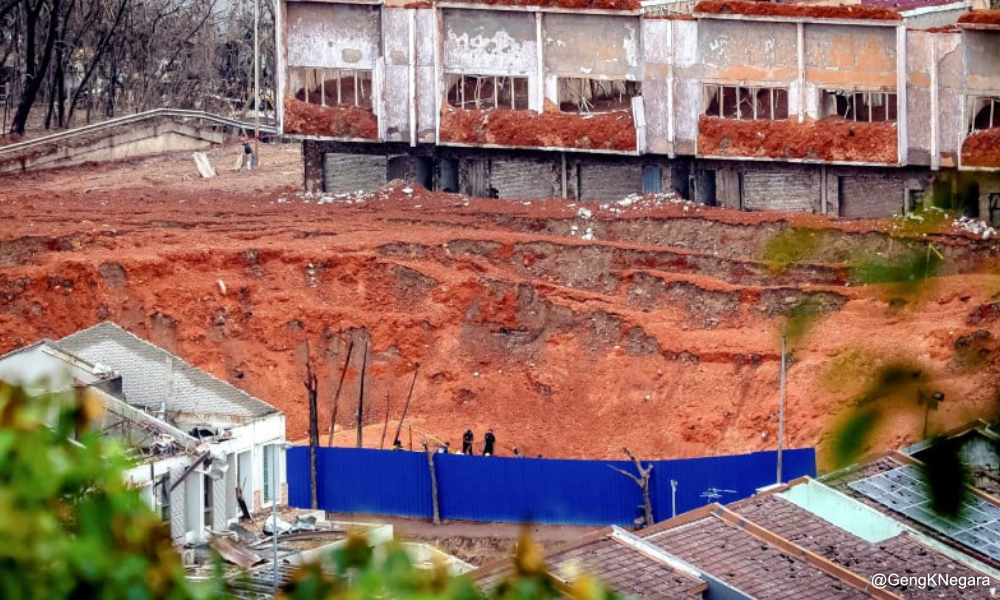
On April 1 last year, an explosion and fire along the Peninsular Gas Utilisation (PGU) Phase II high-pressure pipeline in Putra Heights, Selangor, sent a flame column estimated at 20 to 30 storeys high into the air.
The blast destroyed or damaged more than 500 homes and hundreds of vehicles, injured over 110 people, and forced the evacuation of more than 600 households.
It also created an 8m-deep crater and burned for more than seven hours before it was extinguished.
At an event held at the Putra Heights Mosque community hall today, The Artivist Network, Greenpeace Malaysia, and RimbaWatch issued a series of demands, leading with a call for the immediate establishment of a royal commission of inquiry (RCI) into the root causes of the incident, including transparency on urban pipeline monitoring procedures, and publishing all findings.
The call was recorded in a policy brief, “Putra Heights One Year On: Unanswered Questions Remain,” prepared by Greenpeace Malaysia and RimbaWatch, which was also launched during a press conference today.
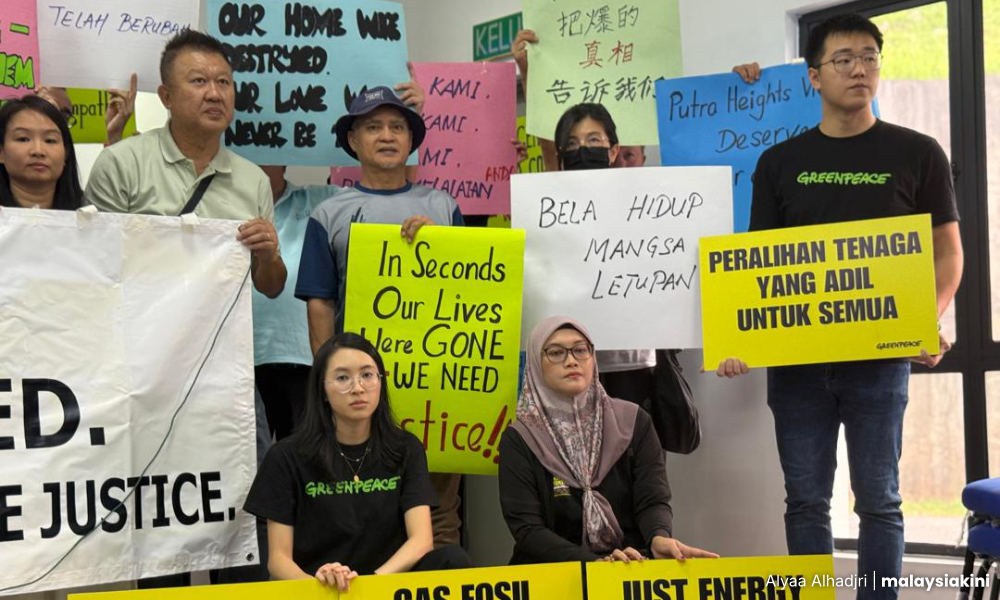
Groups make demands
Apart from an RCI, the groups’ key demands include:
Strengthen the Energy Commission
Empower the commission as the lead safety agency to set and enforce minimum pipeline safety standards, including buffer zones based on the potential impact radius, and ensure relevant laws and environmental impact assessment guidelines mandate buffer zones and risk assessments.
Public access to air quality data
Disclose all air quality monitoring data before, during, and after the incident in full detail.
Independent health impact study
Commission an independent study on short- and long-term health impacts, benchmarked against World Health Organization standards.
Disclosure of methane emissions
Ensure full reporting of methane emissions from the incident in corporate and national frameworks.
Accelerate fossil fuel phase-out
Recommend phasing out fossil fuels as a primary energy source and expanding renewable energy, including solar.
Just energy transition
Urge the government to lead a transition from fossil fuels to safer, cleaner alternatives such as energy efficiency and renewables.
Rapid renewable development
Adopt a national grid roadmap targeting 100 percent renewable energy by 2050, supported by carbon pricing and smart grid investments.
Mandatory independent audits
Implement periodic independent audits of pipeline systems, with results made fully public.
Justice and answers
Over 50 affected residents, many bearing permanent physical and emotional scars, attended the press conference to call for “justice and answers”.

Spokespersons for RimbaWatch, Greenpeace Malaysia, and Artivist later presented copies of the policy brief to Kota Kemuning assemblyperson Preakas Sampunathan and a representative from the Energy Transition and Water Transformation Ministry.
Greenpeace Malaysia climate and energy campaigner Hamizah Shamsudeen said, “Based on our findings, the community is seeking basic accountability, transparency, and clear communication throughout the repair and remedy process.
“The lack of risk awareness and emergency preparedness has only deepened the physical and emotional toll on residents, raising serious questions about whether enough was done to safeguard both the pipeline system and the communities living around it,” said Hamizah.
The policy brief further identified numerous key issues that were not addressed by the Parliamentary Special Select Committee (PSSC) on Infrastructure, Transport and Communications, the body tasked with investigating the explosion.
Key concerns highlighted include:
Poor planning and siting
Pipeline routed through residential areas, raising questions over planning decisions and coordination.
No clear buffer zone rules
Existing 30-50m buffer seen as inadequate; no law requiring safer distances based on risk.
Low public awareness, unclear assessments
Residents are unaware of the pipeline and safety steps; unclear if proper risk and environmental studies were done.
Monitoring failures
Significant ground movement went undetected despite advanced systems.
Climate and health impacts ignored
No assessment of emissions or health risks from the explosion.
Failure to learn from past incidents
Similar subsidence issues occurred previously, but the lessons were not fully applied.
Ongoing risks in new projects
New pipeline projects continue with similar concerns and limited transparency.
Key issues not addressed
In October 2025, the PSSC concluded that the explosion was primarily caused by long-term soil subsidence beneath the pipeline.
Citing PSSC findings, the policy brief highlighted that soft, waterlogged ground conditions led to 24.3cm of soil settlement and 15.9cm of pipeline displacement, weakening a welded joint under repeated cyclic loading until a gas leak ignited.
The PSSC said there was no evidence of sabotage, over-pressurisation, construction interference, or operator negligence, and classified the matter as requiring “no further action”.
However, the policy brief argued that the report did not adequately address key issues. - Mkini

No comments:
Post a Comment
Note: Only a member of this blog may post a comment.