



KUALA LUMPUR, May 27 — For anyone who has applied for a loan or credit card, product disclosure sheets (PDS) are often treated as little more than paperwork to skim through or sign off on.
Although these documents are filled with technical terms and lengthy explanations that can overwhelm the average consumer, they do serve an important purpose.
After all, PDS contain important information a consumer should understand before committing to a financial product, from repayment obligations to potential risks.
But how do you get a consumer to actually read PDS? Well, banking regulators like Bank Negara Malaysia (BNM) design them using behavioural insights in order to fit that purpose.
It’s just science
All PDS are now standardised under BNM’s policy document to ensure uniformity and make it easier for consumers to compare offerings across different financial service providers (FSP).
FSPs must adhere to a prescribed PDS format and comply with set parameters, including limiting disclosures to a maximum of two A4 pages and using readable font sizes and clear, active language.
“Why two A4 pages? We have sometimes seen that PDSs can be very long, which might deter people from reading.
“So we wanted to make sure that the key information is in the PDS and limited to two A4 pages,” a BNM officer said at Sasana Kijang here.
Rather than assuming consumers read every line logically and deliberately, behavioural science — the study of how people think and make decisions — is applied to shape how a PDS is framed, presenting information in a sequential “storyline” using plain language.
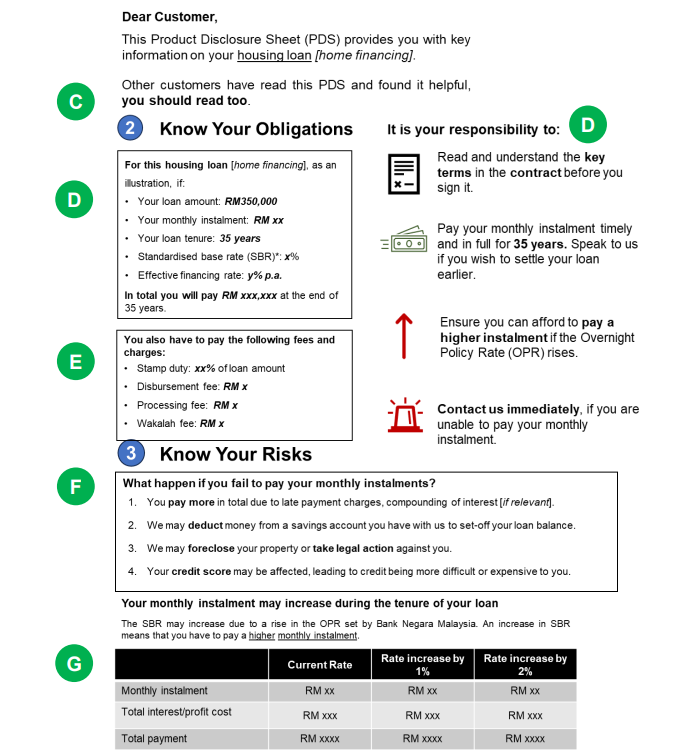
Infographics are also used to improve consumer engagement, including applying social norms to signal desired behaviour and encourage consumers to follow the actions of others.
“So as you can see, it is done in a way that nudges you to think like in a storyline, so you should understand what the product is, know your obligations, know your risks and other key terms,” the officer continued.
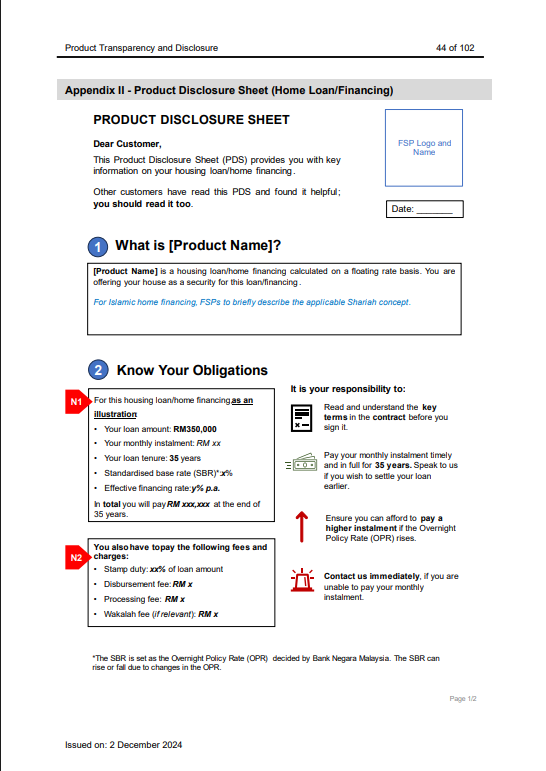
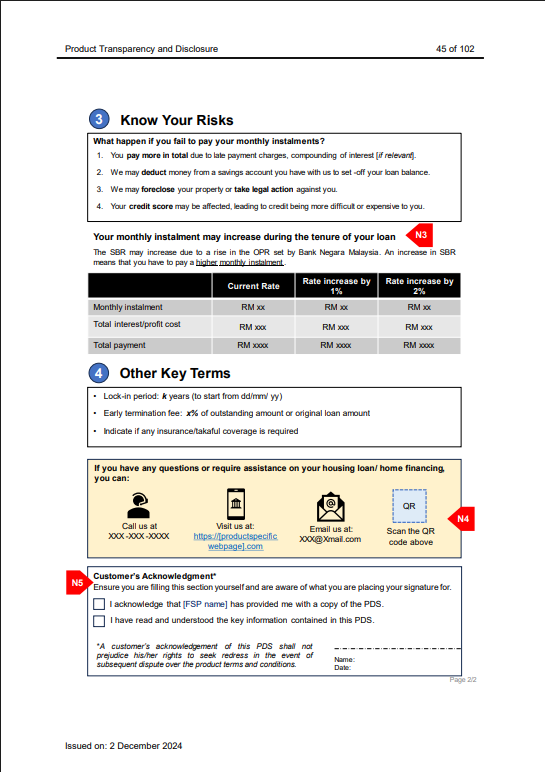
The infographic above illustrates a standardised PDS example for a home loan/financing, which must include five key requirements per BNM’s policy:
- Key information such as effective financing rate and monthly instalment
- Disclosure of relevant fees and charges
- Inclusion of a table showing how changes in the Standardised Base Rate affect monthly instalments, interest or profit costs and total repayment amounts
- Contact channels for consumers to reach the FSP for queries or assistance
- Optional acknowledgement that consumers have read and understood the PDS, which does not affect their right to seek redress if any dispute arises over the disclosed product terms.
Driven by digital advancement
When asked about the need for revision, BNM said it updated the guideline in response to the rapid development of digital platforms and banking institutions in recent years.
It also noted insufficient disclosure for non-direct digital channels, such as online e-commerce marketplaces where consumers expressed concern over unclear key cost components when making purchases, including fees, commissions and total payable amounts.
“If you really look prior to this revision, your PDSs are so dense, they almost look like a legal document.
“It’s really long, it’s convoluted, the fonts are really small, and you do not even know where to look,” a BNM officer said.
In fact, BNM revealed the enhanced PDSs — designed to be more attractive and intuitive — were first tested on home loan disclosure sheets and later expanded to improve all product disclosure sheets across financial services and products.
“What we are trying to do here is make PDSs as simple as possible so that consumers can understand what they are getting into.
“Our experience has shown that most of the time, customers don’t read or sometimes they just think the fonts are very small, so now we’re trying to be more transparent,” a BNM officer added. - malaymail

No comments:
Post a Comment
Note: Only a member of this blog may post a comment.