


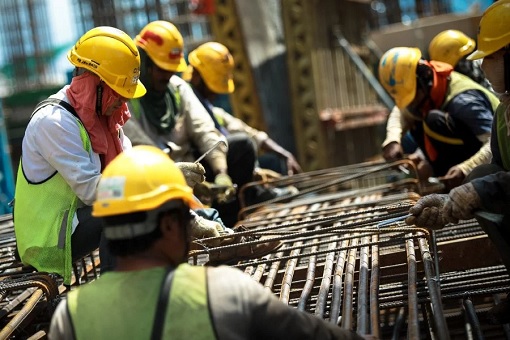
MALAYSIA’S economy runs on work most of us wouldn’t want to do. The so-called “3D” jobs—dirty, dangerous, and difficult. Think construction sites, oil palm plantations, waste disposal, and certain factory floors.
These are the unsung engines of our country. And yet, we treat them like an afterthought. Poorly regulated, often ignored in policy, and definitely undervalued.
The result? A growing gap between what we want our economy to achieve and how we treat the people who actually make it happen.
Here’s a telling stat: over 30% of workers in construction and plantations are migrants, according to Malaysia’s Department of Statistics. That’s not just a number—it’s a sign of dependence.
Yes, foreign workers keep these industries alive, but they also keep wages low, safety standards optional, and local participation minimal. Why would companies invest in better machines or safer conditions when cheap labour is always available?
That mindset leaves workers vulnerable—and holds back our entire economy from upgrading.
So what do we do about it? A few things, none of them easy, but all of them necessary.
First, enforce the laws we already have. Malaysia actually has decent labour laws on paper. But enforcement? Spotty at best. Different agencies, different rules, little coordination.
Imagine a simple digital system that tracks safety and fair pay in real time—no more hiding violations. Transparency shouldn’t be a bonus; it should be the baseline.
Second, stop treating worker welfare as a checkbox. Low pay, dangerous conditions, cramped housing—these aren’t just moral failures. They’re bad economics.
Studies show that when you treat workers better in high-risk jobs, productivity can jump by up to 20%. Fair treatment and safe shelters aren’t charity; they are smart business. Workers stay longer, get hurt less often, and actually care about doing a good job.
Third, bring in technology but don’t leave people behind. Machines can take over the most dangerous, backbreaking tasks. That’s a win. But we also need training programmes so both local and migrant workers can move into higher-skilled roles. Modernisation shouldn’t mean marginalisation.
Beyond dollars and cents, this is about who we are as a nation. A cleaner, a construction worker, a planter—they’re not invisible. They’re part of Malaysia’s heartbeat.
When we ignore them, underpay them, or let them get hurt on the job, we’re not just failing them. We’re tearing our own social fabric. Inequality grows. Resentment builds. Unity suffers.
And let’s talk about stigma. Be honest—when was the last time you heard someone say “I want to be a waste collector when I grow up”? Probably never. We look down on these jobs. That needs to change. Recognising the dignity of every kind of work isn’t just nice; it’s necessary. It shifts how we see each other.
At the end of the day, closing the gap in Malaysia’s 3D economy is about alignment. Making sure what we say matches what we do. That growth and fairness aren’t enemies. That efficiency and humanity can walk hand in hand.
We want to be a high-income nation an that is fine but you can’t get there while leaving a huge chunk of your workforce in the shadows. That’s not progress—that’s a house built on cracked foundations.
With real political will, smarter coordination, and a shift in how we value work, Malaysia can turn these forgotten jobs into a source of strength. Not just for the economy but for national unity.
Because in the end, productivity and dignity are not opposites. They are partners. And together, they can build a Malaysia that works for everyone.
The bridging can only be brought about by government policies and legislations where the marginalised will contribute to greater national unity.
KT Maran is a Focus Malaysia viewer.
The views expressed are solely of the author and do not necessarily reflect those of MMKtT.
- Focus Malaysia.

No comments:
Post a Comment
Note: Only a member of this blog may post a comment.