


First there was DAP’s Kuala Kubu Baharu, and then there was PKR’s Sungai Bakap. Now it is Umno’s turn to test its electoral mettle as part of the Madani government.
It will be a tough fight for Malaysia’s grand old party in this competitive rural Kelantan constituency.
The last time Umno faced an electoral contest was in December last year in Kemaman. It lost badly. Besides this contest, Umno has had three by-elections since the 15th general election – Pelangai last October, Kuala Terengganu in August last year and Tioman in December 2022.
It has won the seats in Pahang and lost those in Terengganu. It did particularly well in Pelangai where the assemblyperson who tragically passed away in an airplane crash, Johari Harun, had been popular and the Umno-led state government in Pahang has been seen to perform well.
Erosion in Kelantan Umno’s footholds: A widening age and gender gap
This is the first individual by-election contest in Kelantan post-GE15/ state elections 2023. Few appreciate the unique electoral dynamics in Kelantan, mistakenly believing that it is a “gone case” governed/dominated by PAS since 1990.
A look at the state-wide trends shows that PAS support is more varied than it seems.
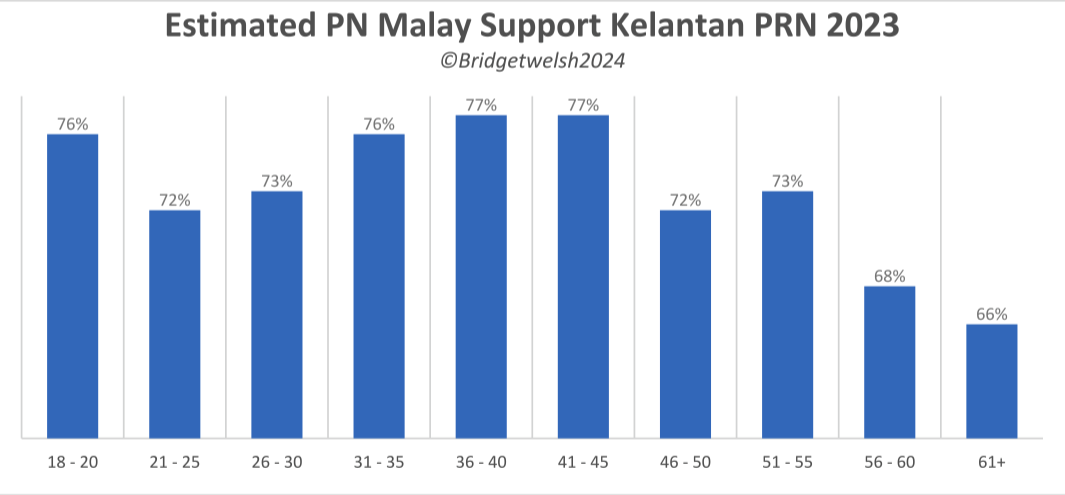
Looking at the state as a whole PAS/Perikatan Nasional dominates support in Kelantan across the Malay community, as shown in the age cohort estimate from the state elections below. In the state, as a whole, PAS won the support of nearly three-fourths of younger voters and two-thirds of older voters.Yet, despite being the incumbent state government for 34 years, PAS support among Malays is not as high at Kedah (an estimated 84 percent) and only slightly higher than Terengganu (estimated 70 percent).
Umno still has an electoral base, although a narrow one. Traditionally three parliamentary constituencies have been the Umno core in Kelantan– Jeli, Gua Musang and Machang.
This changed in elections from GE15 with PAS (and its junior partner in Kelantan Bersatu) winning all the seats except Galas in Gua Musang, a constituency that includes the bustling town. There remains strong support for Umno in Gua Musang despite the state-wide trends.
Each of the parties contesting Umno/PAS with Bersatu have weaknesses. PAS’ is low turnout. Kelantan has the lowest turnout of all the states in Peninsular Malaysia only 61 percent in the state elections.
Many Kelantanese do not return home to vote, seeing the contests in Kelantan as not competitive. Also, not to be underestimated, many opt not to vote at all, preferring not to vote for either option. There is an element of “no choice” politics in Kelantan.
For Umno, the biggest weakness has been a gender gap. Women have abandoned the party in high numbers. Umno only won an estimated 21 percent of female voters compared to only 42 percent of men in the last state election.
This highlights one of the biggest shifts in Umno’s electoral behaviour in recent years, a crumbling of Wanita Umno and collapse of support from women. This is particularly acute in Kelantan, which has a history of strong entrepreneurial women.
Another Umno weakness is among younger voters, as many of the leaders in Umno no longer have the same appeal among younger voters than in the past.
Although important, the youth swing away from Umno in Kelantan is not as significant as the female shift. In Kelantan as a whole, Umno wins an estimated 30 percent of younger voters under 30 across communities, compared to an estimated 21 percent of women.
Competitive Nenggiri battleground
In the coming by-election, Nenggiri will give the 20,259 voters a choice. It is a competitive seat.
Nenggiri is in the long-held Umno parliamentary constituency of Gua Musang and the seat was only lost by a mere 163 votes in the last general election.
Umno lost Nenggiri by 810 votes out of the 12,351 that voted in the state election, or by 6.5 percent.
The last Nenggiri loss simultaneously shows further erosion of support in a constituency that arguably was in Kelantan Umno’s base and that the party still has a base of support. This election will test whether that base will remain or collapse further.
Lying 20km to the east of Gua Musang town, Nenggiri is rural with a few concentrated settlements of traditional kampungs and Felda settlements. It is along the transportation hub that connects Kelantan to the rest of the country.
The main products are palm oil and rubber, but the area has garnered attention for its resources with a recent focus on hydropower. The main products are agricultural. It has wonderful durian, located in that northern sweet spot for the delicious fruit.
Construction of a hydroelectric dam is ongoing and projected for 2027, with the hope of improving water supply and bringing eco-tourism. The project is controversial as it impacts land and the environment.
The constituency is a Malay majority constituency of 86 percent Malays, with 14 percent Orang Asli. Chinese and Indian voters only comprise less than one percent of the electorate.
An estimated quarter of the voters in Nenggeri live outside of the constituency. Development challenges in the area are real, from water to poverty as infrastructure while improved in recent years remains poor in the more remote areas of the seat.
Pivotal Orang Asli vote
Nenggiri is the home of the largest settlements of Orang Asli in Kelantan, primarily from the Temiar and Mendriq tribes. There are five Orang Asli settlements, Pos Tohoi, Pos Simpor, Pos Gob, Pos Pasik, Pos Pulat and Kampung Kuala Lah. The Orang Asli vote has been a traditional vote bank for Umno but this has changed over time.
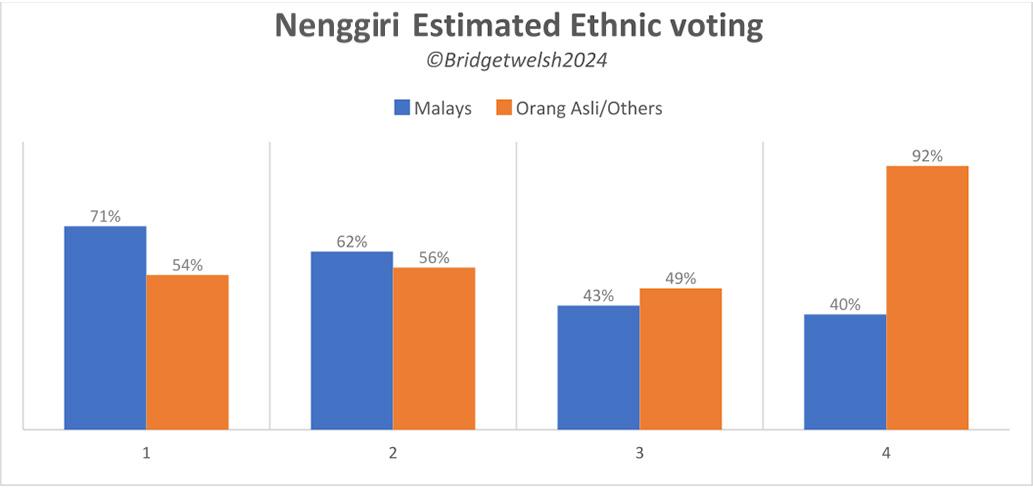
A look at ethnic voting estimates from GE15 and the state elections in Nenggiri shows that almost half of the Orang Asli do not vote, reflecting the “no choice” dynamic above.
Orang Asli support for Umno increased significantly from an estimated 49 percent in 2022 to an estimated 92 percent in 2023, with Pakatan Harapan making way for Umno in the state polls.
Umno’s cooperation with the Madani government yielded them a boon in support from a community that had been increasingly unhappy with them over local grievances.
Positive momentum on local issues significantly contributed to the state election electoral gain for Umno. Issues of land/livelihoods, religious rights and representation have been contentious.
Key, however, was the legal settlement of the still emotive issue involving the death of five students from Tohoi in 2015. The children starved after they were threatened with punishment and seven students left the school in fear. It is a case where negligence was clear.
Only two students survived. The families received a total of RM1.2 million, a low amount given the losses to families but a historic victory for the community.
Voting trends show that when faced with a straight-fight choice of the two as was the case in the state election, the Orang Asli communities chose Umno. The Orang Asli vote will be crucial if Umno is to have any chance of winning this by-election.
Voting trends favour PAS
Umno, nevertheless, goes into this election with a disadvantage. The situation for Umno is extremely challenging - Malay support for the party is low in Nenggiri, and this community votes in higher numbers.
Turnout among Malays dropped to an estimated 61 percent in 2023 from 71 percent in 2022. Given their numbers, Malays are the voters that have the most influence on the outcome. Umno faces an uphill battle to gain Malay support. It will need at least a gain of five percent in Malay support to win the seat.
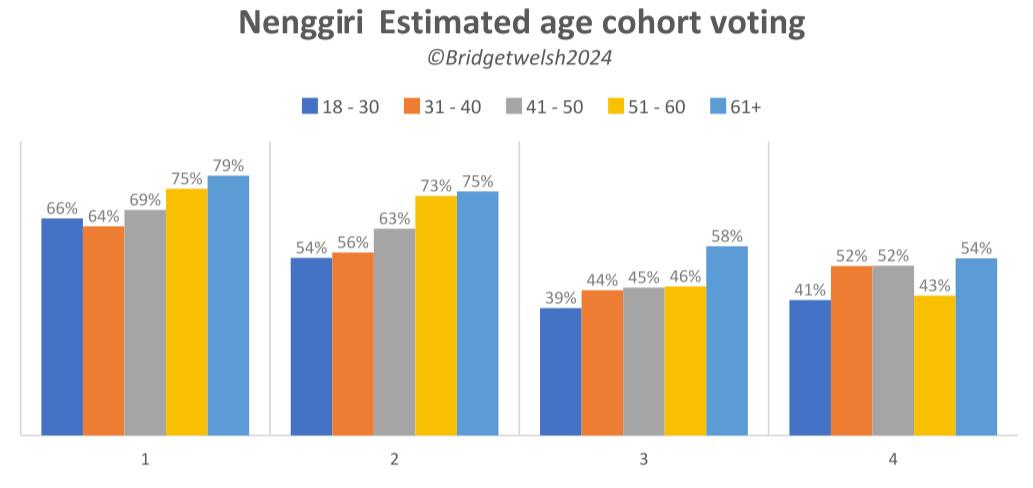
Generational voting trends are not similarly in Umno’s favour. In the state election, the party lost the most ground among voters in their 30s and 40s, but still won the majority of voters above 60.

Umno’s share of younger voters under 30, who comprise 38 percent of the electorate, is the lowest of all age cohorts at an estimated 41 percent.
The Nenggiri numbers are much higher than the state-wide trends detailed above but point to difficulties for Umno to win the seat if these constituency voting trends continue.
Interviews on the ground also show that the female factor remains serious for Umno in Nenggiri, as women are not coming back to the party – at least in this early stage of the campaign.
One of the gains in the last state election in Kelantan was in the urban seat of Kota Lama, where Amanah fielded a female candidate and received a female swing.
Women matter in electoral outcomes despite the views of male leaders who run largely masculine-centred campaigns.
Local and national
Not surprisingly, the Nenggiri by-election involves two male candidates. Kelantan Umno Youth chief and local Mohd Azmawi Fikri Abdul Ghani, 38, and now Bersatu member and former member of the navy Mohd Rizwadi Ismail, 41 competing under a PAS flag.
Both hope to appeal to that critical group of voters in their 30s and 40s. Recent history shows that the candidate factor matters in Gua Musang, as it did in adjacent Galas where a popular candidate Mohd Syahbuddin Hashim won.
Having served in the area, Azmawi has a small advantage as a candidate. The question is whether both candidates can expand their appeal beyond the party faithful.
The campaign claims to target local issues rather than national ones, and local factors will be important in the outcome. The result, however, will go beyond Nenggiri; this by-election barometer will signal if Umno is able to hold its own and build an electoral recovery, or whether under the leadership of Ahmad Zahid Hamidi – the most unpopular Umno president in the party’s history - it is to sink further into an electoral pit.
Trends suggest will take more than appeals to community “development” issues and a local candidate pull to push Umno over the electoral line. This said, expect a hard-fought campaign as Umno knows this outcome is about its electoral future. - Mkini
BRIDGET WELSH is an honourary research associate of the University of Nottingham’s Asia Research Institute, a senior research associate at Hu Fu Center for East Asia Democratic Studies, and a senior associate fellow at The Habibie Centre. Her writings can be found at bridgetwelsh.com.
The views expressed here are those of the author/contributor and do not necessarily represent the views of MMKtT

No comments:
Post a Comment
Note: Only a member of this blog may post a comment.