



I CERTAINLY agree that the Unified Education Certificate (UEC) is not recognised by the Malaysian government but nonetheless implemented in the form of entry to private universities and colleges.
Sarawak and lately Sabah have recognised the UEC on the grounds of their autonomy on matters of education.
Some top universities/colleges in the world as well as in commonwealth countries have recognised the UEC as the entry point.
In the Malaysian context, UEC is equivalent to the Sijil Tinggi Pelajaran Malaysia (STPM), the local variant of the A-Level qualification.
The private Chinese secondary schools are under the educational umbrella of Dong Zong a.k.a. the United Chinese School Committees Association Of Malaysia.
Recognition of the UEC has been long on the agenda of the Chinese culture and language organisations in the country.
Current scenario
From a non-political angle, the powerful and influential Dong Zong has been the forefront of the struggle for its recognition.
In other words, students from Chinese secondary schools in the country applying to public universities via the UEC route would gain access to public universities.
As it is, there are already Chinese and Tamil vernacular schools in the country – mother-tongue education allowed under the Federal Constitution – while Bahasa Malaysia (BM) remains the undisputed national and the official language of the country.
The existence of vernacular Chinese and Tamil schools at the primary level is no affront to the Constitution or Malay as the national language. Malay remains the mandatory language in vernacular schools.
Even Malay parents are increasingly sending their children to Chinese vernacular schools on the grounds of the quality of education.
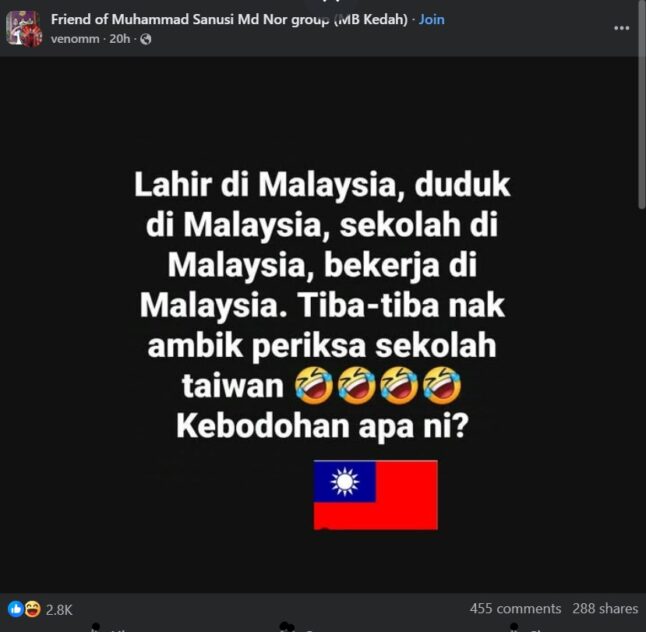
However, as soon as DAP with its brand of politics hijacked the UEC matter, its recognition has become mired in the ethnic divisive politics of the country.
Given the operation of zero-sum game in ethnic politics, DAP’s gain on the UEC is regarded as the loss of the Malay rights particularly pertaining to the constitutional protection of the national language.
It is the zero-sum game of Chinese versus Malays that stands in the way of the recognition of the UEC.
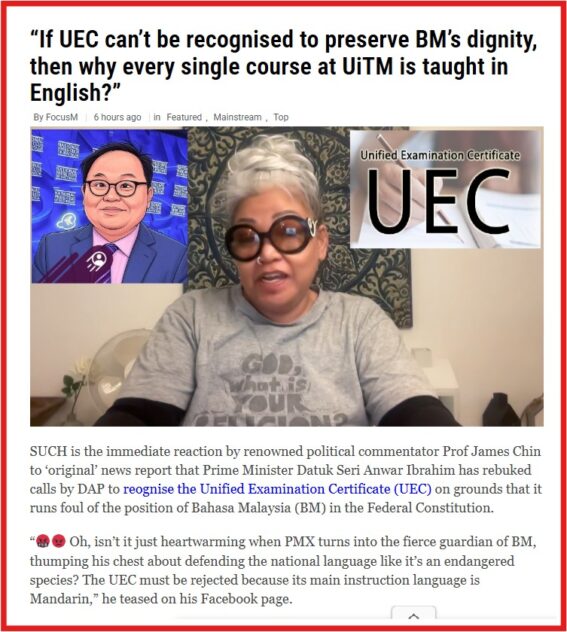
However, those who oppose the UEC on constitutional grounds fail to take account why some public universities in the country have English as the language of instruction.
PMX’s UEC recognition dilemma
Shouldn’t Malay be the medium of instruction even if there are good reasons why English should be used especially as a well-established scientific language?
On this note, Prime Minister Datuk Seri Anwar Ibrahim contended that UEC should not be recognised as it might weaken the national language.
He used the constitutional position of the national language to ward off attempts to seek recognition for the UEC.
But at the same time, Anwar by selectively relying on the Federal Constitution failed to account why the vernacular schools in the country that uses Mandarin and Tamil function within the framework of the Constitution.

A recent attempt to challenge the constitutional basis of the vernacular schools was struck down by the court of law.
Anwar’s real problem is not the UEC is against the Constitution but the political implications of recognising it.
Since DAP is championing the recognition, all the more reason for Anwar to deflect the request from a constitutional perspective.
Having suffered a major defeat in the Sabah state election especially among the Chinese voters, DAP wants to reinvent its popularity.
As soon as the election results were announced in Sabah, the DAP leadership took upon the role of urging Anwar to implement reforms that were promoted before the last national polls in 2022.

‘DAP hijacks UEC from Dong Zong’
However, what DAP is asking is not for institutional reforms but the recognition of the UEC, so much for the progressive nature of the DAP leadership.
However, the recognition of UEC is the last thing in Anwar’s mind given the dwindling Malay support for his ruling coalition
Of course, in his usual superficial philosophical and flamboyant style, Anwar used the constitutional argument rooted in the pre-eminence of Malay as the national language to repulse the demand by DAP’s born-again reformists.
Anwar knows that DAP might have 40 parliamentary seats and five ministers but it can do nothing to jeopardise the government in power.
Likewise, DAP leaders are fully aware of the extent they can push the government to recognise the UEC.
At the end of the day, Anwar will not recognise the UEC and DAP will do nothing to pressure the government.
So much for the once vociferous party that symbolised its struggle under the slogan of Malaysian Malaysia!
If Dong Zong has pursued the matter of recognition of the UEC through its own initiative, the pre-university qualification would have been recognised by now with some conditions.
Unfortunately, DAP by having hijacking the UEC has rendered its recognition near impossible. If only DAP had been sincere from the beginning.
By politicising the matter, DAP has done a great disservice to the Chinese community in the country.
As UEC has already been implemented in the country, the only thing that stands in the way of the full acceptance is the lack of government recognition. Recognition should be the logical consequence following its earlier implementation.
Former DAP stalwart and Penang deputy chief minister II Prof Ramasamy Palanisamy is chairman of the United Rights of Malaysian Party (Urimai) interim council.
The views expressed are solely of the author and do not necessarily reflect those of MMKtT.
- Focus Malaysia.

No comments:
Post a Comment
Note: Only a member of this blog may post a comment.