


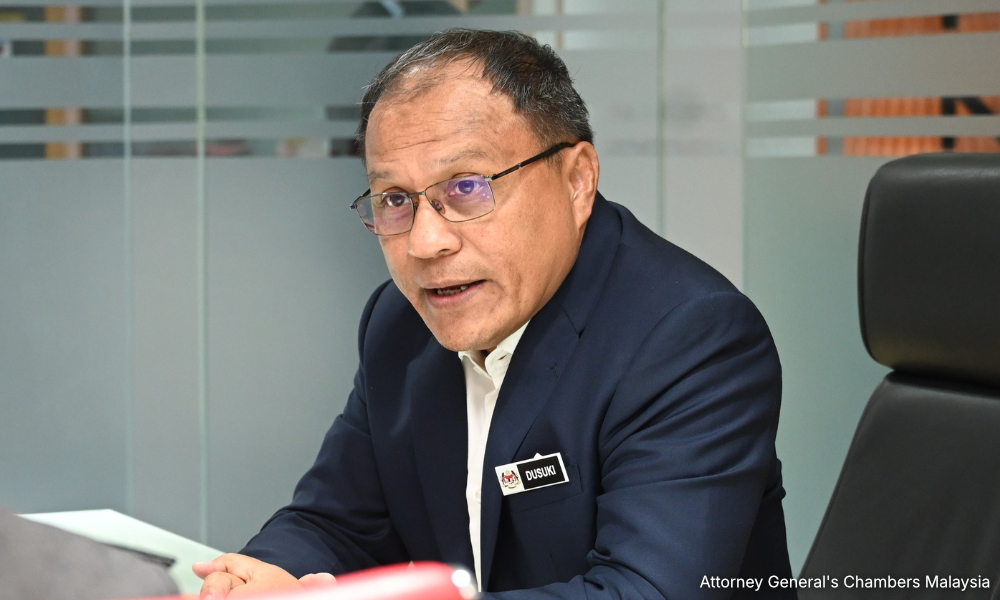
When Attorney-General Dusuki Mokhtar declared on Jan 12 that Deputy Prime Minister Ahmad Zahid Hamidi's corruption case was "settled once and for all", he could have unwittingly exposed a fundamental breach of prosecutorial procedure established by one of his predecessors.
This comes after the Attorney-General’s Chambers (AGC), on Feb 24, said it did not object to Zahid’s (above) application for full acquittal from 47 corruption charges involving Yayasan Akalbudi funds, the Kuala Lumpur High Court heard.
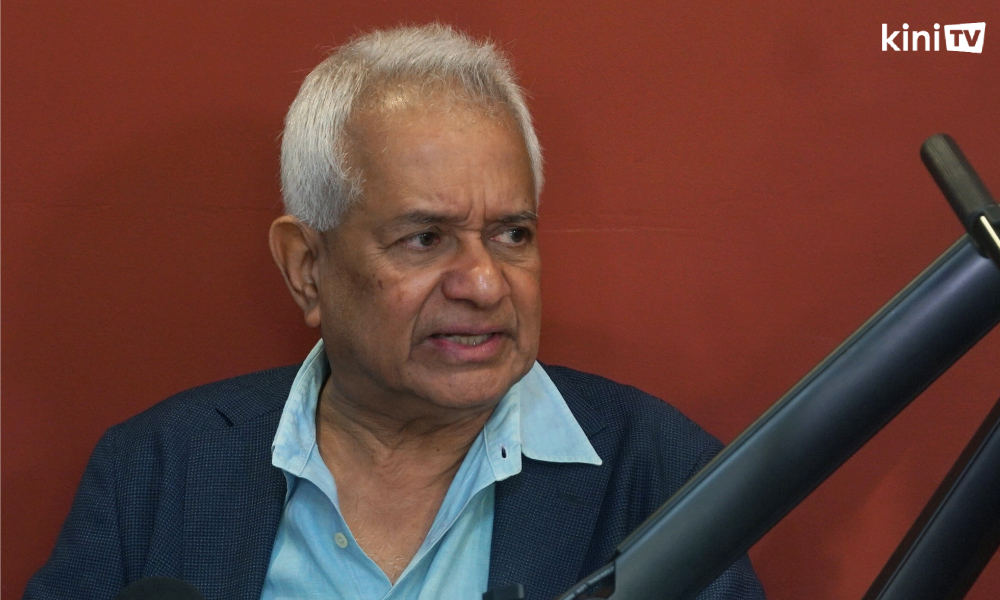
The question centres on Public Prosecutor Direction No. 2/2019, a directive issued by then-attorney-general Tommy Thomas on May 3, 2019.
It established stringent safeguards against the discontinuance of criminal proceedings. A close examination of Dusuki's handling of Zahid's case reveals what appears to be a possible disregard for the very principles this directive was designed for.
For context, Public Prosecutor Direction 2/2019 emerged after a period of public outrage over prosecutorial decisions that appeared to lack transparency and consistency.
Thomas wrote in the directive's background, lamenting how the spate of discontinuance of proceedings at that time had called into question the integrity of the entire prosecutorial system.
It is worth noting that the directive, as of the time of writing, is accessible via the Malaysian Bar's official website. It is, however, not listed on the AGC website.
‘Seven cardinal principles’
The directive established several cardinal principles.
First, the sanctity of the original prosecution decision. The directive mandated that due respect and weight must be given to the decision to prosecute, "originally made by an authorised prosecutor from the public prosecutor's office".
Once a prosecutor is satisfied that a prima facie case exists, this finding carries significant weight in any subsequent deliberations.
The second rule concerns material change as the threshold for discontinuance. The directive makes clear that, when considering representations, the primary question is whether there has been any material change in circumstances between the time the charges were preferred and the submission of the representation.
Third, the trial must be completed once commenced. Perhaps, most critically, the directive declared: "If the trial has commenced, and witnesses have testified, the decision invariably must be to reject the representation, and allow the trial to complete."
The rationale was clear: where the prosecution’s case lacks merit, the court itself will safeguard the accused, either by declining to call for a defence or by acquitting the accused after the defence has been heard.
The directive concluded with an emphatic restriction that only in very exceptional cases should discontinuance occur after trial has started.
A timeline of contradictions
When it comes to Zahid’s case, it seems the AGC may have violated the directive issued by Thomas.
Zahid was charged by Thomas, and his trial commenced on Nov 18, 2019, seven months after Thomas issued his directive.
The prosecution was not a hastily assembled affair, as it was built on comprehensive evidence. Over more than 50 days of proceedings, the prosecution called 99 witnesses to testify. The prosecution's case closed on March 19, 2021.
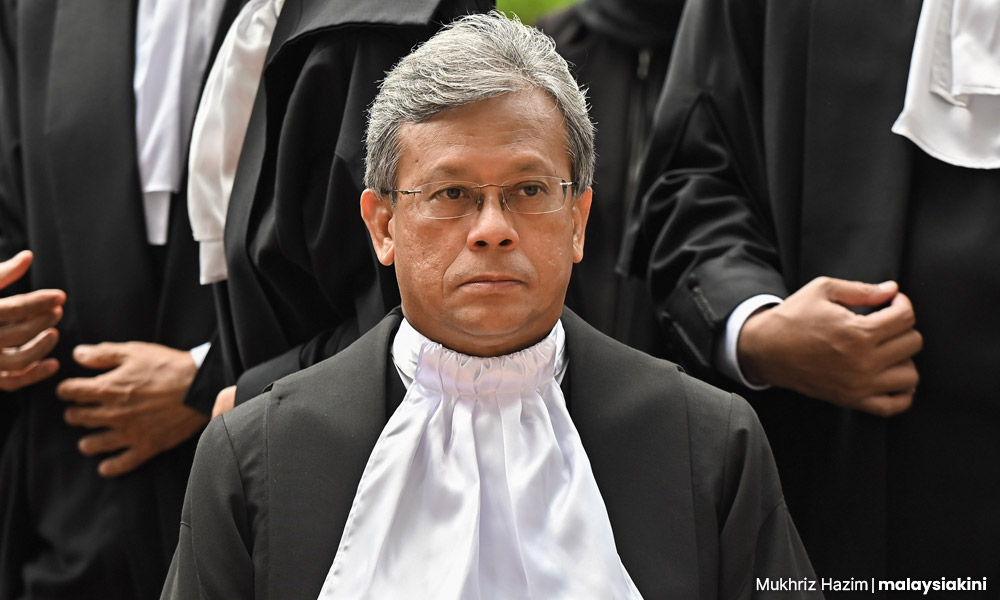
On Jan 24, 2022, then-High Court judge Collin Lawrence Sequerah delivered his ruling. After what he described as a maximum evaluation of the prosecution's evidence, he found that the prosecution had proven the ingredients of all 47 charges. Defence was called.
The prima facie case was not marginal or borderline; the judge found it proven for every single count of criminal breach of trust, corruption, and money laundering.
This was precisely the scenario Thomas' directive had addressed: a trial that had commenced and where witnesses had testified extensively.
Under the directive's clear language, this alone meant the trial ought to have been allowed to be completed. That a prima facie case had additionally been established on all 47 charges only reinforced what the directive already required.
Yet on Sept 4, 2023, the prosecution applied for a discharge not amounting to acquittal (DNAA), citing the need for further investigations after Zahid sent letters of representation via his lawyer.
Then, on Jan 9, 2026, Dusuki announced that no further action (NFA) would be taken, effectively terminating the case permanently.
Discontinuing proceedings
The most glaring breach of the 2019 directive is the decision to discontinue proceedings after the trial had not only commenced, but had progressed to the defence stage following a prima facie finding.
The directive was clear: when a trial has commenced, and witnesses have testified, discontinuance should occur only in "very exceptional cases."
The rationale was institutional: the trial court, having heard the evidence, was best positioned to protect the accused through acquittal if the prosecution's case proved insufficient.
Dusuki's justifications for the NFA, which further investigations revealed issues with money flows and that the case had become "diluted", appear not to fit into the kind of “exceptional circumstances” contemplated by the directive.
These are precisely the sort of factual disputes that trials are designed to resolve.
Disregarding prima facie
When Sequerah ruled that the prosecution had proven a prima facie case on all 47 charges, he was making an independent judicial finding that sufficient evidence existed to require Zahid to enter his defence.
That finding stood entirely on its own merits. If anything, it served to further fortify the case for allowing the trial to run its course, precisely because the directive had already mandated as much from the moment witnesses began testifying.
Dusuki’s approach, however, appeared to disregard the prima facie finding. When pressed on this point, he argued that such findings could be revisited even at the Court of Appeal stage, citing cases in which convictions had been overturned.
This analogy, however, runs counter to the very purpose of the directive.
The directive was concerned with one thing only: how the public prosecutor ought to respond to letters of representation submitted by the defence seeking discontinuance of proceedings. It had nothing to do with the Court of Appeal review of judicial decisions.
The appeal process exists to correct judicial findings, whilst the directive exists to govern prosecutorial responses to defence representations at the trial stage.
The existence of one has no bearing on the other, and the availability of an appeal remedy cannot serve as justification for a prosecutor acceding to a letter of representation and abandoning a case where the court has independently found sufficient evidence to proceed.
No material change in circumstances
The directive required that discontinuance representations be evaluated based on material changes in circumstances between the time the charges were preferred and the time of the representation.
Dusuki cited MACC's further investigations as justification for the NFA, claiming these investigations were comprehensive and covered all angles. He stated that upon review, particularly of money flows, the evidence supporting the prima facie case had been diluted.
This explanation raises profound questions. The prosecution called 99 witnesses over 50 days of trial. The evidence examined by the trial judge included detailed testimony about credit card payments, insurance policies, vehicle licences, remittances, and alleged bribes totalling millions of ringgit.
The money flows were not some newly discovered dimension; they were central to the prosecution's case from the outset.
Moreover, the DNAA on Sept 4, 2023, came halfway through Zahid's defence testimony. If the MACC's investigations were indeed comprehensive and covered all grounds, why weren't these investigative gaps identified before 99 prosecution witnesses testified?
Why weren't they apparent when prosecutors closed their case in March 2021?
Multiple representations
Thomas' directive addressed what it called a practice that had developed over the years; defence lawyers making multiple representations, essentially "trying their luck."
The directive, therefore, mandated a standard reply, declining representations, particularly if no fresh or compelling reasons are given in subsequent representations.
In this regard, Dusuki had acknowledged that Zahid's defence team had submitted six representations to the AGC. Whilst he claimed these raised factual and legal issues, he provided no detailed explanation of what fresh or compelling reasons emerged in these multiple submissions that weren't available to the prosecution during the trial itself.
However, the content of these six representations remains unknown, whether they were repetitive or substantively different.
Were these letters merely “trying their luck”, or did they reflect material changes in circumstances? - Mkini

No comments:
Post a Comment
Note: Only a member of this blog may post a comment.