


Before former Selangor menteri besar Khir Toyo was sentenced on his corruption charge in 2015, his lawyer, Shafee Abdullah, made an impassioned plea to the court.
He argued that his client should serve community service by providing free dental care to the poor three days a week for two years.
Having investigated and exposed several shenanigans under Khir’s watch for about 10 years, I disagreed, saying leniency sets a dangerous precedent - allowing a high-profile politician convicted of major corruption to avoid jail time by cleaning teeth would make a mockery of the justice system.
The punishment, I had then argued in my regular column, must fit the crime. I asserted that white-collar criminals and corrupt politicians should not be given soft alternative punishments that are unavailable to ordinary citizens caught stealing small sums.
At the sentencing hearing, Shafee complained to the Federal Court judges: “Two articles - a commentary by R Nadeswaran titled ‘Truth, nothing but the truth’ and an editorial titled ‘Don't do the crime, if you can’t do the time’ - were prejudicial to my client.”
He argued that by explicitly demanding a prison sentence and publicly eviscerating the defence's mitigating arguments while the judges were still deliberating on the sentence, the newspaper and I were attempting to exert media pressure on the court.
Shafee claimed this went beyond fair reporting and crossed into sub judice territory, attempting to dictate to the apex court what the final punishment should be.
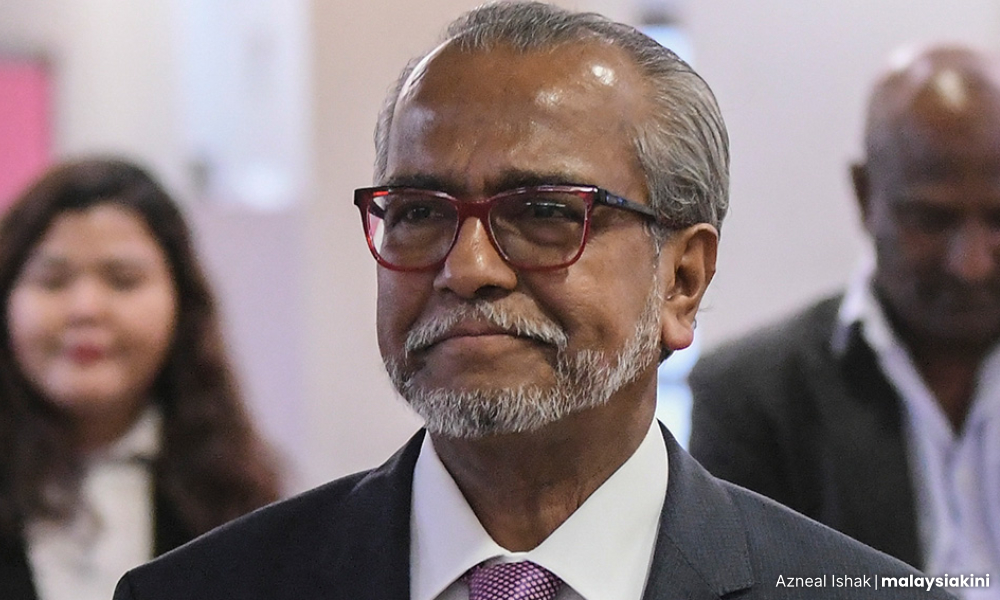
What the court did not hear was the most crucial part of my critique: “It is not this writer’s or this newspaper’s business to dissect and scrutinise mitigation pleas from convicted people. The competent authority is the court, and we don't seek to influence them or prejudice the case of the convicted person.”
However, the Federal Court panel said they were not affected by any reports and had decided purely on the evidence and the facts.
“None of these reports, either here or other reports, influenced us at all,” then chief judge of Malaya Zulkefli Ahmad Makinudin said before he went on to deliver the five-person panel’s unanimous decision.
Outside the court, Shafee was still at it. “But definitely we are filing for contempt against theSun, that’s for sure. That’s one thing Khir wants us to file for both these articles,” he told reporters after his client was sent off to jail.
Fast forward: In October 2022, Shafee apologised for comments made regarding the 1MDB-Tanore trial, yet maintained that his statements made during a press conference were accurate and not exaggerated.
This came after lead prosecutor Gopal Sri Ram said that Shafee's comments could be seen as an attack against the prosecution. Any dissatisfaction, he said, should be aired in the court before the trial judge.
Sri Ram also warned the senior defence counsel not to conduct a trial by media and told him to fight his case in court, adding that he would have to ask the court to bar discussions of the trial in public by those involved.
Outside the courtroom
These days, it is not uncommon to see lawyers, including Shafee, at the footsteps of the courthouse, offering a critique of what had transpired during the trial.
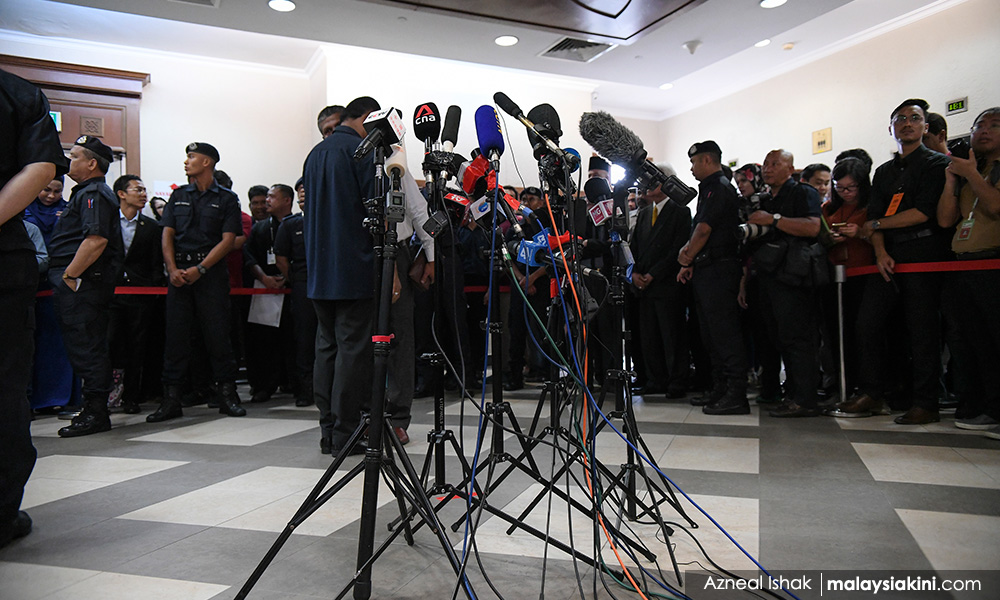
Similarly, comments were made after former Tabung Haji chairperson Abdul Azeez Abdul Rahim and former Treasury secretary-general Irwan Serigar Abdullah were ordered to be remanded for seven days by the Magistrate’s Court.
More recently, former human resources minister M Saravanan released a video and issued a 15-page letter even before he was charged, in which he denied wrongdoing.
Besides, there have been scores of other videos and hundreds of comments on social media on the case.
Should innocence or guilt be decided before a judge instead of a trial by media or a trial of public opinion? Do we need the sub judice rule in our statute books if it is being breached with impunity?
In 2016, I posed this question to the then attorney-general Apandi Ali: “Why do we have to maintain the sub judice rule since jury trials have already been abolished? Surely, judges can’t be influenced by our writings.”
The response was: “The rule must stay because judges are only human. We can’t take for granted that judges can’t be influenced. There have been instances (where) judges have been influenced. Even the mere presence of people in a courtroom can instil fear in a judge.”

Remnants of jury system
Former Bar Council chairperson Ragunath Kesavan described the concept of sub judice in the Malaysian context as “subverting a judicial process”.
He explained that it was “a creature of the past”, a leftover from an era when the outcome of court cases was decided by a jury.
“It was relevant in jury trials. You don't want a jury to be swayed by external pressure or undue influence,” he said.
“Judges are trained in the law. They have been sitting on the bench for years. It would be unlikely for them to be swayed by public discussion,” Ragunath was quoted as saying.
So, little said in not as many words, but the Khir case was not just about one man’s fall from grace; it was a litmus test for how Malaysia confronts corruption at the highest levels.
When defence counsel sought leniency through community service, the proposal revealed a troubling mindset - that white-collar crime could be sanitised into charity work, while ordinary citizens face the full brunt of the law for far lesser offences.
To accept such a plea would have been to trivialise corruption, erode public confidence in the judiciary, and reinforce the perception that the powerful play by different rules.
Justice must remain insulated
Equally dangerous is the creeping culture of trial by media, where lawyers, politicians, and even accused persons attempt to sway public opinion outside the courtroom.
While robust reporting and commentary are essential in a democracy, they must never be confused with judicial authority.
The Federal Court’s insistence that it was guided solely by evidence and facts is a reminder that justice must remain insulated from noise, spin, and theatrics.
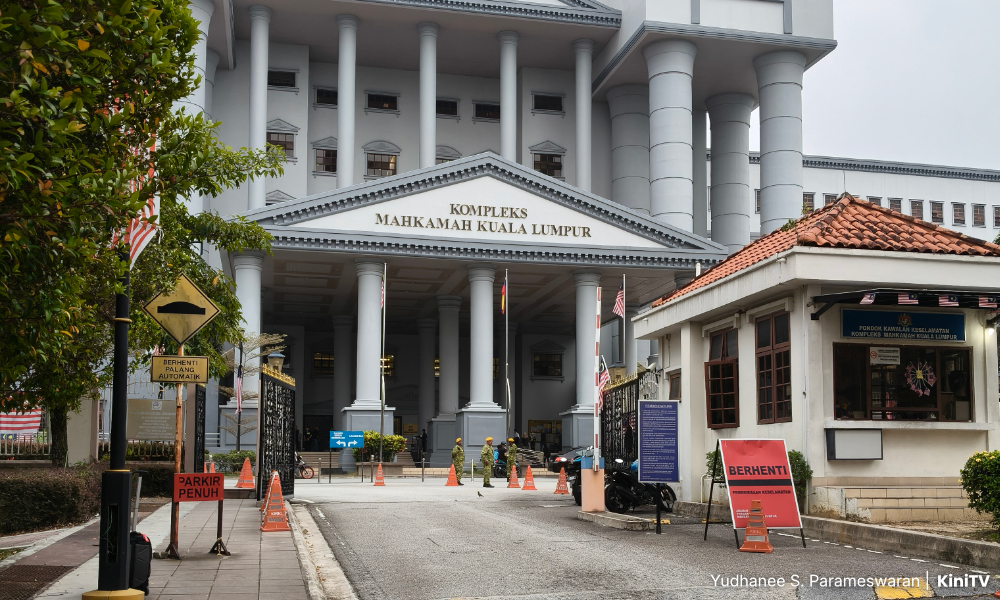
The real challenge lies in striking a balance: protecting the sanctity of the courts while preserving the public’s right to scrutinise those who wield power.
Sub judice cannot be invoked selectively - weaponised by the powerful to silence criticism, yet ignored when they themselves conduct press conferences or issue videos proclaiming innocence.
If the rule is to have meaning, it must apply evenly, and breaches must be addressed with consistency.
Ultimately, justice must be seen to be done, not bargained down to dental check-ups or drowned out by media campaigns.
The punishment must fit the crime, and the verdict must rest with judges - not with headlines, press conferences, or viral videos.
Only then can the courts command respect, and only then can the fight against corruption carry real weight. - Mkini
R NADESWARAN is a veteran journalist who strives to uphold the ethos of civil rights leader John Lewis: “When you see something that is not right, not fair, not just, you have to speak up. You have to say something; you have to do something.” Comments: citizen.nades22@gmail.com.
The views expressed here are those of the author/contributor and do not necessarily represent the views of MMKtT.

No comments:
Post a Comment
Note: Only a member of this blog may post a comment.