


I am all for the evolution of language. For example, I use Manglish as much as possible, as it is a unique way that spoken English has developed and progressed in Malaysia.
If there is American English and Australian English in those respective countries, then we should have Manglish.
English is no longer owned by the queen of England - or the king, now - and so many nations have made it their own. Colloquialisation means that local identity has crept into the language and what was initially a sign of colonisation has been taken back. The colonial language is now out of the colonisers' power.
This is important because we are tailoring something that originally wasn’t ours to become ours. It is reclaiming our own identity. That said, I’m not much of a fan of the corruption of our identity by outside elements, and that includes language as well. This is different from taking a colonial language and making it our own.
We can do without the infiltration of foreign words into our local language. Bahasa Melayu is perfectly fine as it is, but in recent years, words from foreign cultures have made their way in.
There are Bahasa Melayu words that I've been using for decades, from growing up to adulthood, which were commonly understood by all. But now those words seem to no longer be good enough. For example, "sembahyang" was something that I frequently used. It means "to pray".
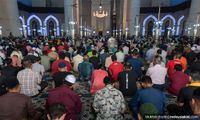
On Fridays, my father and I would go to the mosque to "sembahyang" as a congregation. Today, however, that word has been replaced with "solat". It means the same thing, but the word isn’t a Bahasa Melayu word. It is Arabic.
I cannot remember when this became the replacement, but I do hear a lot of people saying it now, and "sembahyang" is rarely used anymore.
Another word that I used a lot growing up is "air sembahyang", which means ablution in English. When we were at the mosque, my father would remind me to take "air sembahyang" before going inside to "sembahyang". Today, that word has been replaced with "wuduk".
The other day, my daughter had to go to school to receive three student excellence awards. She said she needed to be in school by 7:45am and had to gather at the "musollah" to meet one of her teachers.
I was a bit confused because I was wondering why her teacher wanted them to meet in the second-largest city in Iraq. It didn’t make sense since her school is in Shah Alam. It would take the students a long time to get there, and they definitely wouldn’t make it there by 7:45am that morning.
Then she said that the "musollah" is where they pray in school and not referring to Mosul as I thought. So, it's another Arabic word that has replaced surau, the Malay name for it that I've been using for most of my life.
Praying for Bahasa Melayu
Funnily enough, I have observed that these foreign words are mostly Arabic, and that all these words refer to religious rituals or places. I understand that for most Malays, Islam is the religion. But does it really mean that we need to corrupt Bahasa Melayu with foreign words?
Is Bahasa Melayu inadequate for religious purposes? Must we all now speak Arabic rather than our own mother tongue? This is pretty surprising since there are many strong movements by Malay groups to preserve and protect the Malay culture and heritage. Why do they not make noise over this?

As a Malay, I am proud of Bahasa Melayu, my mother tongue. It is a language that has a deep history. In fact, it was the lingua franca of the entire Southeast Asian region many centuries ago. I also believe that this beautiful language can be used for all purposes.
The word "sembahyang" is just as Islamic as "solat", "air sembahyang" has just the same meaning as "wuduk", and a surau is just as sacred a place to pray as a "musollah". Except for perhaps some who feel these words in their mother tongue are just not good enough.
I dread the day that the language becomes unrecognisable and an unadulterated Bahasa Melayu will cease to exist. So please, to all those who have taken it upon themselves to always fight for the preservation and protection of our culture, do something.
The integrity of our language depends on your passion and dedication. - Mkini
ZAN AZLEE is a writer, documentary filmmaker, journalist and academic. Visit fatbidin.com to view his work.
The views expressed here are those of the author/contributor and do not necessarily represent the views of MMKtT

No comments:
Post a Comment
Note: Only a member of this blog may post a comment.