


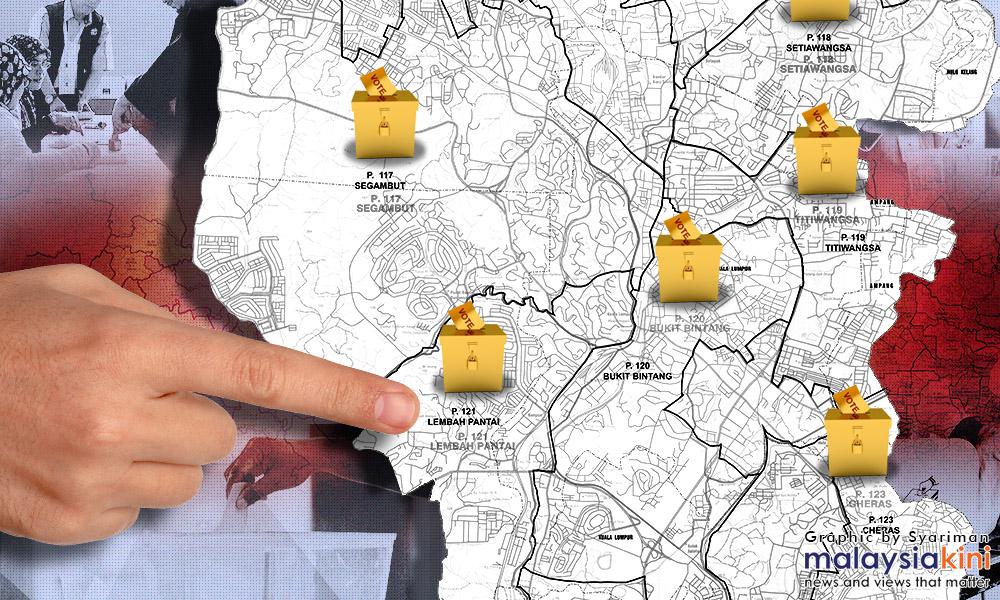
Representatives from Gerakan and MCA were among those made their objections heard today at the Election Commission’s (EC) local inquiry of its Petaling Jaya Utara redelineation exercise.
Gerakan deputy speaker Syed Abdul Razak Alsagoff, who is his party's prospective candidate for the Bukit Lanjan state constituency which is affected, said he is objecting to the EC’s redelineation proposal because it amounted to gerrymandering and malapportionment.
“I consider this gerrymandering of the highest order. In closing, although this is not a valid argument, I am and Muslim and many in the EC are also Muslims.
“If this thing is pushed through and if I have spent my own money (on election campaigning) and lost (the election), I will demand retribution in the afterlife from each person who believes in Judgement Day.
“This is totally unfair and is against the spirit of the proper way of carving out constituencies. You have the right (to redraw constituency boundaries) every few years, but this is definitely not the right way (because) you carve out to benefit certain parties,” he told reporters in Shah Alam after recording his objections with the EC at the hearing today.
Syed Abdul Razak pointed out the new electoral boundaries for Bukit Lanjan would increase the number of Chinese voters from about 57 percent to 62 percent while lowering the proportion of Malay voters from 28 percent to 26 percent.
The seat would also have significantly more voters than its neighbouring constituencies, he said.
Bukit Lanjan is currently a state constituency that is a part of the Subang parliamentary constituency.
The EC’s redelineation proposal is for the Petaling Jaya Utara parliamentary constituency to be renamed Damansara and comprise parts of the Taman Templer, Kampung Tunku, Damansara Utama, Bukit Lanjan and Paya Jaras state constituencies.
The new Damansara constituency would comprise two state constituencies with new boundaries, namely Kampung Tunku and Bandar Utama (formerly named Damansara Utama).
Based on the Sept 2016 electoral roll, there are 84,456 voters in Petaling Jaya Utara.
After redelineation, Damansara would have 150,439 voters within its proposed boundaries based on the same electoral roll.
Syed Abdul Razak said Damansara would be one of the largest parliamentary constituencies in Malaysia and questioned whether voters could be served adequately by just one parliamentarian.
He said Kampung Sungai Kayu Ara in Bukit Lanjan was a traditional village rife with social problems such as drug addiction. He doubted whether a single member of Parliament would be able to service the entire area if the constituency is lumped together with Petaling Jaya Utara.
Meanwhile, Petaling Jaya Utara MCA deputy chief Ch’ng Soo Chau urged the EC to maintain Petaling Jaya Utara’s current parliamentary boundaries.
He said Petaling Jaya Utara MCA supports former EC chairperson Abdul Rashid Abdul Rahman’s 2013 statement that parliamentary constituencies should have fewer than 100,000 voters in order to remain manageable.
He also noted that in terms of area, the Bukit Lanjan state constituency was much larger than the Petaling Jaya Utara parliamentary constituency.
“It (Damansara) is too big, and it is a bit difficult for any MP to manage this urban area. As I’ve said, the total area of Bukit Lanjan is bigger than the existing Petaling Jaya Utara parliamentary seat.
“It is very large; it extends from Sri Damansara all the way to Sungai Buloh, which I think is very big. For that reason, we made a protest and we hope that it will go back to the status quo,” he told reporters before attending the EC hearing.
Several voters who each attended separate hearings today also complained about Damansara’s disproportionally large number of voters. Among these concerned voters were auditor Lim Fang Hau, lawyer Yvete Mah and Petaling Jaya Utara resident Chua Piak Chwee.
They argued that the large number of voters would make it difficult for the elected representatives to service the constituents.
They also said that the disproportionately large number of voters would dilute their rights as voters to elect their representatives noting that the Federal Constitution’s 13th Schedule requires the number of voters in each constituency to be 'approximately equal'.
Under the proposed boundaries, Damansara would have about four times the number of voters compared to Sabak Bernam, which has the lowest number of voters in Selangor.
Mah noted that the new boundaries would also mean that the incoming Damansara MP would need to deal with three different local councils and this would result in voters being underserved.
She also complained that the EC was not providing adequate information for voters to make an informed decision about the redelineation proposal.
“The information given was very vague, so I’m only able to object through Tindak Malaysia because they helped us to break it down as to how to object and so on,” she said.- Mkini

No comments:
Post a Comment
Note: Only a member of this blog may post a comment.