


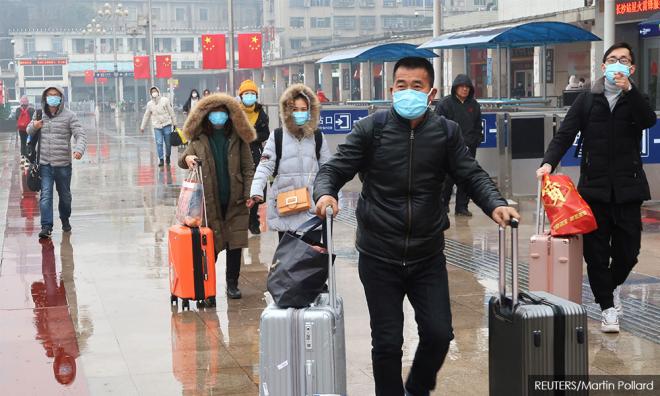
CORONAVIRUS | The announcement by the Health Ministry (MOH) this morning that three China visitors in Johor have tested positive for the new coronavirus confirmed expectations that the dreaded new strain had reached Malaysia’s shores joining 11 other countries affected by the infectious disease.
The outbreak comes as hundreds of millions around the globe, especially in China, were set to travel in anticipation of the Chinese New Year, or Lunar New Year, celebrations.
Here's what we know so far (The number of cases detected, deaths and countries affected are accurate as of the time of writing):
What is the new coronavirus and where it started
According to the World Health Organisation (WHO), it detected a new strain of coronavirus after the organisation was alerted to several cases of pneumonia in Wuhan city, which is the capital of the Hubei province in China.
The virus did not match any other known viruses, and this raised concern as it was not known how it affected humans.
WHO said on its website that the Chinese authorities confirmed on Jan 7 they had identified a new coronavirus which could be transmitted from human to human.
"The new virus is a coronavirus, which is a family of viruses that include the common cold, and viruses such as Sars and Mers," it said. This new virus was temporarily named "2019-nCoV".
How coronavirus affects humans
According to WHO, coronaviruses are a large family of viruses that cause illness ranging from the common cold to more severe diseases such as the Middle East Respiratory Syndrome (MERS-CoV) and the Severe Acute Respiratory Syndrome (SARS-CoV).
"Common signs of infection include respiratory symptoms, fever, cough, shortness of breath and breathing difficulties.
"In more severe cases, the infection can cause pneumonia, severe acute respiratory syndrome, kidney failure and even death," said the health organisation.
Number of confirmed cases
To date, close to 1,300 people have been infected globally, the majority of whom are Chinese nationals.
Death toll
As of 4pm today, the death toll stands at 41, all patients in China.
The latest among them is Liang Wudong, a surgeon who had been treating coronavirus patients in Wuhan.
Countries with confirmed cases
According to latest news reports by Reuters, apart from China where the virus was first detected, 11 other countries have reported confirmed cases.
They are Thailand, Vietnam, Singapore, Japan, S Korea, Taiwan, Nepal, France, the US, Australia and Malaysia.
Is there any cure or vaccine to tackle the new coronavirus?
According to Health Minister Dzulkefly Ahmad, there is no medicine or vaccine available yet for the new virus.
He said the only treatment that can be applied to patients tested positive for the virus was to observe and treat their symptoms like cough, flu and fever.
However, works to engineer a vaccine are on the way by numerous health agencies around the globe.
According to the Wall Street Journal, several drugmakers in the US and researchers at the University of Queensland in Australia are among those racing to develop a vaccine for the respiratory virus.
CNN also reported that the National Institutes of Health, the primary agency of the US government responsible for biomedical and public health research, is also working on a vaccine.
A team of scientists in Texas, New York and China are also at work on a vaccine, CNN said, quoting Dr Peter Hotez, a vaccine scientist at Baylor College of Medicine in Houston.
How many cases in Malaysia?
As of Saturday noon, the Health Ministry confirmed that there are only three positive cases involving three tourists from Wuhan, China. They are a grandmother aged 66 and her two grandchildren aged 2 and 11. All of them are related to two men who had been tested positive for the virus in Singapore on Jan 22.
Dzulkefly said the three patients had crossed into Johor from Singapore on Jan 23 together with five others and Malaysian health authorities had taken them for isolation and screening after being alerted by their counterparts in Singapore.
Results from the tests came back positive last night for the three and they have since been put in an isolation ward at the Sungai Buloh Hospital for observation. They are reported to be in stable condition.
Five others have so far tested negative including the children's mother. Four of them had left Malaysia for China on Saturday morning, while the mother is at the Sungai Buloh Hospital taking care of her children under strict supervision by health personnel.
What steps are being taken by Malaysia?
The Health Ministry has activated its Rapid Response Team (RRT) and Rapid Assessment Team (RAT) on the ground to carry out contact tracing activities.
Health services personnel have also been ordered that patient screening at all health facilities must be done thoroughly to ensure that cases that fit the criteria are referred for further investigations.
Dzulkefly told the press that they are also mulling the possibility of restricting visitors from China, and will suggest the move to the Home Ministry.
Budget airlines Malindo Air and AirAsia have suspended all flights to and from Wuhan following the outbreak.
Malaysia Airports Berhad, meanwhile, announced today that stringent screening will be conducted on all incoming international flight passengers and crews at gateway airports across the country.
In a statement, it said this included thermal screening for arriving passengers and flight crews from China.
Malaysian diplomatic missions in China, including the embassy in Beijing, are setting up emergency response teams to assist Malaysians in areas affected by the new coronavirus outbreak.
What you can do to minimise risks of contracting '2019-nCoV'
The Health Minister is urging all Malaysians to avoid unessential travel to China for the time being.
Should they still have to visit the country, one is advised to take personal hygiene care seriously like washing hands using soap, hand sanitiser and face masks.
They are also advised to avoid going to crowded places, livestock farms, markets that sell live animals, slaughtering facilities and to refrain from touching animals.
Eating raw meat should also be avoided.
Those who show symptoms of the new coronavirus must inform their physicians on their travel history.
WHO has also come up with recommendations for the public to reduce exposure to and avoid transmission of a range of illnesses. They are as follows:
- Frequently clean hands by using alcohol-based hand rub or soap and water;
- When coughing and sneezing, cover your mouth and nose with a flexed elbow or tissue – throw the tissue away immediately and wash your hands;
- Avoid close contact with anyone who has a fever and cough;
- If you have fever, cough and difficulty breathing, seek medical care early and share previous travel history with your healthcare provider;
- When visiting live markets in areas currently experiencing cases of novel coronavirus, avoid direct unprotected contact with live animals and surfaces in contact with animals;
- The consumption of raw or undercooked animal products should be avoided. Raw meat, milk or animal organs should be handled with care to avoid cross-contamination with uncooked foods, as per good food. - Mkini

No comments:
Post a Comment
Note: Only a member of this blog may post a comment.