


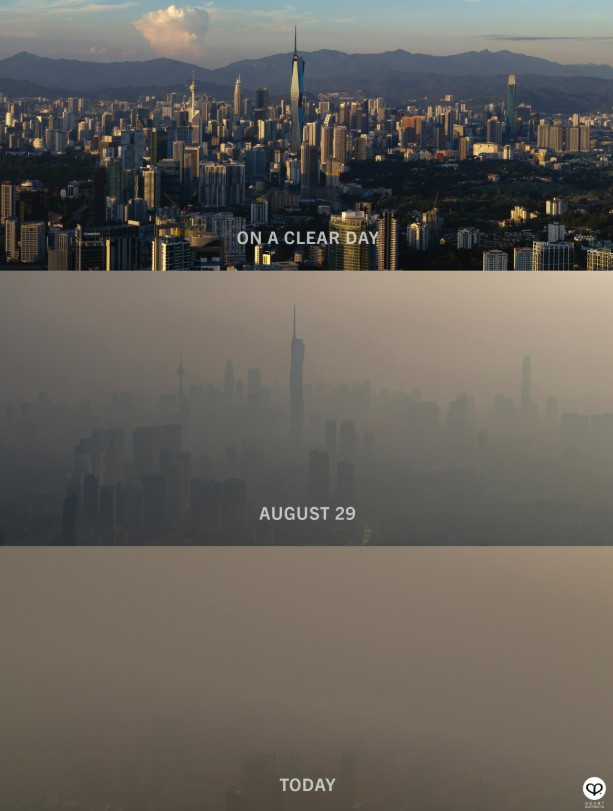
THE dreaded haze has been descending on Malaysia almost regularly and the whole world knows this toxic smoke comes from Indonesia.
Yet our giant neighbour appears unable to douse the land and forest fires that are still raging uncontrollably mostly in southern Sumatra and Kalimantan.
Although nearly 60,000 Indonesian ground personnel backed by water-bombing helicopters and patrol aircraft have been reportedly mobilised to battle this “enemy”, Jakarta is not making much headway.
How do we know that the fire-fight is far from over? Simple: just step outside your house and you will immediately be hit by the ever-present acrid smoke.
Or take a drive and you will see the thick haze blanketing buildings and even the sky. From sunrise to sunset, you are enveloped in the toxic smoke. All is so grey and depressing.
Even the sun is one big, angry reddish-yellowish globe as it rises and sets behind the heavy veil of the haze.
Prolonged exposure to hazardous ashes is bad for health, especially for children who reportedly can come down with lung cancer and cardiovascular disease, among other serious health problems.
Although Indonesia has accepted rather belatedly the offer by Malaysia to help put out the fire, the measure is more a knee-jerk reaction than a concrete action to solve a recurrent problem.
The aid was offered when Deputy Prime Minister Ahmad Zahid Hamidi met Indonesian President Prabowo Subianto in Jakarta on Sept 18.
Lack of political will
Subsequently, Natural Resources and Environmental Sustainability Minister Arthur Joseph Kurup told lawmakers at the current sitting of Parliament that both countries are coordinating their efforts to combat the fire using aerial water bombing, amphibious aircraft support and cloud seeding operations, among others.
However, the combined operation might not be effective enough to extinguish the fire.
The question that arises is why didn’t Indonesia act promptly when the first puff of smoke was sighted?
Jakarta already knows that at this time of the year the blaze would start in a forest somewhere in the vast archipelago, especially during the dry season.
In fact, it had already acquired knowledge and experience from decades of feeling the heat and would have been well-equipped to face the pesky enemy.
Almost every year, Malaysia has been shrouded in haze caused mainly by open burning or the slashing and burning of agricultural land in Indonesia.
Recall that in 1991 the haze lasted for more than a month as a result of serious forest fires in Kalimantan and southern Sumatra.
And in 1997 the choking smoke – regarded as one of the worst on record – stayed for three months (from September to November) to the extent that a haze emergency was declared in Sarawak. It also coincided with the onset of the El Nino weather.
The years rolled on – 2005, 2006, 2010, 2011, 2012, 2013, 2014, 2015 – all marked by the haze imprint.
It was only last year that the transboundary haze caused by forest and peatland fires in Sumatra and Kalimantan had resulted in poor visibility and unhealthy air quality in peninsular Malaysia.
Now, this seasonal “visitor” has returned and would probably be worse than the one recorded in 1997. It came to our shore in August and it is still with us.
Is there a lack of political will on the part of Indonesia to tackle this seasonal disturbance? Is Malaysia afraid to reprimand this “big brother” for not doing enough to end this “stubborn crisis”?
Why no settlement at ASEAN level?
Or is the Indonesian government not taking the matter seriously? Even the Indonesians themselves have reportedly filed a suit against Prabowo for “failing to handle the forest and land fires effectively”.
In 2019, Indonesia didn’t take too kindly to reports that the haze originated in the republic. Its Forest Ministry claimed that satellite images showed the forest fires started in Malaysia.
It accused Malaysia of “not being transparent about its own forest fires”.
The heated row didn’t erupt into a full-blown diplomatic crisis but it goes to show that there is a lack of a strong mechanism to contain the wildfires and avert the blame game.
There must be a way to resolve this burning issue. Perhaps, ASEAN can convene an emergency meeting to discuss only one item: how best to tame these wild forest fires.
Although the ASEAN summit held in Malaysia in 2025 had addressed environmental concerns, including cross-border haze pollution, all those expressions of concerns didn’t translate into tangible action.
Most of the time, leaders will mouth about strengthening economic co-operation but all these high-sounding words are an exercise in futility when the economic lung of the nation is choking on haze.
When the health of the nation is imperilled, our economy will suffer dire consequences.
Perhaps, Malaysia must go on a “war footing” to deal with this “ecological terrorist” that has taken a heavy toll on our health. As soon as the dust and ashes begin to cloud our skies, Malaysia must compel Indonesia to jointly launch an aerial attack by dropping water bombs on the targeted hotspots.
They can operate under the aegis of the Asean Agreement on Transboundary Haze Pollution which came into force in 2002 in the wake of the severe 1997-1998 fires.
This moribund pact can be reactivated and this time the member nations, especially Malaysia, Indonesia and Singapore must go all-out to combat this seasonal enemy once and for all.
And Jakarta can go one step further by “capturing” all the culprits – be they Indonesians or Malaysians – responsible for causing this fiery havoc and meting out severe punishment. – Oct 8, 2026
Phlip Rodrigues is a retired journalist.
The views expressed are solely of the author and do not necessarily reflect those of MMKtT
- Focus Malaysia.

No comments:
Post a Comment
Note: Only a member of this blog may post a comment.