


Prime Minister Ismail Sabri Yaakob, in unveiling his new cabinet today, tried not to rock the boat by largely maintaining the balance of power.
Many factors were at play - suitability, balancing of coalitions, party politics and factionalism.
Ismail Sabri also had to address the long-standing complaint that Umno was getting fewer government positions despite having the most MPs in government.
Even though the previous Muhyiddin Yassin government was criticised for being bloated with a total of 70 ministers (including the prime minister) and deputy ministers compared to the 55 in the Pakatan Harapan government, Ismail Sabri chose not to rock the boat.
The prime minister maintained the exact same number of ministers and deputy ministers as in Muhyiddin's cabinet and mostly kept the same people.
Excluding Ismail Sabri, there were only five new ministers while 16 were retained in the same portfolio and another 10 were reshuffled.
As for deputy ministers, there were only four new faces, 23 were retained in the same portfolio while another 11 were reshuffled.
The following are the major takeaways from Ismail Sabri's new cabinet:
Umno expands
During the previous cabinet under Muhyiddin, who is also the Bersatu president, Bersatu controlled the most number of ministers and deputy minister positions.
With Umno's Ismail Sabri now at the helm, he sought to make Umno more dominant, at least in terms of the number of ministers.
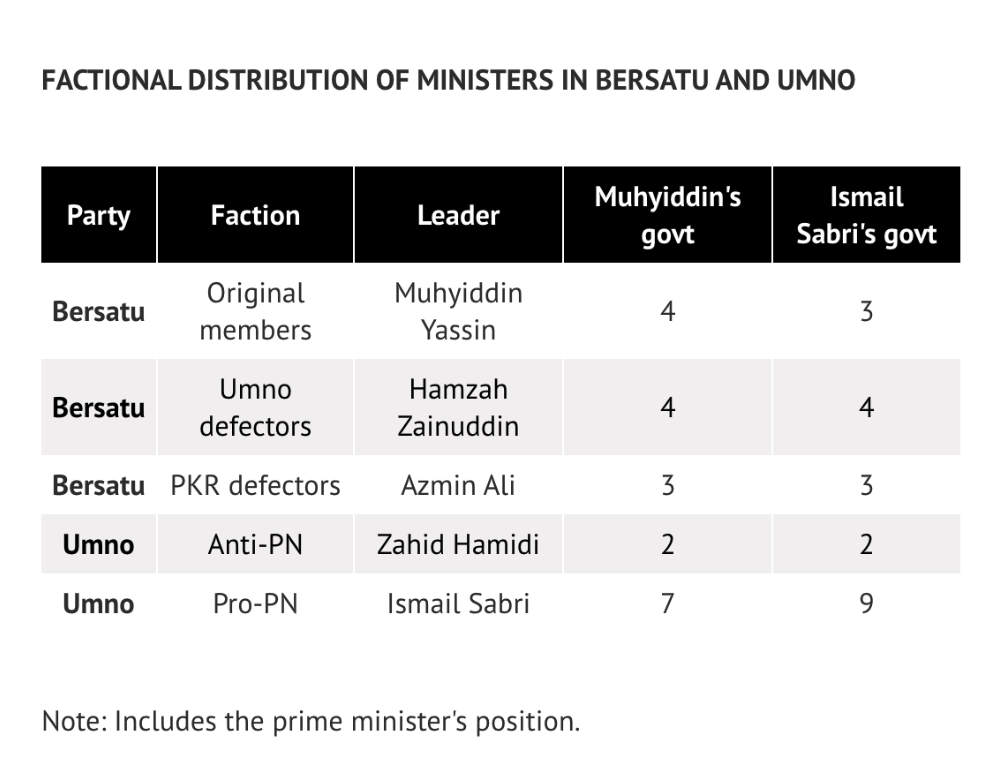
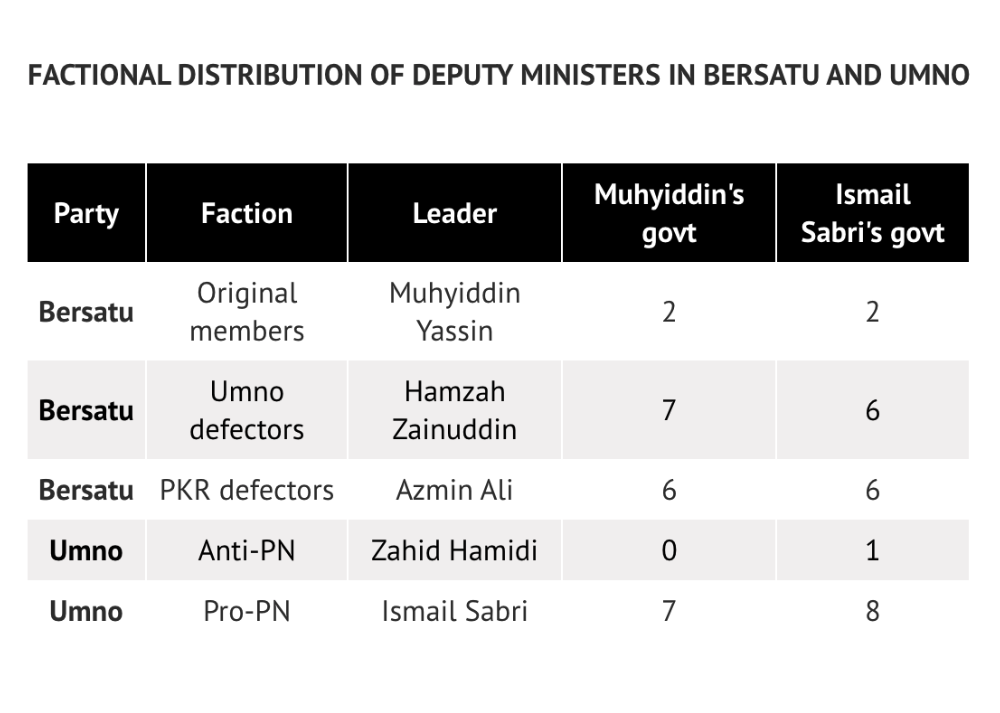
The party composition of Ismail Sabri and Muhyiddin's cabinet is as follows:
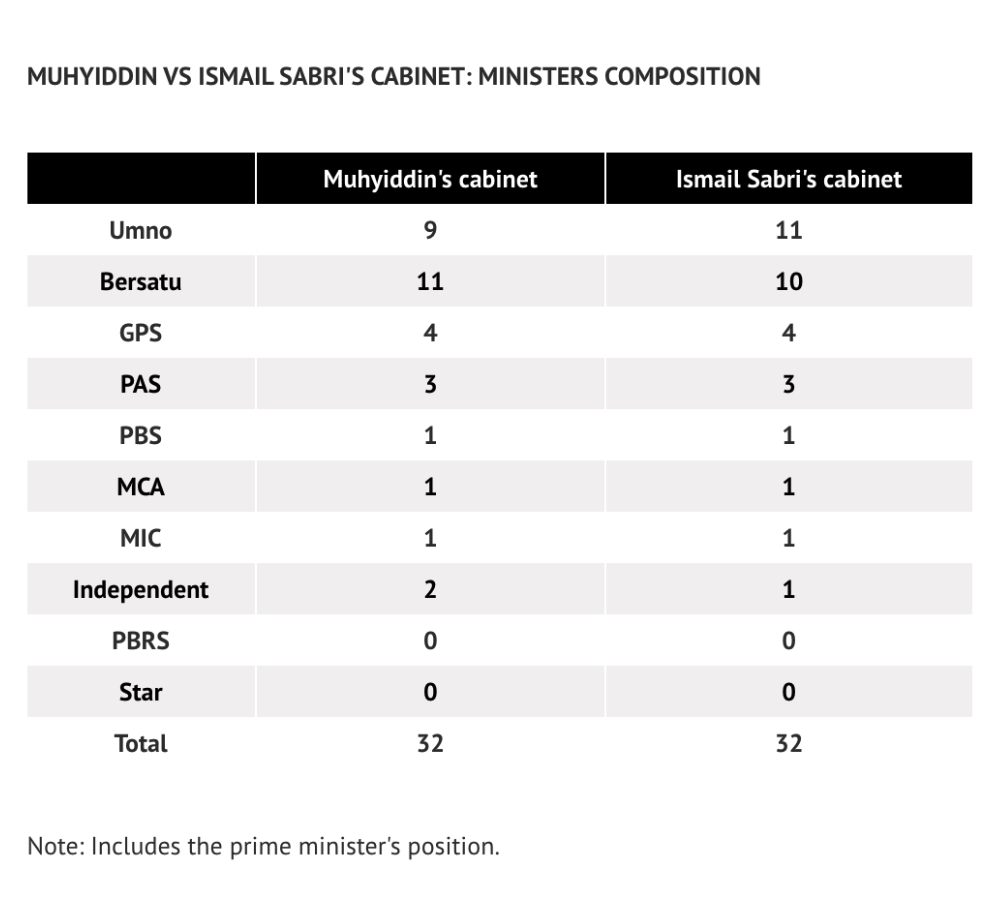
Ismail Sabri's cabinet now has more Umno ministers than Bersatu. While trying to achieve this, the Bera MP was mindful not to "take too much" from Bersatu.
This was done by dropping Zulkifli Mohamad Al-Bakri, who is not aligned to any party, in the new cabinet.
It freed up one slot for Umno. Umno also took one slot from Bersatu for a total of two additional ministerial positions.
However, Bersatu still retains the most number of deputy ministers, albeit at a reduced level.
Similar to the formula for ministers, Umno took only one deputy minister position from Bersatu but it also took another from Star.
This leaves the Sabah-based Star, a Perikatan Nasional (PN) partner of Bersatu, with no representation in the cabinet.
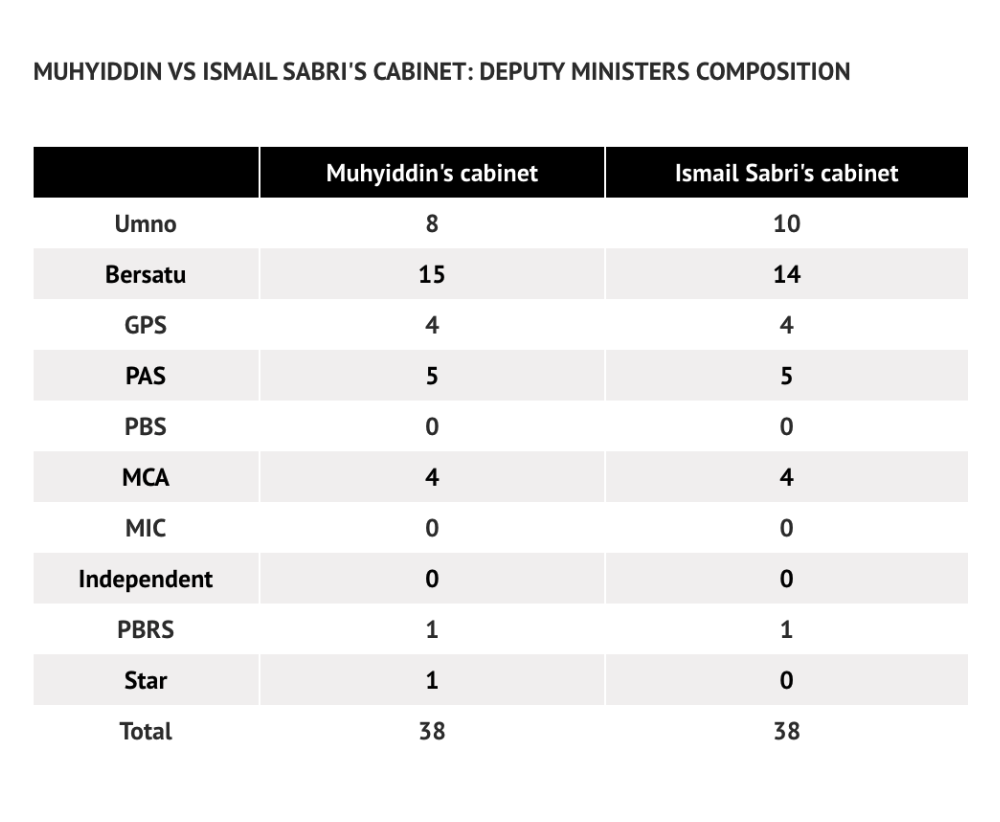
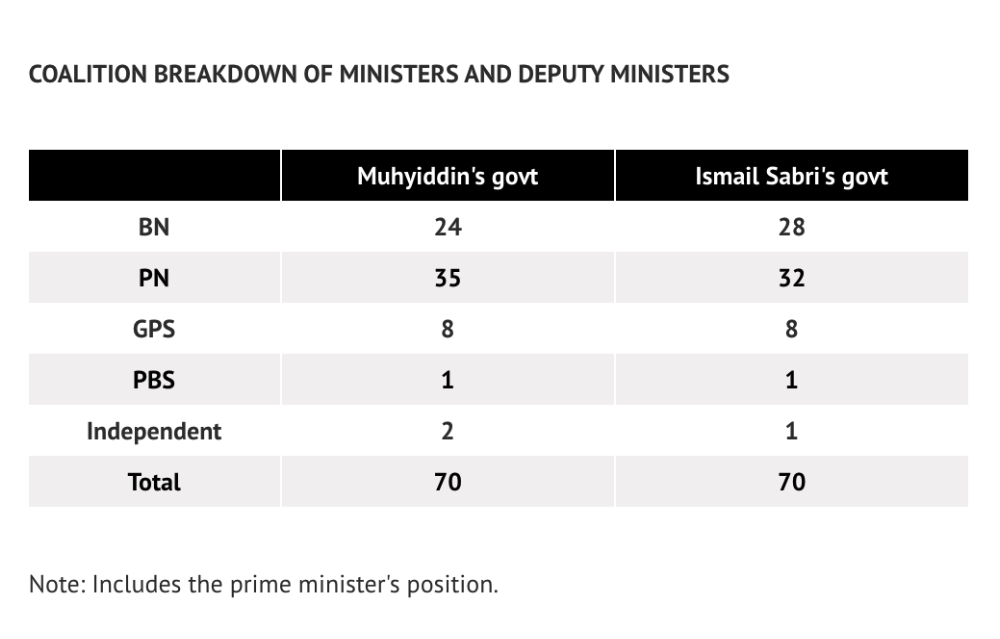
At the coalition level, PN still has the most ministers and deputy ministers.
Ismail Sabri's government comprises several coalitions and parties, namely PN, BN, GPS, PBS and independent MPs.
For the record, PN comprises Bersatu, PAS and Star. Gerakan and SAPP are also part of PN but do not have any parliamentary seats.
BN comprises Umno, MCA, MIC and PBRS while GPS comprises PBB, PRS, PDP and SUPP.
Zahid gains very little
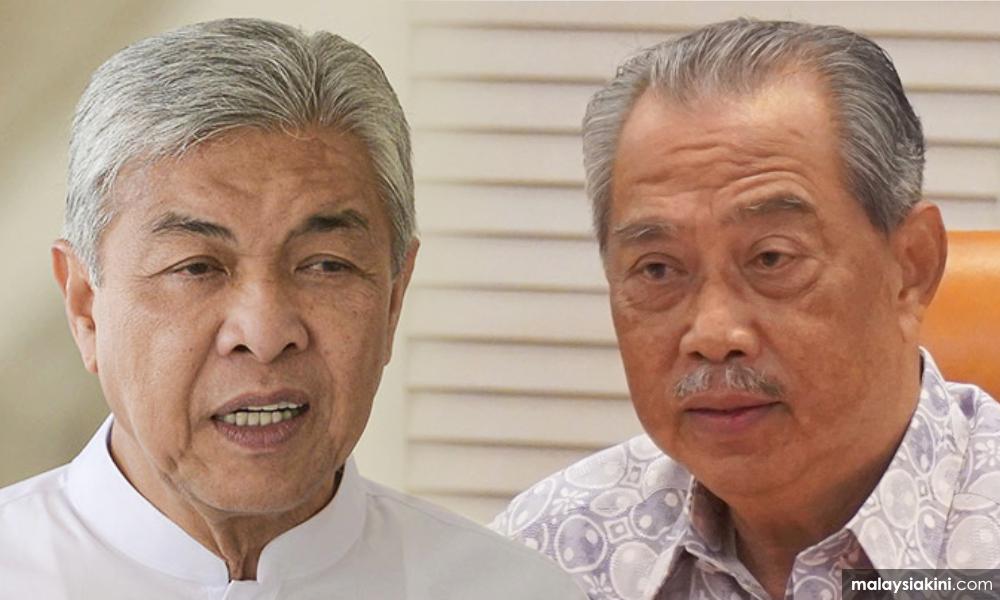
Ismail Sabri's rise was made possible only after Umno president Ahmad Zahid Hamidi led a group of 15 Umno MPs, including himself, to oust Muhyiddin.
Despite the political manoeuvring, the "Umno 15" gained very little from Ismail Sabri's ascendance.
In terms of ministers, those aligned to Ismail Sabri increased to nine (including himself) while those aligned with Zahid remained at two.
Lenggong MP Shamsul Anuar Nasarah, who is part of the Umno 15 and had resigned as a minister to force Muhyiddin's exit, was not reappointed to the cabinet.
However, Shamsul's slot was taken by a new face - Tanjung Karang MP Noh Omar - who is also part of the Umno 15.
The only other minister from the Umno 15 group in the cabinet is Parit Sulong MP Noraini Ahmad.
Noraini was retained in Ismail Sabri's cabinet despite resigning from Muhyiddin's government while Mohamad Alamin is a newcomer for one of the deputy minister positions in the Education Ministry.
Muhyiddin had sidelined Zahid's faction when he led the government and Ismail Sabri had chosen not to rock the boat.
Another development worth noting was the exclusion of Pengerang MP Azalina Othman Said, who was also part of the Umno 15 group.
Azalina had resigned as the Dewan Rakyat deputy speaker, a move seen as an attempt to improve her chance of being appointed into the government, although she cited reforms as the reason for her resignation.
She had positioned herself as a suitable candidate to liaise with the opposition on proposed bipartisan reforms, but Ismail Sabri chose not to rope her in.
Ismail Sabri also did not take into account Umno Youth's call for Umno deputy president Mohamad Hasan, a party rival, to be appointed as the finance minister.
Tengku Zafrul Abdul Aziz, who is not aligned to any political party, was retained as the finance minister.
Azmin keeps full team but loses key portfolios
The reduction of Bersatu positions mostly came at the expense of Muhyiddin's faction (the original Bersatu members) and Hamzah Zainudin's faction (the group that defected from Umno to Bersatu after the last general election).
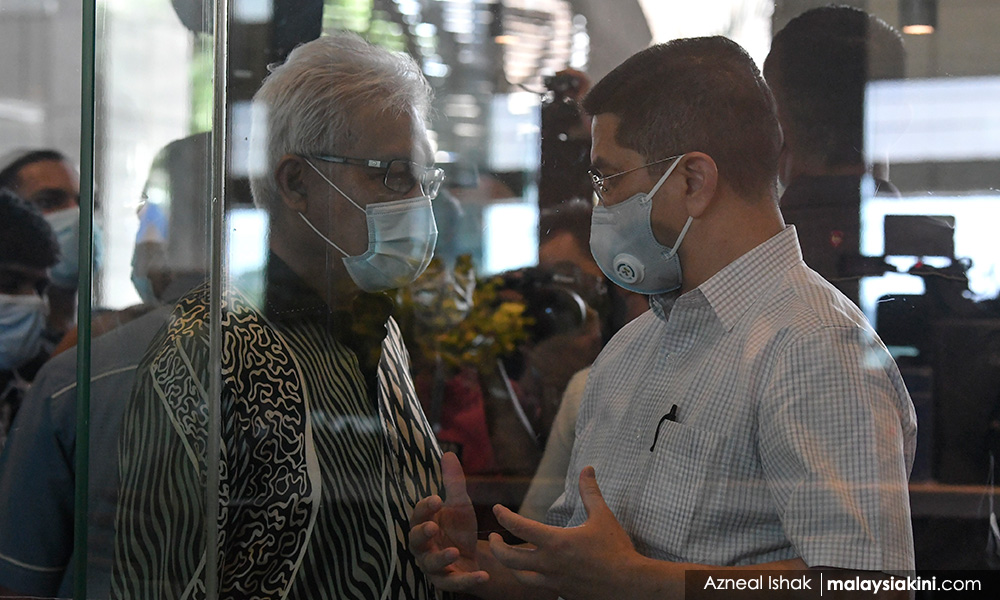
In contrast, Azmin Ali's Bersatu faction, comprising PKR defectors, was untouched.
Azmin's group retained all three ministers and six deputy ministers positions, albeit with some reshuffling.
Despite retaining his entire team in the government, the portfolio swaps could weaken his faction.
Notably, Zuraida Kamaruddin was moved from the Housing and Local Government Ministry to the Plantation Industries and Commodities Ministry.
The Housing and Local Government Ministry has deep connections to the local councils and Zuraida had leveraged that to shore up her grassroots support.
She put in place federally appointed "shadow" local councillors in Selangor that ran in parallel to the ones appointed by the state government.
Zuraida may find the apparatus to shore up her grassroots lacking in her new portfolio.
Likewise, Saifuddin Abdullah was moved from the Communications and Multimedia Ministry to Foreign Ministry, a portfolio he held during the Pakatan Harapan administration.
While the Foreign Ministry is seen to be a more prestigious portfolio, the Communications and Multimedia Ministry has been viewed as more useful for propaganda purposes to influence local politics.
Umno gains key portfolios
Both the Housing and Local Government Ministry and the Communications and Multimedia Ministry were taken from Azmin's faction and handed over to Umno.
Another key ministry that Umno took over from Bersatu is the Rural and Regional Development Ministry.
Padang Terap MP Mahdzir Khalid, who was not part of the previous cabinet, was roped in to lead the ministry. Mahdzir is an Ismail Sabri supporter.
The Rural and Regional Development Ministry has always been a key ministry with vast resources to ditch out projects in Umno's heartland.
Ismail Sabri himself had previously led the ministry, from 2015 to 2018.
All these ministries are crucial for building party grassroots, particularly for the general election.
Who's out: Some controversial figures
Here's a quick overview of the leaders dropped from the new cabinet.
Ministers
Muhyiddin Yassin (Bersatu - Original)
Redzuan Md Yusof (Bersatu - Original)
Zulkifli Mohamad Al-Bakri (Independent)
Shamsul Anuar Nasarah (Umno - Team Zahid)
Khairuddin Aman Razali (PAS)
Deputy ministers
Shahbudin Yahaya (Bersatu - Umno defector)
Abdul Rahim Bakri (Bersatu - Umno defector)
Che Abdullah Mat Nawi (PAS)
Guan Dee Koh Hoi (Star)
Some of the leaders, such as Zulkifli and Guan, were dropped simply to make room for an expanded Umno while others who were replaced had notably been controversial during Muhyiddin's administration.
For example, Khairuddin had been embroiled in a controversy over Covid-19 standard operating procedure violations, but more notable was his alleged friction with PAS president Abdul Hadi Awang.
Meanwhile, Redzuan had openly criticised his own government over its management of the Covid-19 pandemic.
Who's in: The new faces
The following are the new ministers and deputy ministers who were not part of Muhyiddin's cabinet:
Ministers
Idris Ahmad (PAS)
Shahidan Kassim (Umno - Team Ismail Sabri)
Noh Omar (Umno - Team Zahid)
Mahdzir Khalid (Umno - Team Ismail Sabri)
Ahmad Faizal Azumu (Bersatu - Original)
Deputy ministers
Yamani Hafez Musa (Bersatu - Umno defector)
Mohamad Alamin (Umno - Team Zahid)
Jalaluddin Alias (Umno - Team Ismail Sabri)
Muhammad Zawawi Salleh (PAS)
Notably, Shahidan has been a fierce critic against Zahid for trying to bring down Muhyiddin's government.
Mahdzir is also a close ally of Ismail Sabri, although he has been less vocal publicly.
Mohamad is the sole deputy minister from Zahid's faction.
Meanwhile, with Muhyiddin's departure, Faizal is now the most senior ranking Bersatu member in the government.
Despite his party seniority, he was given a relatively junior portfolio - the Youth and Sports Ministry.
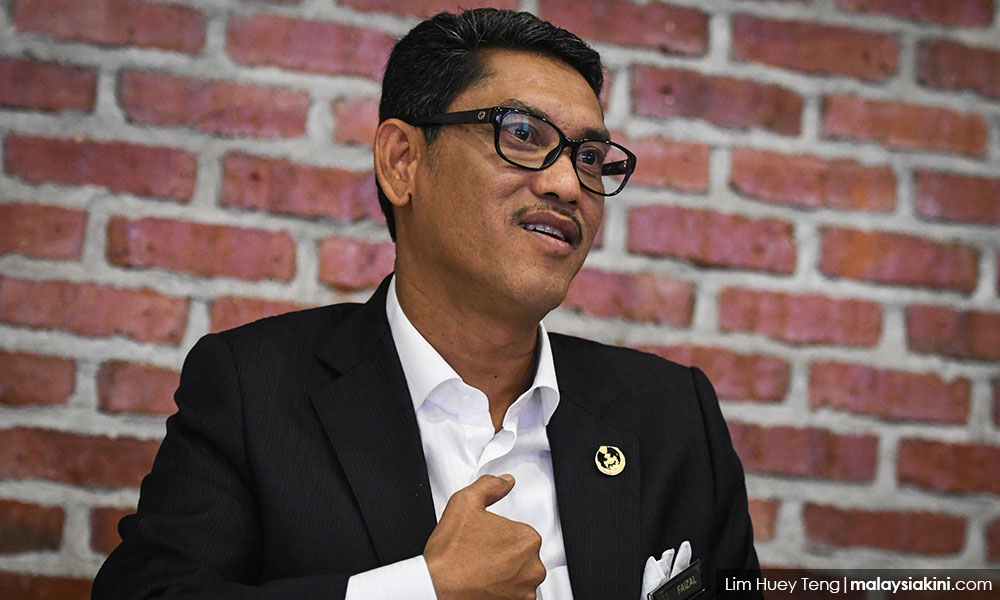
Faizal's influence is significantly weaker than Azmin's or Hamzah's.
He only became Bersatu deputy president after winning uncontested due to the sacking of his potential contender Marzuki Yahya, who is now in Parti Pejuang Tanah Air (Pejuang).
Deputy premiership
Ismail Sabri chose to retain the original model Muhyiddin initially used for his cabinet, where there is no deputy prime minister. In its place are four senior ministers.
The four senior ministers in Ismail Sabri's cabinet are similar to Muhyiddin's, namely Azmin (Bersatu), Radzi (Bersatu), Fadilah (GPS) and Hishammuddin (Umno).
Muhyiddin ditched the position of deputy prime minister when forming the government to avoid appearances of favouring one party or action and Ismail Sabri likely adopted the same model for similar reasons.
It was initially agreed that Bersatu will take the deputy prime minister post, but it led to conflicts among competing Bersatu factions.
Azmin and Hamzah were among Bersatu's frontrunners if the position was made available.
Others
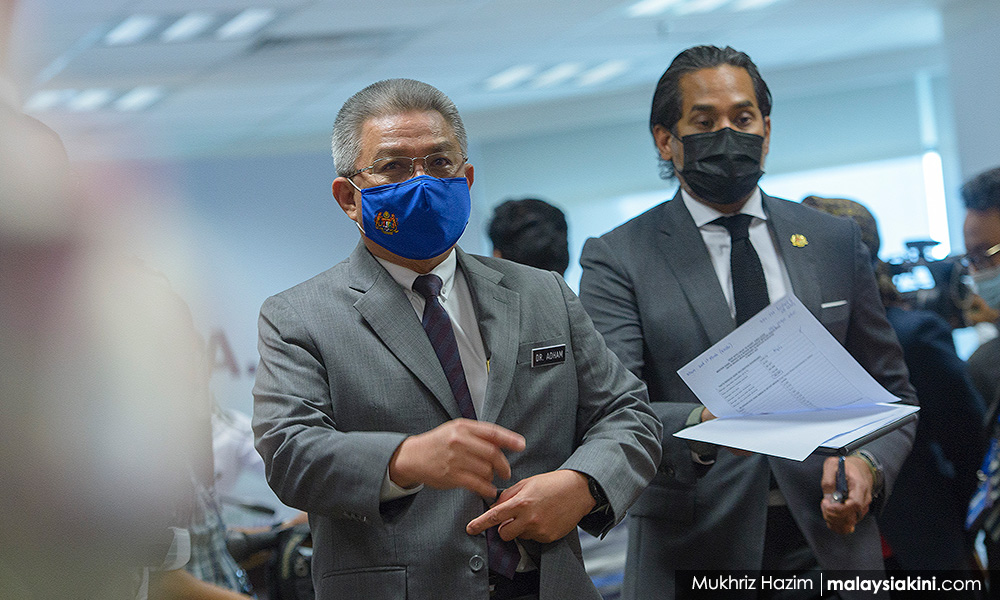
Another notable development was the swapping of ministries between Khairy and Adham.
With Malaysians occupied with the unending Covid-19 pandemic, many ministries had a limited role to play as society came to a grinding halt.
A key ministry during the pandemic has been the Health Ministry, which was previously led by Adham.
After a series of gaffes, Muhyiddin had sought to delegate some of the responsibilities to others without outrightly replacing Adham.
This saw then science, technology and innovation minister Khairy being assigned the portfolio as head of vaccination.
However, it led to complaints about coordination issues, such as the Malaysian Medical Association questioning why the vaccination programme was not under the Health Ministry.
Prior to the Covid-19 pandemic, all vaccination exercises were placed under the Health Ministry.
It could also be observed that during the press conferences, Khairy had to sometimes defer decisions to the Health Ministry because it was not his portfolio.
Under Ismail Sabri's cabinet, Khairy will now lead the Health Ministry while Adham will take over the Science, Technology and Innovation Ministry.
- Mkini

No comments:
Post a Comment
Note: Only a member of this blog may post a comment.