


Many government hospitals across the country are facing a critical shortage of medications, including those needed to treat serious Covid-19 cases, according to sources inside the healthcare system.
Among the medicines involved are those widely used in intubation procedures at intensive care units (ICUs).
It is learnt that the high number of coronavirus patients who needed to be put on life-support machines was the chief reason behind the shortage.
Sources said the medicines that are running out, among others, Precedex, Propofol, Morphine, Rocuronium and Atracurium - used for sedation and as muscle relaxants.
Clexane, an important anticoagulant drug used for Covid-19 treatment, and Fentanyl, a pain medication used with other medication for anaesthesia, are also depleted in at least one hospital, it is learnt.
Some hospitals are also said to be short of Pantoprazole, a medication which functions to lower stomach acid.
It is not directly related to Covid-19 treatment but is prescribed to patients who develop gastric or intestinal bleeding resulting from other medications used for treatment of coronavirus patients.
Shortage abnormal
Doctors in several hospitals in multiple states told Malaysiakini that while the medication supplies have not completely run out, they fear severe shortage if another surge occurs before new stock arrives.
The doctors, who spoke on condition of anonymity as they are not authorised to speak to the media, also said the shortage is abnormal for ICUs in public hospitals.
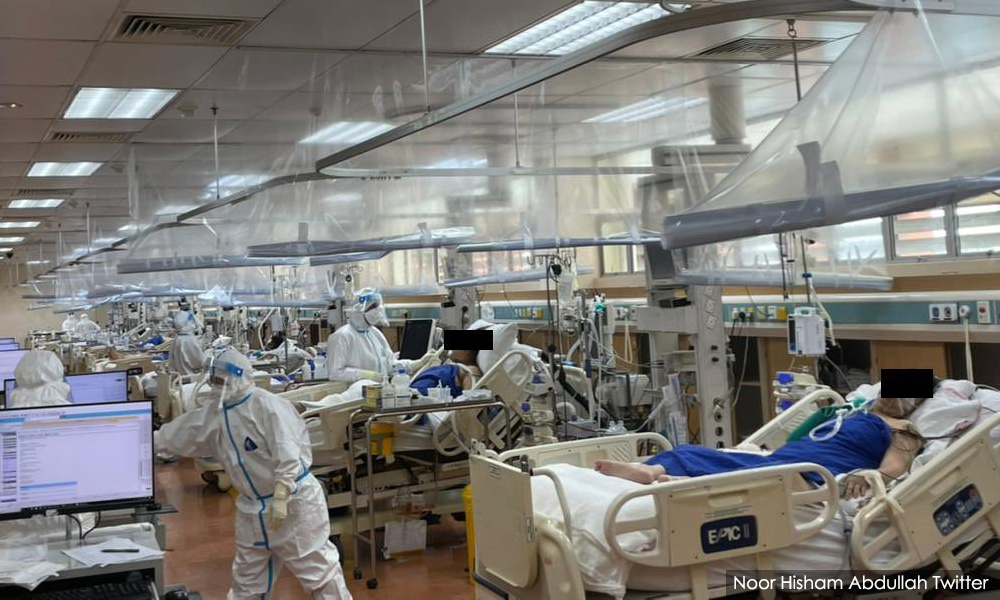
At one point, a doctor at a large Covid-19 hospital said there was even a shortage of vitamins including Vitamin C, although this situation has improved.
"At the hospital where I work, we only have a stock of injection Precedex that can last less than a month, and for injection Propofol, less than two months of supply.
"So to save up on these two medications, doctors are now using Midazolam as sedative, whenever possible," said another source at a Health Ministry facility in East Malaysia.
Precedex is the trade name for Dexmedetomidine, which, according to clinical trials, reduces the duration of mechanical ventilation compared to the alternative, Midazolam.
The doctor added that colleagues in ICUs in other states have shared that Midazolam, too, has been in short supply at their facilities.
Checks found that hospitals in the Klang Valley have also been hit by the shortage of medications.
“We are managing. But the holding stock would not last very long.
“At this juncture, where the number of cases at Emergency Department is down, and category 4 and 5 patients are also decreasing, medications that we have can last for around 25 to 30 days.
“But it would not last that long if the rate of usage increases. So we need to improve our holding stock - minimum three months - so we can be safe in case there is a surge again,” said a high-ranking healthcare officer, who is directly involved in day-to-day operations at a fully Covid-19 facility.
A source at another hospital in the Klang Valley said that they were also experiencing shortage of the medications, but the problem there was “on and off”.
“We will be informed whenever there is a shortage, but so far it was only on and off, and still manageable as we still have alternatives.”
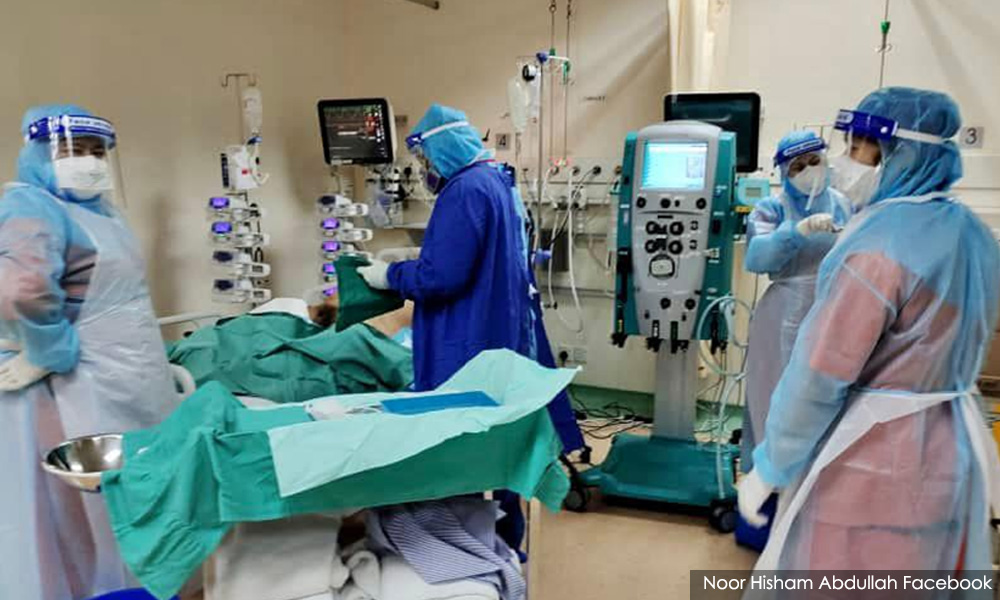
Malaysiakini also learnt the situation is more dire with muscle relaxants Rocuronium and Atracurium, which are used to paralyse patients with bad lungs due to Covid-19 infection.
This is because patients with bad lungs who experience hypoxia may take large gulps of breath, causing excessive expansion and injury to the lungs. To protect them, they need to be placed under paralysis, a specialist explained.
Rocuronium and Atracurium are also used to intubate non-Covid patients in operation theatres, and are in short supply in non-Covid hospitals, too, it is learnt.
"At one point, the two drugs were out of stock. So we used Scoline as an alternative," said a doctor at a non-Covid hospital, adding that he learnt from a colleague in another state that it was also facing a similar shortage.
While Scoline can be safely used to intubate patients in operation theatres, it is considered “very old practice” and “scientifically dangerous” to use it to maintain paralysis in ICU patients.
"So usage (of Scoline) in ICU is a no-no," the specialist said, adding that the drug has side effects like increased intracranial pressure and hypertension.
Addressing nationwide shortage
According to sources, the high usage of sedation medications was due to spikes in the number of patients who had to be ventilated.
At some fully Covid-19 hospitals, the number of patients who needed intubation crossed 100 in a month since the start of the current wave of infections in May.
Some 11,793 patients have been intubated nationwide since March 8, 2020.

When contacted, Health Ministry secretary-general Mohd Shafiq Abdullah said the nationwide drug shortage is driven by a “sudden increase” in demand for Covid-19 treatment.
He added that usage of these drugs “increased drastically” over the course of six to 11 months, with the latest surge starting in May.
However, he assured that the ministry's stock of medication was never completely depleted but only “supplied in stages to meet procurement needs”.
“Various efforts have been made by the Pharmaceutical Services Programme to address this issue such as through emergency procurement, working closely with contract suppliers to find alternative sources and discussing with clinicians on suitable alternative medicines that can be used to ensure continuity of treatment for the greater benefit of the rakyat,” he said.
Malaysia has endured a prolonged surge of Covid-19 cases, with 265,841 active cases and 990 patients in ICU, as of Aug 26. Of that, 487 patients are intubated.
While the situation has shown signs of improvement in the Federal Territories of Labuan, Negeri Sembilan and the Klang Valley, several other states are experiencing a spike in the number of cases and deaths. - Mkini

No comments:
Post a Comment
Note: Only a member of this blog may post a comment.