


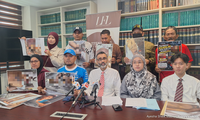
When Lawyers for Liberty (LFL) laid out the catalogue of injuries sustained by Noorizwan Zulkefly at a media conference last week, the organisation described his case as the worst custodial abuse case since A Kugan.
The comparison was chilling. It summoned the memory of a young man who entered police custody alive but never emerged from it.
Who was Kugan? And why, nearly two decades later, does his name continue to haunt Malaysia’s record of custodial deaths?
Hailing from Puchong, Kugan was a 22-year-old tow-truck operator when he was arrested in January 2009 to assist in investigations into a syndicate suspected of stealing luxury vehicles.
The circumstances surrounding his death were made even more troubling by the stark discrepancies between two post-mortem examinations.
The first, conducted by a pathologist from Serdang Hospital, recorded 22 external injuries. It found his brain, neck muscles, heart, spleen and abdominal organs to be normal, attributing his death to pulmonary oedema while leaving the underlying cause unknown.
The second autopsy, conducted by a pathologist from Universiti Malaya Medical Centre, painted a far grimmer picture. It documented 40 external injuries, V-shaped burn wounds believed to have been inflicted with a heated object, congested blood vessels in the brain, haemorrhaging in the neck muscle and heart, and extensive bleeding in the spleen.
Its conclusion was stark. Kugan had died of kidney failure due to beatings.
Pursuit for justice
In 2012, former constable V Navindran, the only police personnel charged over Kugan’s death, was sentenced to three years’ imprisonment for causing hurt to the 22-year-old.
But the criminal proceedings were only one part of the family's pursuit of justice.
On Jan 13, 2012, Kugan’s family filed a civil suit against several senior police officers, including then-Selangor police chief Khalid Abu Bakar, who would later become inspector-general of police, former Subang Jaya police chief Zainal Rashid Abu Bakar, the then inspector-general of police, Navindran and the government.
A year later, the High Court found Navindran liable for Kugan’s death in custody, holding him responsible for the fatal abuse. The court awarded the family RM751,700 in damages and RM50,000 in costs.
In 2017, the Federal Court ruled, in relation to Kugan’s case, that exemplary damages could not be awarded to family members of individuals who died in custody as a result of police action.

Kugan’s case had thus travelled through the criminal and civil courts, laying bare the consequences of abuse in custody. But it also revived a question that had been raised years before his death: who watches the police?
Push for independent body
The push for an independent body to oversee the police did not begin with Kugan’s death. It had gathered momentum five years earlier, when the government, under then prime minister Abdullah Ahmad Badawi, established the Royal Commission to Enhance the Operation and Management of the Royal Malaysia Police.
The commission received 926 complaints, including allegations of deaths in custody, physical and psychological abuse of detainees, abuse of power and a lack of accountability.
Its 2005 report contained 125 recommendations. Among them was a proposal that would become the centrepiece of a protracted battle over police oversight, which is the establishment of an Independent Police Complaints and Misconduct Commission (IPCMC).
The idea was straightforward but consequential. Rather than leave complaints of police misconduct to mechanisms within the force itself, an independent commission would investigate wrongdoing and hold errant officers accountable.
In cases involving deaths in custody, such a body could have provided an independent avenue to examine the circumstances surrounding a death, scrutinise the conduct of officers and ensure that allegations were not left to languish within the very institution under investigation.

However, the proposal ran into fierce resistance from within the police force. Despite Abdullah’s initial support, the government did not proceed with the IPCMC in its original form.
Instead, it opted for a broader oversight body, the Enforcement Agency Integrity Commission (EAIC), established under legislation passed in 2009 and operational from 2011.
The EAIC was tasked with overseeing multiple enforcement agencies, including the police. But critics argued that it fell short of the original IPCMC proposal, particularly in its ability to secure meaningful accountability.
IPCMC vs IPCC
The distinction mattered. A watchdog's effectiveness depends not simply on its existence, but on its independence, investigative authority and ability to ensure that its findings lead to consequences.
The IPCMC idea resurfaced after Pakatan Harapan’s victory in the 2018 general election, when the new government revived the reform and tabled an IPCMC bill in 2019.
Once again, the proposal encountered scrutiny and resistance. The government subsequently shifted towards a different model, the Independent Police Conduct Commission (IPCC).
The cabinet approved the IPCC bill in August 2020, and Parliament passed it in 2022. It came into force on July 1, 2023.
Civil society groups criticised the new framework as a watered-down version of the original IPCMC, pointing to limitations in its investigative and enforcement powers. - Mkini

No comments:
Post a Comment
Note: Only a member of this blog may post a comment.