`


THERE IS NO GOD EXCEPT ALLAH
read:
MALAYSIA Tanah Tumpah Darahku

LOVE MALAYSIA!!!


16 SEPTEMBER 2026

Friday, March 1, 2019

UM paves the way for student-run campus polls

Suara Siswa supporters marching to the Student Affairs building.
PETALING JAYA: Elections for the Student Representative Council at the country’s oldest university this year will be fully organised by students, in a first for Malaysian public varsities.
At Universiti Malaya (UM), a Campus Election Committee (CEC), made up entirely of students, has been set up to organise and oversee the elections which will be held on March 4.
This follows the government’s announcement in September that campus elections at public universities will be free from interference by university administrations.
“This is the first time in the history of UM, and also Malaysia, that we’re allowing students to conduct elections on their own,” deputy vice-chancellor for UM’s Student Affairs and Alumni Division, Abdul Aziz Abdul Rahman, told FMT.
He added that UM wanted to empower the students and prove that they are capable of managing their own affairs.
“We believe this can develop them into well-rounded students. When they finish their studies, they will carry these leadership values along with them.
“This is good for Malaysia. This is our contribution,” he said.
Students appeared to be taking the development in stride, with about 300 of them marching to the Student Affairs and Alumni Division building to show their support for student parties during the recent nominations.
Spirits high, they chanted party slogans as they marched, waving colourful flags.
In a break from previous practice, student parties now enjoy greater freedom in what they can put up on their banners, flyers and posters.
Voting stations will be placed at every faculty instead of only the Tunku Chancellor Hall, while the student political parties contesting will be allowed a longer campaign period.
They have been given the freedom to nominate any of their members without the need for prior approval from their faculty deans.
CEC president Vanessa Scully said the main challenge now was to win the students’ trust after promising them a fair and transparent election.
“This is a situation where students handle students,” she said. “It’s something no one has experienced since the 1960s.”
Student candidates registering to take part in the elections, to be held on March 4.
Scully, a law student, said the CEC had managed to organise the elections in just four months, with efforts beginning in November.
This year’s elections will see a five-cornered fight among Suara Siswa, Penggerak Mahasiswa, Neo-Siswa, Harmoni and Pewaris.
FMT spoke to the three biggest groups – Suara Siswa, Penggerak Mahasiswa and Neo-Siswa – about their causes.
Besides calling for direct participation in UM’s decision-making on policies, Suara Siswa has pledged to improve student autonomy by reintroducing the student union.
The establishment of student unions has been restricted since the enactment of the Universities and University Colleges Act 1971 (UUCA).
Their manifesto has also pledged to enhance campus safety and guarantee students’ freedom of association.
Wong Yan Ke, the leader of component party, Umany, one of the three associated with Suara Siswa, said allowing the students to organise elections on their own was a step in the right direction.
Penggerak Mahasiswa, meanwhile, has won campus elections over the past three years and is confident it will win again.
Its representative, Muhammad Saidul Husaini, 22, said they were striving for better student welfare this time instead of just student autonomy.
“We have been working with the university administration to improve students’ lives all this while,” he added.
Over the past three years, he said they had given out free laptops for students in need, started funds for the poorer students and improved the efficiency of campus buses.
“If we win this year, we want to work on issues regarding national education policies, like the National Higher Education Fund (PTPTN) student loans.”
Meanwhile, Islamic party Neo-Siswa has pledged to encourage more forward-thinking, intellectual students through its programmes and initiatives.
“We want to see students using their knowledge to contribute to society,” its representative, Mohamad Syafiq Mohd Adabi, 22, said.
They also want to use Islam as a solution to tackle the common woes faced by students.
“We have student welfare issues such as a lack of campus buses, bad WiFi reception and a shortage of food. We propose a ‘wakaf’ system for the students, so the funds can go towards upgrading university facilities,” he said.

They also want to encourage more “dakwah”, or spread of Islamic knowledge, within the university. - FMT

In Malaysia, is sorry really the hardest word?


The singer-songwriter team of Elton John and Bernie Taupin had a big hit in 1976. Their song, “Sorry Seems To Be The Hardest Word”, is a mournful ballad about a romantic relationship which is falling apart.
The lyrics, “It’s a sad, sad situation, and it’s getting more and more absurd”, describe Malaysia’s political scene these days.
Our politicians have been apologising to the public, and to each other, for decades. They apologise mainly for making racist and bigoted remarks, for personal slander, character assassination, baseless insults, and to a lesser extant, for gender and sexually-biased attacks. Within nine months of the fledgling Pakatan Harapan government, however, the rate seems to have increased.
A majority of these apologies are laughable, almost ridiculous, which demonstrates the infantile level of the Malaysian political scene these days.
Lately, colourful “apologetic” members of both the ruling coalition and the opposition have been able to claim high accolades for both demanding and dishing out apologies.
Ultimately, it boils down to personality kinks based on ego trips and insecurity. Some of our politicians have become caught up in the larger political game of outdoing one another – not in issues that really matter to the public, but in preserving what they feel is their “dignity”.
Apologies in Malaysian political life, it seems, have little to do with creating stronger national cohesion.
There is no sense of remorse in the apology demanded or made. Apologies that are made feel forced, skin-deep and insincere. Apologies that are demanded are bellicose, misplaced and manufactured from an imagined reality. Worse still, we the public hardly feel any sense of potential reconciliation between the parties involved, despite one apology after another. In the process, our hopes for an improvement from the Barisan Nasional (BN) decades are slowly slipping away.
Last July, CEO of the Malaysian Communications and Multimedia Commission, Mazlan Ismail, resigned. He said he wanted to leave the post “with a good reputation”.
In GE13, Mazlan was the BN candidate for Permatang Pauh. We might recall that in 2013, Anwar Ibrahim filed a defamation suit against Utusan Melayu, TV3 and Mazlan. As leader of the then-opposition coalition (Pakatan Rakyat), Anwar contested the Permatang Pauh seat in GE13 and defeated Mazlan.
In the events after GE13, Anwar accused all three parties of defaming him. In August 2018, after his resignation, Mazlan apologised for the statements he made about Anwar five years before, which were “without any reference”, and “promised not to repeat (his) statements in the future”.
The episode ended with a short and sweet statement from Anwar: “I accept this apology with an open heart… I hope our political scenario will not be smeared with slander and condemnation.”
It remains to be seen how sincere Mazlan’s apology was, but it was gracious of Anwar to accept it “with an open heart”.
Most of us would agree that slander of this nature, a baseless, empty accusation of corruption, is detrimental to any individual’s political career. It also has larger ramifications for the nation. In this case, an apology is befitting.
Our present political scenario, though, is pregnant with silly and childish name-calling that can hardly be called a national threat. Yet, there is a scramble to demand apologies and haste to oblige.
Two weeks ago, an insinuation by PAS president Abdul Hadi Awang drew the wrath of minister Mujahid Yusof Rawa. Hadi hinted that Mujahid may have a degree but “has a small brain”. This form of banter is characteristic of five-year-olds. It is unexpected from grey-haired politicians who claim to represent a large minority of influential Muslim Malaysians.
What is crucial here is Mujahid’s reaction. As minister in the Prime Minister’s Department, and an individual who is respected for his intelligence in the Islamic affairs of the country, Mujahid should not have demanded that Hadi apologise. He should not have issued a letter for the withdrawal of the “small brain” remark.
A better course of action would have been to dismiss it and move on. It takes more than such remarks to influence the thinking public’s perception of their leaders. Contrary to what Mujahid felt, we the public do not think his image has been affected by the rantings of a desperate opposition politician.
The Malaysian public prefers their leaders to behave with matured dignity and confidence. We need them to fight their political battles on a higher level. Name-calling of this nature belongs to a very low rung. It does not deserve such retort, let alone an apology.
Former prime minister Najib Razak’s Al-Jazeera interview with journalist Mary Ann Jolley last October generated another knee-jerk demand for an apology. Utusan Malaysia’s editorial team slammed Najib, calling him a liar after his evasive answers to probing questions concerning 1MDB.
Utusan readers and Umno members felt they had been fooled. They wanted Najib to apologise for “wiping out the people’s confidence in BN’s leadership”. Definitely very legitimate reactions.
However, in light of the charges of embezzlement, money laundering and corruption that have already been made, Najib need not apologise. The legal system has already kicked in, and Najib is on the way to being publicly tried.
It is juvenile to cry foul over a case that has already gone many steps ahead. In this instance, it seems that the demand for Najib’s apology was to satisfy the egos of Utusan and Umno member. This is extremely unnecessary as it waters down the utility of political apologies.
Politics is a dirty dogfight. Egos are hurt when character assassinations are made. This is part of the brutal competition for the power to lead.
More importantly, leaders want to remain legitimate in the eyes of the voters. After all, we are a democracy. This legitimation can be challenged through fake news, lies, attacks on morality and intrusions into the private lives of these leaders.
Matured democracies in other parts of the world have a developed political culture of apology. Their leaders apologise for having wronged their citizens. The aim is to recommit to justice.
Ideally, an apology is demanded and obliged in recognition that there is something serious to apologise for. This recognition is shared by both the offender and the harmed.
Apologies are demanded when someone’s honour is at stake. This honour is linked to the bigger notion of state legitimacy.
The apology is made to restore such an honour as it has ramifications on state survival.
Apologies are not demanded or made for petty issues which have no influence on the lives of the present and future generations of the country.
Our politicians must be selective in how apologies are used. We must graduate from petty bickering to instil more confidence in the public.
Our leaders must devote more time and mental resources to tackling the serious issues facing our shaky democracy, such as the politicisation of race and religion.
It is a waste of time and an insult to our intelligence when our media runs three or four days of news coverage on politicians demanding apologies for useless ego-massaging issues.
Elton John is perceptive in saying that sorry is the hardest word. It is hard to say sorry if one is sincere about it.
Likewise, it should be a huge political responsibility to justify why an apology should be made or demanded. As the old adage goes, familiarity breeds contempt. The more we read about apologising politicians, the more likely we are to lose trust in them.
What we want are apologies for corrupt practices, nepotism, cronyism, flip-flop decisions, U-turn policies and unfulfilled promises. - FMT

It’s ‘Slander’, PAS Deputy Says Of Anwar’s Claim Hadi Paid RM1.4m To Sarawak Report

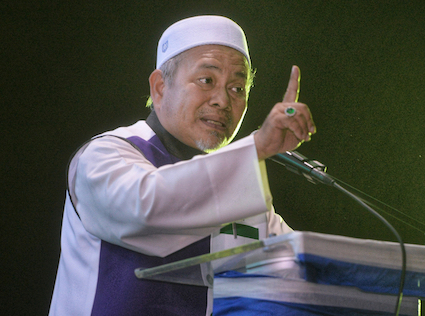
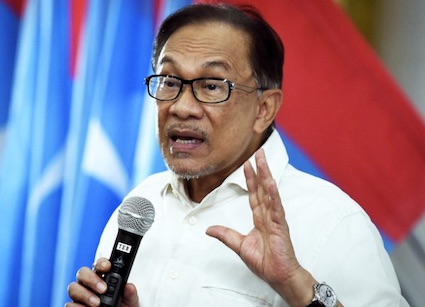
(MMO) – No one will believe the claim that Datuk Seri Abdul Hadi Awang paid over RM1 million to Sarawak Report to settle his civil suit against the news portal, the PAS president’s deputy said last night.
Datuk Tuan Ibrahim Tuan Man said that the claim, which was made by PKR president Datuk Seri Anwar Ibrahim, was slander and therefore PAS did not need to prove anything.
“These allegations are just slander,” said Ibrahim.
“All it does is to make us stronger. We can see not all the people listen nor believe these lies so it’s not a problem for us.
“We will give our full support to the relevant agencies to investigate (the claims). It’s not up to us to prove anything. Let those slandering us show proof.”
PAS secretary-general Datuk Takiyuddin Hassan has said neither PAS nor Hadi had paid anything to Sarawak Report editor Clare Rewcastle-Brown to settle the defamation suit.
Earlier on February 13, Hadi said both sides agreed to settle the suit on confidential conditions.
However, he added that Rewcastle-Brown could reveal the details should she choose to, even as he decided otherwise.
Hadi chose to pursue the suit against Sarawak Report in 2016 for its report which claimed former prime minister Datuk Seri Najib Razak provided RM90 million to the PAS leadership for their support in the 14th general election
Tuan Ibrahim also said PAS was supporting Umno and Barisan Nasional for the upcoming Rantau by-election.
“When Rantau by-elections come along PAS will be there to ensure the victory of Tok Mat and these are the wishes of our president as well,” Tuan Ibrahim said.

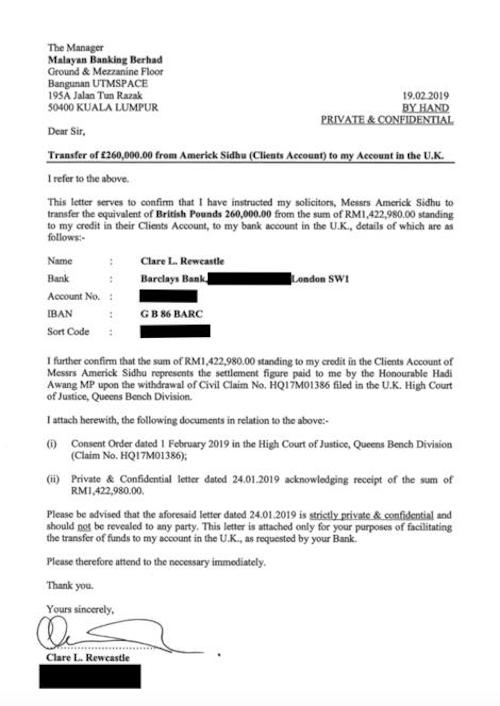
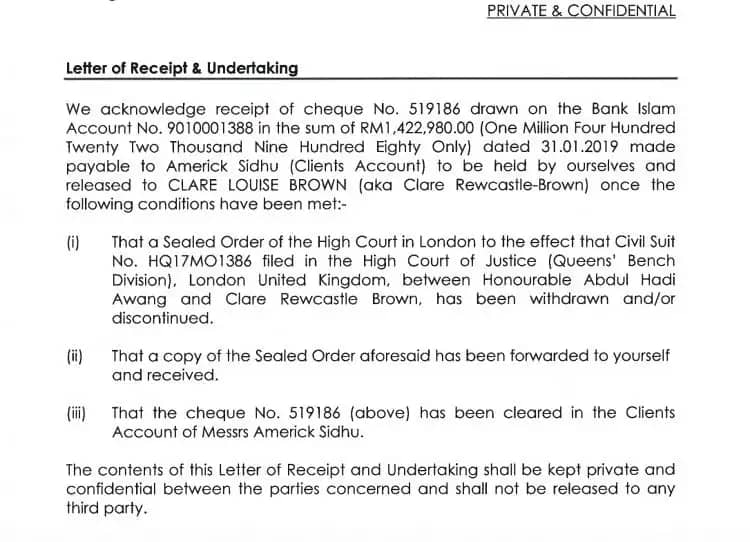
Ini, Kononnya, Bukti Yang Hadi Awang Bayar Clare Brown RM1.4 Juta

Ini, kononnya, bukti yang Abdul Hadi Awang telah bayar Clare Rewcastle Brown RM1.4 juta. 


Islam Berkata Orang Munafiq Tidak Boleh Dipercayai

Hari ini Anwar mendakwa bahawa beliau mempunyai bukti yang PAS telah bayar RM1.4 juta kepada Clare Rewcastle Brown. Bagaimana hendak percaya manusia yang tabiatnya kuat membohong? Orang seperti ini dipanggil munafiq dan cakapan orang munafiq tidak boleh dipercayai.

NO HOLDS BARRED
Raja Petra Kamarudin
Anwar Ibrahim telah banyak kali sangat menipu rakyat. Mula-mula, pada tahun 1974, Anwar mendakwa yang ramai orang di Baling mati akibat kebuluran. Kemudian ianya dibukti sebagai fitnah semata-mata.
Pada tahun 1982, Anwar berkata dia masuk Umno kerana nak ubah Umno dari dalam. Yang sebenarnya Anwar merosakkan lagi Umno apabila dia mambawa budaya politik wang ke dalam Umno. Ini berlaku semasa Anwar menggulingkan Tun Ghafar Baba dengan membeli undi.
Selepas itu Anwar cuba menggulingkan Tun Dr Mahathir Mohamad dengan alasan Mahathir, bersama Tun Daim Zainuddin, sapu atau lesapkan RM200 bilion duit rakyat. Hari ini Anwar sendiri yang menyokong Mahathir.
Pada tahun 1998 Anwar kata dia difitnah dan tidak meliwat Azizan Abu Bakar. Hari ini kita sudah mengetahui yang Anwar bukan sahaja meliwat Azizan tetapi meliwat berpuluh-puluh lagi budak lelaki yang lain.
Begitu banyak pembohongan Anwar Ibrahim seperti dakwaan dia mempunyai bukti sebanyak enam kotak berkaitan rasuah Mahathir dan pemimpin Umno yang lain, peristiwa 16 September 2008 dimana Pakatan Rakyat akan mengambil alih kerajaan, Langkah Kajang, dan berbagai-bagai cerita dongeng lagi.
Hari ini Anwar mendakwa bahawa beliau mempunyai bukti yang PAS telah bayar RM1.4 juta kepada Clare Rewcastle Brown. Bagaimana hendak percaya manusia yang tabiatnya kuat membohong? Orang seperti ini dipanggil munafiq dan cakapan orang munafiq tidak boleh dipercayai.

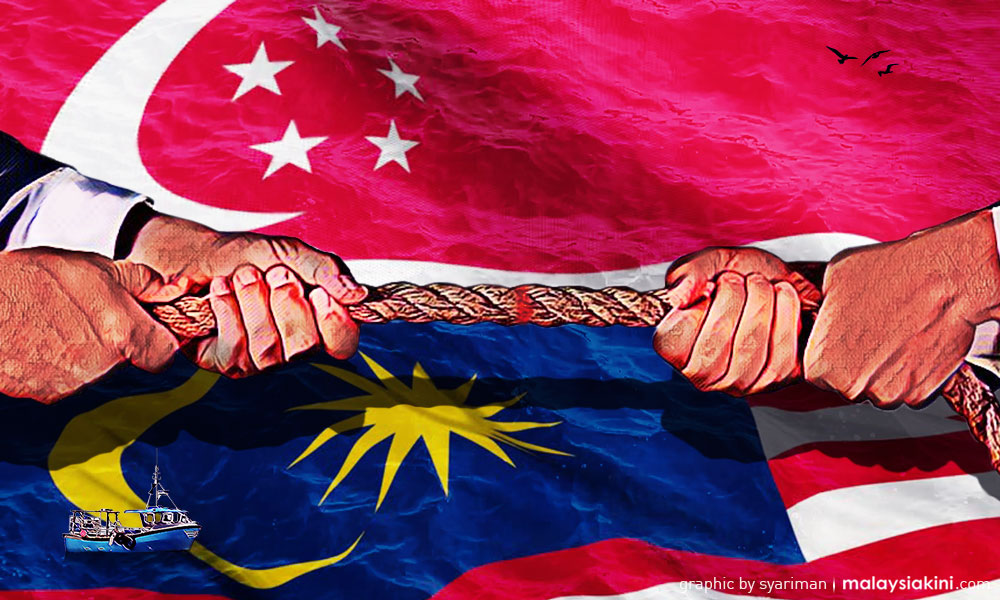
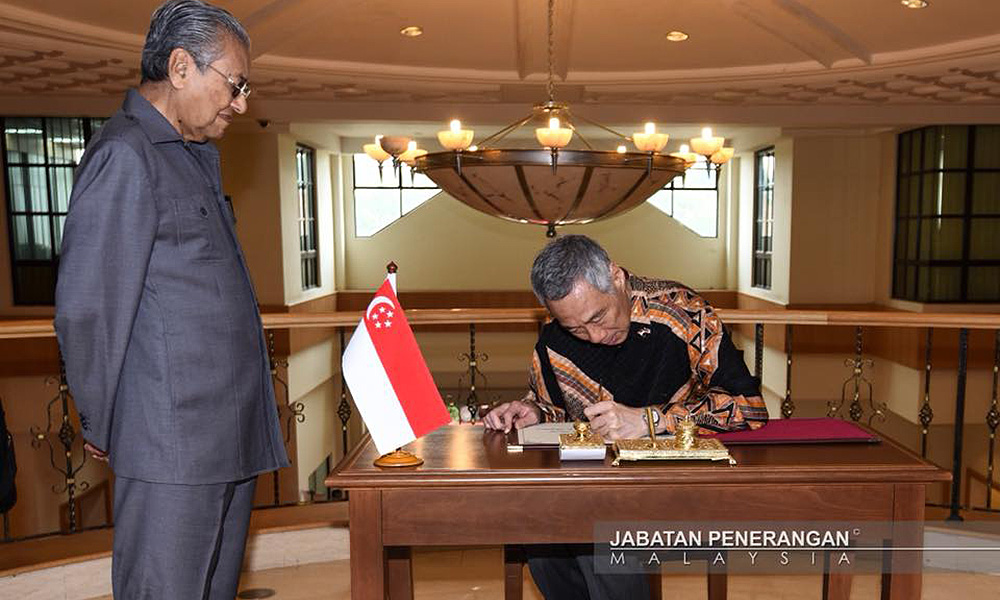
Singapore – our frenemy down south


Many of us Malaysians derive a sort of guilty pleasure in hating Singapore. We may be from Johor, Kedah, Sabah or the cosmopolitan enclave of KL, but we are quickly united in our vexation at the sometimes preposterous claims of our smug neighbours. Particularly when the subject of food crops up.

And that just about sums it up. We are not bitter enemies with a history of hostility dating back many centuries. We are actually half-siblings, occasionally close, but usually unable to look beyond the rivalry that exists between us. Basically, Singapore is a pesky, precocious kid brother who annoys us, but whom we don’t really want any serious harm to come to.
Just watch their news and you’ll notice that we weigh far more heavily in their consciousness than they do in ours. I swear you can barely go a half-hour before encountering a news item with the hidden subtext: See, we made the correct choice in breaking away from this chaotic nation above us.
A few headlines this week about Malaysia on the Straits Times page bear this out: ‘Singapore will not allow any foreign government to assert authority in its waters, says Vivian Balakrishnan’, ‘Haze, burning smell in Singapore expected if Johor fires continue; second hot spot detected: NEA’ and ‘Malaysia's flying car plan jets into controversy’. Believe me, there’s plenty more where that came from.
There’s little doubt the nanny state has been employing the strategy of using us an example (and even a common enemy) for its people to unite again. And there have been some serious disputes. The agreement over raw water supply, high-speed rail and naval borders all come to mind. But if you want real emotion, there’s nothing like claims and counterclaims over something truly vital like hawker food.
Last August when Singapore nominated its hawker culture to the Unesco Representative List of the Intangible Cultural Heritage of Humanity, we were outraged because we are pretty damn sure our food is tastier and far more varied. The scenario just repeated itself recently with some claims and counter-claims to yee sang. Now I don’t normally give a toss about yee sang (yes, I went there), but the temptation to wade in was just too strong.
But let’s be honest with ourselves, our Singaporean brethren have always been savvier when it comes to self-promotion. What should we do about it - remain infuriated as Chef Wan was, or learn to beat them at their own game?
Mirror image
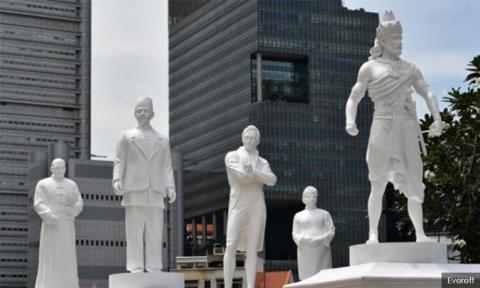
If you go to a museum in Singapore, you are likely to see some wide claims to a cultural heritage that we will feel is more ours than theirs. Yet it could be equally be argued that a lot of our shared heritage - from language to fashion to the arts as well as food - has its roots in Indonesia, China and India. And you know what else? It turns out that quite well-run Singapore museums are staffed by Malaysian-born folk!
We really are a mirror image of each other. When I was younger and watched the Lee Kuan Yew ‘breakaway’ speech (with the benefit of added commentary from an indignant Malaysian patriot that the man was crying crocodile tears), I thought it was a great pity that we could not have made it work. Later on, an understanding of the dynamics of the formation of Malaysia made me see that there would have seemed no other choice at that time.
Just imagine, at the time of the nation’s formation, when Sabah, Sarawak and Singapore joined Malaya, there were actually more Chinese than Malays among its population of 9 million. This lasted during the 23 months - from Sept 16, 1963 to Aug 9, 1965 - when Singapore was part of the country. In the midst of increasing racial tensions, the decision to split with a Chinese-dominated Singapore and Malay-dominated Malaysia was probably a wise yet painful one.
In some ways, they are “just” a city and we are a country with much more complex demographics and landscapes. I am happy that we have a more vibrant political scene and greater press freedom and indisputably better food, but I do admire lots of aspects of their well-ordered society even if it is a tad sterile. Urban planning, cleanliness, low crime rates, public transport. Frankly, there are areas in which they are streets ahead of us.
I don’t like visiting but it’s really because the exchange rate is not just exorbitant but a humiliating blow to our national ego. Let’s not forget that many Malaysians are guilty of taking advantage of this. Going over there to earn and rushing back to invest in our property market, thereby driving prices up beyond the means of their countrymen who have chosen to carry on working and living in Malaysia.
Brainwashed population
I would argue that we have a brainwashed population on both sides of the Causeway. But while our affliction seems to be more haphazard and tied to identity politics of race and religion, theirs seems to be state-sanctioned and calculated. I have often found that if you engage different Singaporeans in debates on a broad manner of topics from foreign policy to the quality of the ruling PAP’s opposition, they will give you the same sort of answers!
A legendary Singaporean I interviewed was the late Joshua Jeyaretnam, back in 2003. In 1981, he had had the temerity to win a by-election and in so doing, he became the first non-PAP MP for 15 years. The man was brilliant, but paid a heavy price for standing up to his country’s authoritarian leader, and was ultimately bankrupted. His treatment summed up his nation’s commitment to justice and democracy.

Singapore has slick and intelligent ministers who articulate their collective position immaculately. Generally well-educated, they have real degrees, quite often from the most esteemed institutions of learning in the world. Yet in their acceptance of the status quo, one has to wonder if it is intellectual curiosity that is lacking, or if they have succumbed to cynicism.
There are Malaysians who are fanboys of the Lee Kuan Yew regime and have cited Singapore’s many non-Chinese presidents are proof of Singapore’s superiority in terms of balancing race relations. I explained that while impressed by the appointments of Yusof Ishak, Benjamin Sheares, Devan Nair and most recently Halimah Yacob, I will truly be blown away if the prime minister post is given to a non-Chinese. That position is clearly the one with the real power and current deputy prime minister, the LSE, Cambridge and Harvard-educated Tharman Shanmugaratnam is an ideal candidate to succeed Lee’s son.
It’s fascinating isn’t it to see the twists and turns of history, and what might have been. But while we can argue endlessly about why our street food is so much better than theirs, I think I would rather recall the great badminton player Wong Peng Soon. Born in Johor Bahru in 1918, he relocated to Singapore, but represented Malaya and led us to three consecutive Thomas Cups in 1949, 1952 and 1955 - years when there was no dividing line, no separate nations.

MARTIN VENGADESAN is a member of Team Malaysiakini. - Mkini

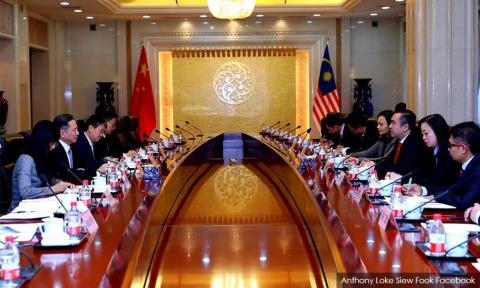
Yoursay: Loke should’ve declined invitation for wife to attend China talks


YOURSAY
 | ‘The minister should adhere to best practices and set strict standards for himself.’

TCM: I agree that, on the one hand, it means Transport Minister Anthony Loke’s wife Ng Chi Ling is not tagging along just to splurge on shopping, but on the other hand, it seems awkward for her to be at the official meeting. In an official dinner, yes, but a meeting is pushing it.
Be more alert towards potential controversy, Mr and Mrs Loke. We hold all of you to higher standards.
Loke has been doing a good job thus far; there was a small misstep here which requires a quick apology, after which we should move on.
The ideal spouse of a minister that I have seen so far is Dr Siti Hasmah Ali. She never overshadows Prime Minister Dr Mahathir Mohamad, but plays the role of a minister’s spouse elegantly and correctly.
Would Siti Hasmah sit in an official meeting? (I am not talking about dignitaries’ visits, but official working meetings).
Sivadass: Dear New Malaysia transport minister, we the rakyat voted for a new government to govern this country professionally and truthfully.
If you claim MCA is taking cheap shots for publicity, it is because you let your guard down and allow them to take these shots.
The last time we checked, we voted for you, not your spouse or anyone else. Your spouse has no standing to be in the vicinity of the meeting venue, let alone in the meeting proper.
Your Chinese counterpart was gracious enough to invite your spouse to the meeting out of courtesy. The right thing for you to do is to politely decline, instead of allowing her in.
Caripasal: This should serve as a lesson to all our rookie ministers. No protocol is required to tell you that an outsider is not allowed to participate in a bilateral talk.
Loke’s wife is an outsider, as she does not hold any official position in the government. Can a company CEO bring his wife for a company meeting?
Loke should just admit the mistake and move on.
Roger 5201: But if Ng was there on invitation from the Chinese minister and she can facilitate a conversation in Mandarin while playing a positive role in improving relations with China, what is so wrong with that?
Seriously, what is MCA's problem?
Quigonbond: MCA is clearly raising this issue as an obvious comparison to how former prime minister Najib Abdul Razak’s wife Rosmah Mansor attended official meetings under BN government in the past.
I’m not sure Loke gets it. It's about official secrets being shared.
And look at it this way. Rosmah also claims people respected her and therefore invited her to meetings, so was she wrong to attend?
Therefore, the principle is about who is accountable, who is responsible, and who is the official representative. It has nothing to do with being invited or otherwise.
Loke has been doing a fantastic job as transport minister. If there has been a breach of protocol, it is best if he just apologises for it and promises never to repeat the same mistake. It will not dent his reputation.
Loke's wife is probably nowhere near as influential as Rosmah, but Pakatan Harapan must show it is above board.
Falcon: Loke, wrong answer - not after the hue and cry over the former first lady.
Even so, an experienced politician like you, from the opposition ranks who, thanks to the 14th general election, became the coalition to form the new government should have politely refused, citing protocol and knowing that political enemies in Malaysia will raise this matter.
However you look at it, Loke, it was inappropriate and you know it. Apologise and let’s move on.
Ipadder: No to spouses in official meetings. Adhere to best practices. Do not give in to shoddy practices in other jurisdictions. Set strict standards for yourself.
It does not matter that the Chinese minister invited her to attend the meeting, you should not have accepted. Confidential government matters were being discussed.
Drngsc: Thanks, lawyer Haris Ibrahim. You are right. Harapan has failed to see through their promises. They have U-turned significantly.
The people must teach them a lesson. Vote PSM for a new Malaysia. That old man must be taught a lesson, again. He has not learned from Cameron Highlands.
Cogito Ergo Sum: I hope the people choose PSM. It’s time that Umno/PAS be put out of its misery and Harapan gets a wake-up call.
Even if Harapan is doing things right, nobody knows what’s happening. This is because it has a very poor communications strategy.
Anonymous 770241447347646: The problem is that a reality check is needed. Do any of these NGOs stay in Semenyih?
The state is in the hands of Harapan. The administration responsible for running the state is also controlled by Harapan.
After the elections, the activists will go back to where they belong. It is the residents that will have to face the consequences of any problem in their area.
It would be easier for a Harapan candidate to get things solved, rather than an independent candidate.
Bluma: These 52 highly educated activists should give the Harapan government a chance. Just give your input to the government and let the Harapan ministers consider and decide.
The damage done to our country for a period lasting 60 years cannot be fixed within a short period, so give the Harapan government more time, at the very least a term or two. - Mkini