


As many expected, PSM lost its deposit in the Negeri Sembilan polls for the Rahang state seat, securing just 3 percent of the total votes cast.
Yet, an article that appeared in theSun a week before the polls noted that PSM remains relevant despite its electoral defeats.
A party inspired by ideology does not fade away simply because of electoral losses; our motivation is derived from other, deeper factors.
PSM candidate S Tinagaran, popularly known as Cikgu Tina, received 400 votes of the total ballots cast in Rahang. This is a slight improvement from the 1.4 percent we garnered in Skudai, Johor, during the previous election.
While this shows some progress, there is clearly much more work to be done.
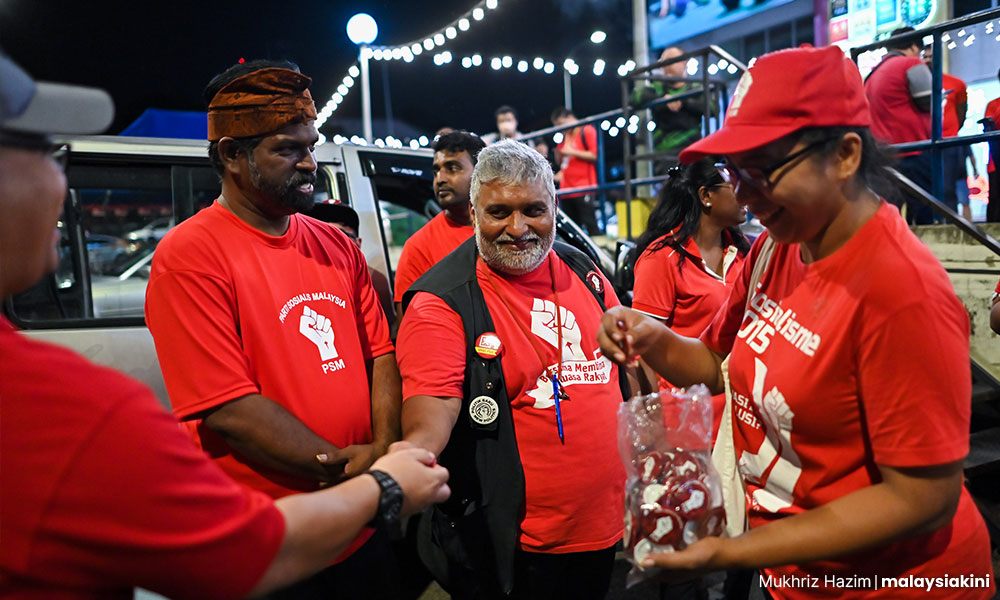
PSM contested in Rahang, an urban seat with approximately 21,000 voters and nine polling districts. Within the first week, our moderate but dedicated machinery managed to cover the entire constituency.
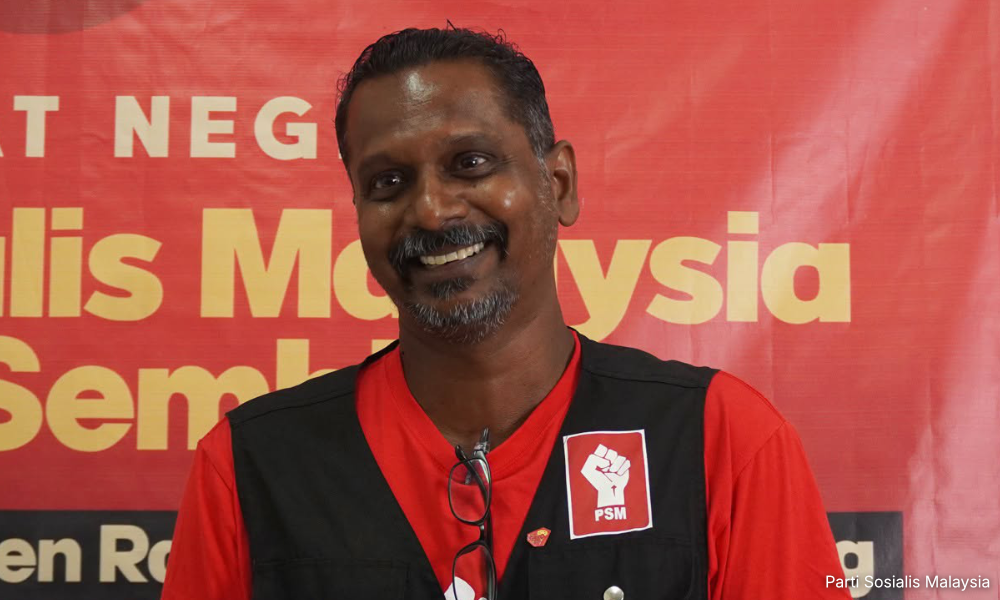
In the second week, we focused intensively on house-to-house campaigning - a strategy that likely secured our 400 votes. The only consolation was that we beat Bersatu and doubled our percentage from Johor.
Observations from the ground
While PSM was doing the hard work of door-to-door engagement, the bigger parties were hosting large jamuan (feasts) and distributing cash handouts.
One resident told me she was paid RM80 just to attend an event for the Indian community. She even indicated that the person who promised her the sum was probably paid RM120 to RM200, of which she received RM80.
According to her, the event was packed and massive but many in the crowd were outsiders. There was plenty of food and money being spent.
As for Prime Minister Anwar Ibrahim’s apology to Indian voters, it was a strategic misstep on the Pakatan Harapan chairperson’s part if he thought a last-minute apology could sway Indian voters.
I don't know who advised him, but it was too little, too late.
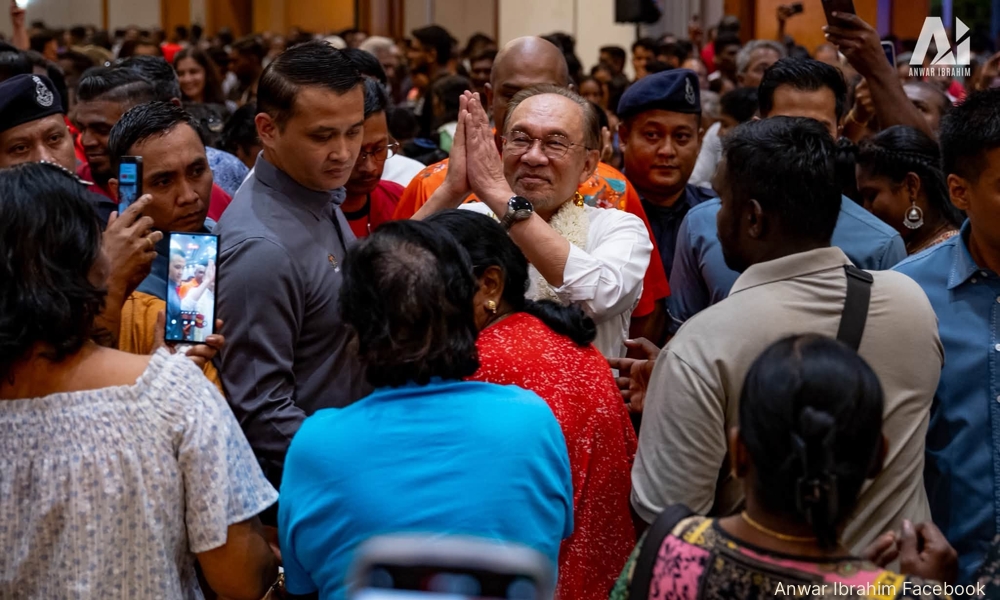
Making an apology during the election campaign only seemed to add salt to the wound. If he had not apologised at all, it might have been better. I do not entirely blame Anwar - he may have been pressured by Indian leaders to do it.
Recently, Anwar said he would personally oversee Indian affairs. Does this mean that there are no Indian leaders capable of doing the job? Or that those in position are not up to the task?
Most of the Indian leaders surrounding Anwar appear to be "yes men" more inclined to praise their leader than to tell him the truth. It is also obvious that critical Indian voices are being sidelined by those who are close to Anwar.
Another woman told me she had hired a taxi to go to Labu, where she was promised RM300, only to be disappointed when the promise fell through.
I asked why she needed the money, and she said it would at least help her pay part of her rent.
A man at the temple told me that both Harapan and BN were giving cash handouts. When I asked him if he was telling the truth, he replied that he does not lie from the temple.
Another observation was the high number of spoilt votes, especially among younger voters.
Perhaps there is insufficient education on how to vote.
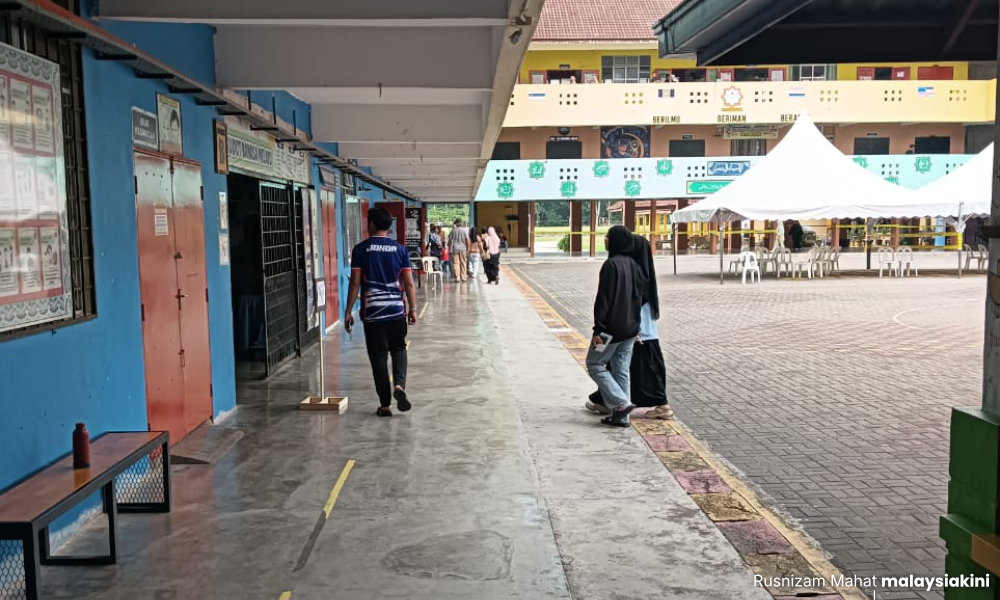
Schools should consider teaching secondary school students the proper voting process, or even organising mock elections to familiarise them with the democratic process. I have observed this consistently in Johor as well, many votes are classified as "undi ragu" (doubtful votes).
The racial divide
Overall, the majority of voters on both sides of the political divide cast their ballots along racial lines.
"Malay unity" is used as a rallying cry to bring together the Malays. It is also the rallying cry to unite the non-Malays to "beat the Malays."
Whichever way you look at it, all major parties play the same game, accusing each other of racial politics while engaging in it themselves.
This trend will continue unless we adopt a better electoral system, such as a proportional representation system where smaller parties like PSM, Muda, and others can have a place in the House of Representatives.
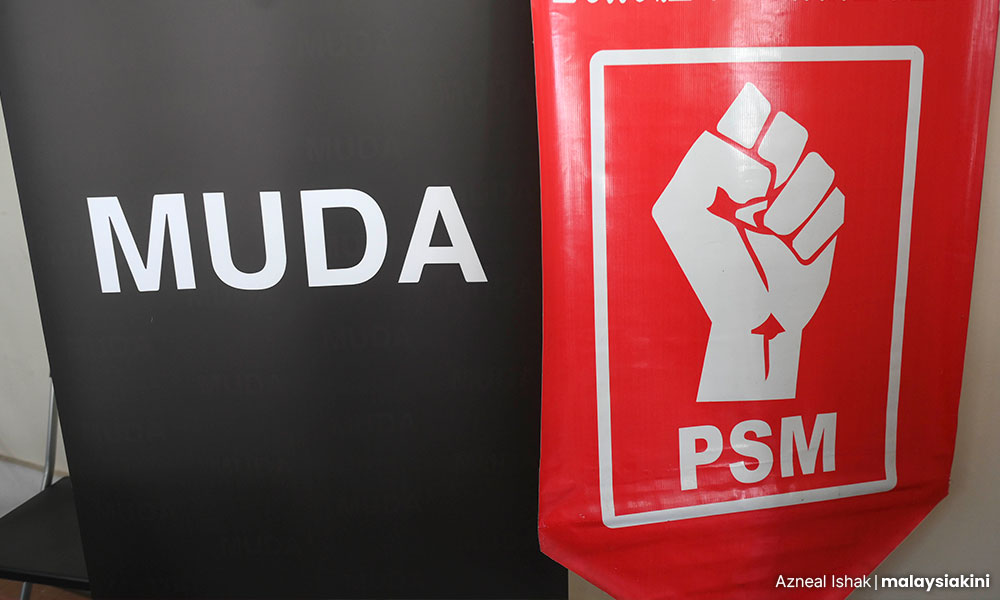
Under the first-past-the-post system, it is nearly impossible for any third force or third party to win an election, or even to get back its deposit.
Why we contest
For a small party like PSM and for parties like Parti Orang Asli, merely contesting in an election is already a significant achievement.
Unless the electoral system is changed to a proportional representation system, there is no way a third party or independent candidate can win back its deposit.
Knowing this and still contesting is what Parti Bersama Malaysia leader Rafizi Ramli would call "kamikaze" politics.
Yet for PSM, elections serve a different purpose. They are an avenue to test party machinery and organisational capacity, activate our volunteer base, train members in electoral work, and put forward an alternative agenda to the public.
As Friedrich Engels noted centuries ago, participation in elections from a left party serves as:
"One of the sharpest weapons" to fight state institutions and expose other parties to the masses
An effective method of reaching the masses with the ideas of the party
A useful platform to express the party's ideas and attack its opponents
A gauge of the party's strength and support among the masses
A means of legitimising the party before the public, and putting the party in a stronger position to resist any attempts to outlaw it
The party's election campaigns remain powerful weapons in the struggle for the right to exist and the right to be heard.
Moving forward
Having said that, it is not too late for the Progressive Bloc to explore becoming a larger coalition and contesting in more seats - so that it can be seen as a real alternative to the existing mainstream political parties.
Our politics should transcend issues of race and religion, and instead focus on substance and programme-based approaches to meet the needs of the people. It will be difficult but not impossible.
PSM and the Progressive Bloc must build on this experience and move forward. - Mkini
S ARUTCHELVAN is PSM deputy chairperson.
The views expressed here are those of the author/contributor and do not necessarily represent the views of MMKtT.

No comments:
Post a Comment
Note: Only a member of this blog may post a comment.