


PETALING JAYA: Same household. Similar usage. Much higher bill.
That is the reality faced by several consumers who are questioning sharp increases in their bills despite only modest changes in their electricity consumption.
Executive manager Diana Nabilah Radzali, 39, saw her usual monthly electricity bill of between RM600 and RM800 jump to RM1,100 and RM1,200 in the past two months.
“My usual bill is RM600 to RM800 for a family of eight. We use three to four air-conditioners at home, but mostly at night.
“However, the bill spiked to RM1,100 last month, and this month it has gone up further to RM1,200, although usage has been roughly the same.
“So I don’t know why it has increased,” she said when contacted yesterday.
Yesterday, Prime Minister Datuk Seri Anwar Ibrahim held a special meeting to consider measures to cushion households against soaring electricity bills.
The Prime Minister said the meeting involved the Energy Transition and Water Transformation Ministry (Petra), Energy Commission, Tenaga Nasional Bhd and Finance Ministry.
Engineer M. Kumar, 49, also questioned the sharp increase in his latest bill, which rose to RM997 in September, almost RM300 more than the previous month.
His electricity consumption increased from 1,349kWh in August to 1,591kWh in September, an increase of about 18%. However, his bill jumped from RM697 to RM997, or about 43%.
“I was surprised to see my bill. My usage did not increase that much, but the amount went up by almost RM300,” he said.
Kumar’s bills over the past six months also show fluctuations in both usage and charges.
In April, he used 1,493kWh and was charged RM684. In May, his consumption increased slightly to 1,515kWh, but his bill rose sharply to RM882.
His usage then fell to 1,029kWh in June, with his bill dropping to RM506, before rising to RM611 in July and RM697 in August.
In September, his consumption climbed to 1,591kWh, crossing the 1,500kWh threshold, while his bill neared RM1,000.
Another consumer, Mohd Aiman Hanbali, 33, was also shocked by his latest electricity bill, which jumped to RM1,407 in September from his previous bills of between RM200 and RM400.
He said his household had two air-conditioners, which were mostly used at night, while the other rooms relied on ceiling or standing fans.
“No additional electrical appliances were added,” he said, adding that his family had tried to reduce its electricity consumption after receiving a higher bill in August.
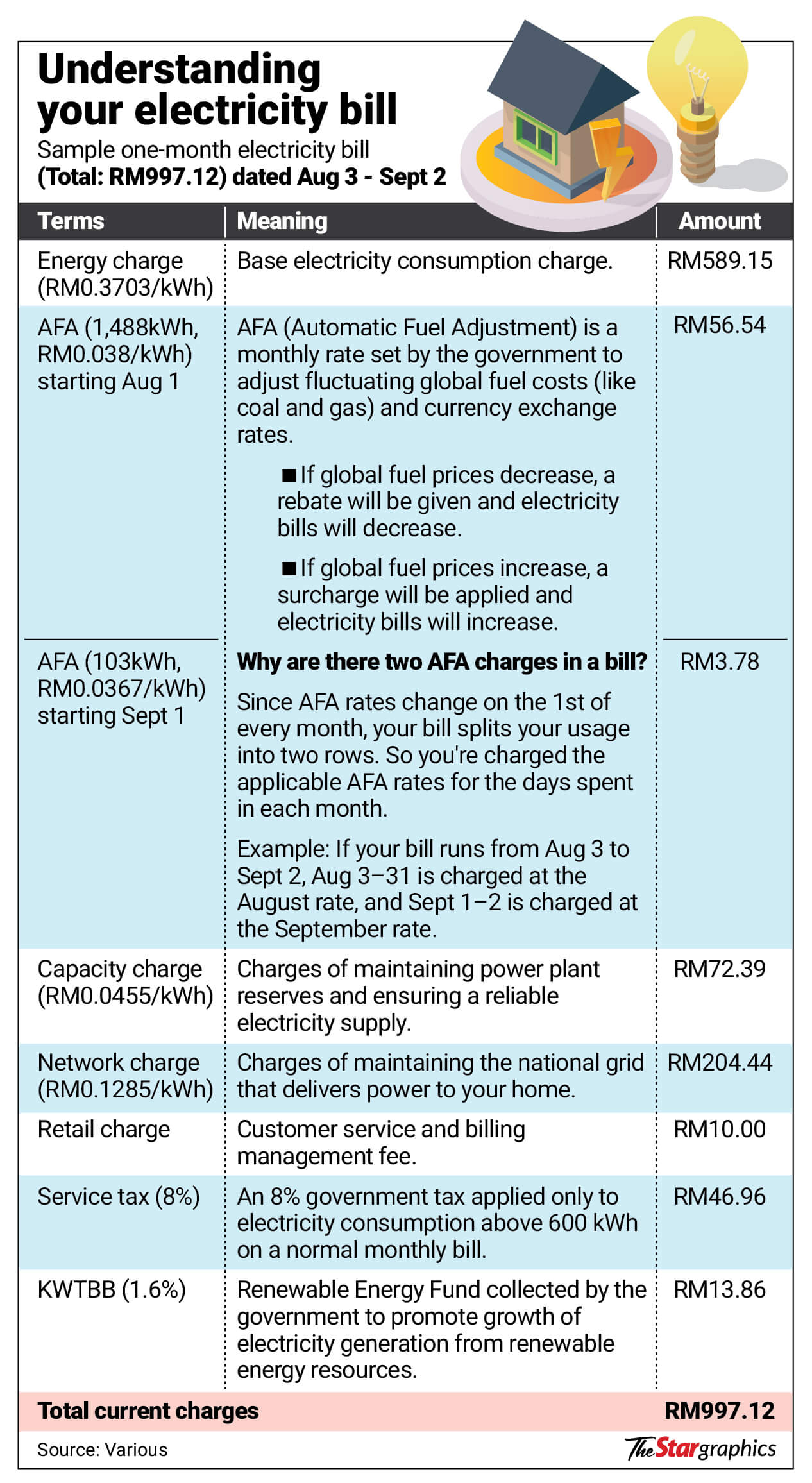
Under the current electricity tariff structure, domestic consumers using 600kWh or less a month are exempt from Automatic Fuel Adjustment (AFA) and the retail charge.
The AFA mechanism adjusts electricity generation charges monthly based on changes in fuel prices, power purchase costs and other generation-related costs.
The current AFA rate is 3.67sen per kWh.
Federation of Malaysian Consumers Associations (Fomca) chief executive officer T. Saravanan welcomed the government’s decision to increase the electricity bill protection threshold from 600 kWh to 800 kWh.
“This is a timely and reasonable decision, particularly considering the current hot weather and haze,” he said.
He added that Fomca has always maintained that the protection threshold should not necessarily remain at one fixed level regardless of circumstances.
“There should be flexibility to review it according to prevailing conditions such as prolonged hot weather, drought, haze or other situations that significantly change normal household electricity consumption.
“At the same time, consumers must continue to use electricity efficiently and avoid unnecessary wastage. The objective is not to encourage higher consumption, but to ensure that households are not unfairly penalised when their electricity usage increases because of circumstances beyond their control,” said Saravanan.
TNB has stressed that AFA was not a new additional charge, but a mechanism that could result in either a surcharge or rebate depending on changes in costs.
TNB explained that AFA was a “two-way mechanism” that adjusted for changes in fuel costs and foreign exchange rates.
“When global fuel costs are lower, consumers benefit from a rebate rate, with the savings passed directly to their electricity bills,” said TNB in a statement. - Star

No comments:
Post a Comment
Note: Only a member of this blog may post a comment.