


HARIMAU Malaya closed the 2025 season undefeated. Our latest victory against Nepal – a clean and convincing performance without any of the suspended players – should have been another moment of national pride.
Yet the celebrations were overshadowed by FIFA’s Appeal Committee decision which dismissed national body Football Association of Malaysia’s (FAM) appeal in its entirety and strongly condemned governance failures within the association.
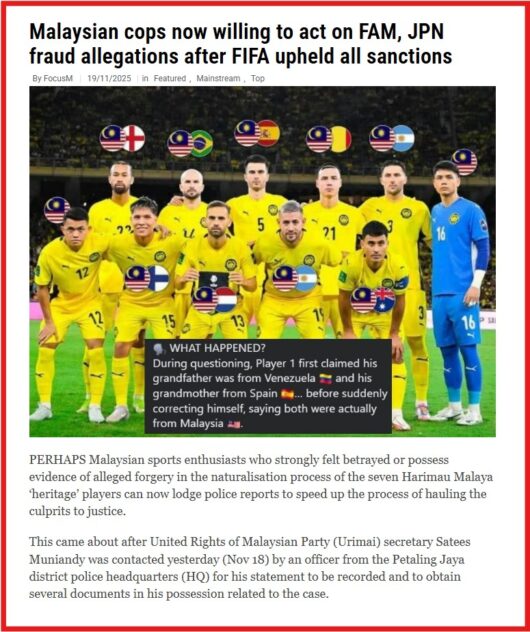
Detailed scrutiny confirmed that the birth certificates submitted during eligibility checks were not authentic. Evidence included WhatsApp messages attaching birth records showing the grandparents were not born in Malaysia.
Despite this, the seven so-called heritage/naturalised players players insisted otherwise or claimed no knowledge. Players denied involvement in falsification, insisting they submitted originals and relied entirely on their agents and FAM.
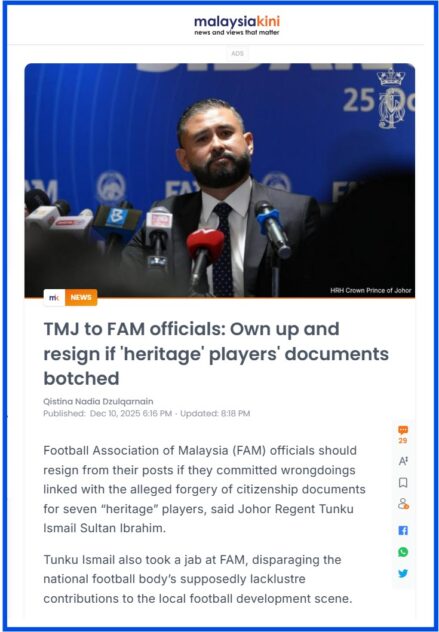
FAM admitted that secretariat members had made “administrative adjustments” to the birth certificates, including altering contents, but insisted this was done without its knowledge or authorisation.
Due diligence lapses, lack of remedial action
Under Article 22 of the FIFA Disciplinary Code, such arguments are irrelevant. The offence lies in submitting the documents – not in whether there was knowledge or intention, hence highlighting the strict liability nature of compliance obligations under FIFA rules.
The Committee criticised the players for taking no steps to verify the documents submitted on their behalf, even after sanctions.
With professional suspensions barring them from practising their profession and earning a livelihood, their inaction was inconsistent with the duty of care and diligence expected of professional athletes.
FAM was also criticised. No disciplinary measures were taken and its secretary-general’s alleged suspension lacked credibility.
The Committee noted serious governance failures and suggested attempts to shield responsible individuals rather than address the issue transparently.
The matter has escalated beyond sporting sanctions. FIFA has lodged criminal complaints in five jurisdictions – including Malaysia – and launched a formal investigation into FAM’s internal operations.
These developments underline that accountability may extend into criminal proceedings, not merely administrative or sporting penalties.
Appeal to CAS
Malaysia sits proudly at the top of Group F in the 2027 AFC Asian Cup Qualifiers. Yet can we defend those points when our administrative integrity is in question?
FAM’s appeal to the Court of Arbitration for Sport (CAS) is within its rights. Nevertheless, with the same facts and defence, expecting a different outcome under a deeper scrutiny by a panel of international arbitrators would be overly optimistic.
FAM’s admission that forgery or falsification occurred as found by the Committee severely limits any argument to the contrary before CAS.
Such an admission carries potential criminal liability and even attempts to argue proportionality of sanctions face significant hurdles, as CAS is unlikely to view leniency favourably for admitted criminal conduct.
FAM’s admission that administrative members altered birth certificate contents yet months later cannot identify the responsible individuals, leaves the association in a difficult position.
How can trust be re-built when the root cause remains unidentified? How do we ensure the achievements of our national players who fight for the jersey with honour are not overshadowed by administrative failures beyond their control?
The implications go beyond FAM and the national team. While public pressure has naturally shifted toward the government, Article 15(c) of the FIFA Statutes reminds us that national associations must remain free from political or governmental interference.
Integrity, the path forward
Any government intervention – even if well-intentioned – risks FIFA suspension, thus affecting all age-group teams, the Malaysian Football League, and its participating clubs, crippling the entire football ecosystem.
During Malaysia’s final home match of 2025, fans made their stance clear with banners calling out FAM, reminding officials that national pride is not for sale.
On the pitch, Harimau Malaya has shown resilience and quality even without the suspended players. Their consistent performances and recent wins despite the on-going chaos surrounding the association prove that Harimau Malaya can roar without controversy.
Malaysia has improved where it matters most: on the field. Now the administration must rise to match that standard.
The appeal decision is not a death sentence but a wake-up call and an opportunity – perhaps overdue – for FAM to re-build trust, strengthen governance and implement robust corrective and compliance measures that meet the demands of international football law.
As the governing body, FAM must be the first and strongest guardian of integrity, not the last line of defence.
Performance may bring victories but only integrity preserves our legacy. Integrity is not optional, negotiable or a matter of convenience but the foundation upon which national pride stands.
After all, integrity must stand alongside performance – and it must never be compromised.
Leonard Yeoh is a partner and Sharon Teo an associate with the law firm, Tay & Partners.
The views expressed are solely of the author and do not necessarily reflect those of MMKtT.
- Focus Malaysia.

No comments:
Post a Comment
Note: Only a member of this blog may post a comment.