


Every Wednesday evening, the Finance Ministry announces the following week’s fuel prices, and the statement always includes the same four words: “using the APM formula”.
It said this when diesel went up 80 sen on March 12, it said this when diesel went up another 80 sen on March 19, and it said this again yesterday when diesel went up yet another 80 sen to RM5.52 per litre.
That is three consecutive weeks of the same increase, to the sen, in a market that has been anything but stable.
I found that odd, so I looked at what happened to global oil prices during the same period. Brent crude surged to US$119 per barrel on March 19 as the Middle East conflict escalated, then fell sharply to US$99.75 by March 25 on ceasefire hopes, a swing of nearly 17 percent in less than a week.
The global market moved dramatically in both directions, yet the output of the government’s pricing formula did not move at all. It produced the same 80 sen increase three times in a row, as though the underlying market conditions were identical each week, which they plainly were not.
This matters because of what the Automatic Pricing Mechanism (APM) is supposed to do. A formula driven by market inputs should reflect market movements, meaning that when crude rises 20 percent in one week and falls 16 percent the next, the retail price of diesel should change by different amounts each week because the inputs feeding the calculation have changed.
Calculating weekly fuel price
To understand why verification is impossible, it helps to know how APM actually works.
The formula has two moving parts. The first is the Mean of Platts Singapore (Mops), which is a benchmark price for refined gasoil set daily by S&P Global Platts based on actual trading transactions in Singapore.
Most Asean countries and Australia use Mops as their reference point for domestic fuel pricing because it reflects the real cost of already refined fuel rather than crude oil, which still needs to be processed before it can be used.
The second variable is the US dollar to ringgit exchange rate, which matters because Mops is denominated in US dollars and must be converted into ringgit before the retail price can be set.
Everything else in the formula is fixed by the government, for example, the oil company profit margin at 2.25 sen per litre, the petrol dealer margin at 10 sen, operational costs at 9.54 sen, and a buffer called Alpha at four sen. These fixed components add up to 25.79 sen per litre and have not changed.
This means that the entire week-to-week movement in the diesel price should be traceable to just two numbers, the Mops gasoil average for the preceding week and the exchange rate used to convert it.
The problem is that Mops data is proprietary, sold by S&P Global Platts to paying subscribers, and the government has never published the Mops figure it uses in any weekly pricing announcement.
While the formula itself is public knowledge, the single most important number that drives it remains hidden, which means the price Malaysians pay at the pump is effectively unverifiable.
What the numbers don’t show
This opacity creates a situation where two very different things could be happening, and neither can be confirmed nor ruled out.
If the true APM-derived price was higher than RM5.52, it would mean the government has been absorbing a gap it has not disclosed, and the RM3.2 billion monthly subsidy figure would understate the real fiscal exposure.
If, on the other hand, the true APM price was lower than RM5.52, then Malaysians are paying more than the formula would produce.
There is another reason why transparency matters more now than in normal times, and it has to do with a concept most Malaysians have never needed to think about: the “crack spread”.
In the oil industry, the crack spread refers to the premium that refined fuel commands over crude oil, reflecting the cost of refining crude oil into usable products like diesel.
Normally, this premium is modest and relatively stable, but when refineries themselves are physically destroyed, as has happened during the current conflict in the Middle East, the crack spread explodes because the global capacity to turn crude into usable fuel has been reduced while demand remains the same.
Diesel affecting the cost of everything
Understanding this structural shift is essential because diesel is fundamentally different from petrol in how it affects the cost of living.
The Budi95 subsidy holds RON95 petrol at RM1.99 per litre, and the government is spending RM2 billion a month to maintain that price, which protects what Malaysians pay when they fill up at the pump.
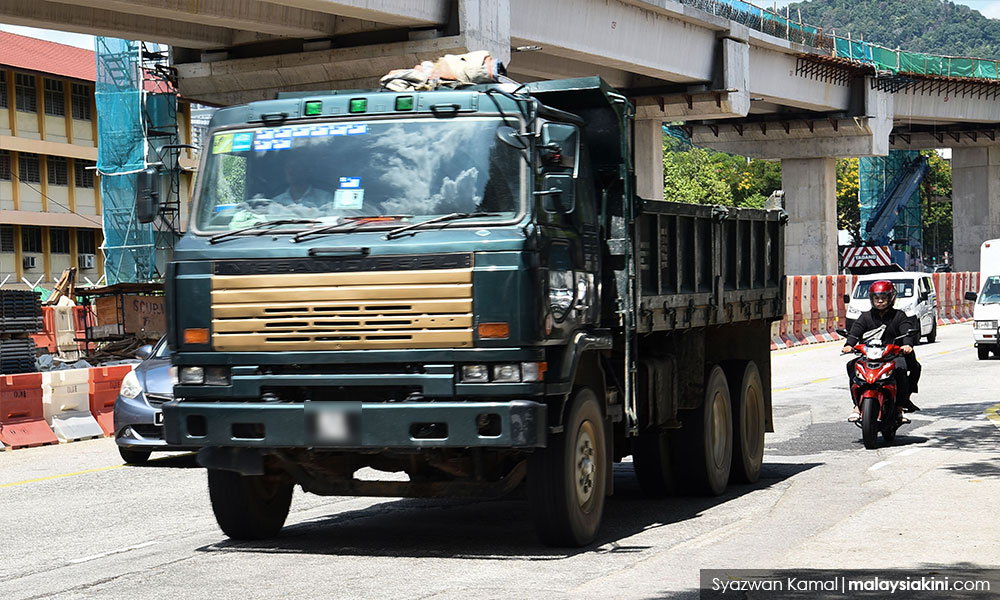
But diesel is the fuel underneath the price of virtually everything else in the economy. It powers every lorry carrying rice to the kedai runcit, every trawler landing fish at port, every refrigerated truck keeping vegetables fresh on the way to the pasar, every excavator on every construction site, and every generator running a factory floor.
Fuel represents 30 to 50 percent of a logistics company’s operating costs, meaning that when diesel doubles, those costs do not stay within the transport sector but instead cascade through the entire supply chain, from farm to factory to warehouse to shelf, until they land on the price of food and daily essentials.
Food and beverages alone account for 29.8 percent of Malaysia’s consumer price index, nearly double the 15 percent weight of transport. The petrol subsidy protects what you pay at the pump, but nothing currently protects what you pay at the dinner table, and that is where the real impact of diesel pricing is felt.
Across the region, governments have responded to the same external shock with concrete emergency measures. The Philippines declared a national energy emergency and moved its government to a four-day work week, Thailand froze diesel prices and banned fuel exports, and Vietnam slashed fuel import tariffs to zero.
Malaysia, by contrast, deferred a decision on work-from-home until after Hari Raya and ruled out a stimulus package. If the government’s position is that its response is adequate and its pricing is fair, the least it can do is show the public the numbers behind the price.
Publish the Mops gasoil average and the exchange rate used in each weekly diesel calculation, and let Malaysians see the arithmetic for themselves. -Mkini
WOON KING CHAI is the director of the Institute of Strategic Analysis and Policy Research (Insap). He previously served in senior roles in the federal government and private sector.
The views expressed here are those of the author/contributor and do not necessarily represent the views of MMKtT

No comments:
Post a Comment
Note: Only a member of this blog may post a comment.