


The expected early dissolution of the Johor legislative assembly paves the way for the 16th state election. Malaysia’s 2026 busy election season has begun.
As with the November 2025 Sabah election, this contest will have national political implications, while the campaign itself will likely centre on local governance and issues.
Under the dynamic leadership of Umno’s caretaker menteri besar, Onn Hafiz Ghazi, Johor’s economy has undergone significant growth and transformation.
His ambitious Maju Johor 2030 blueprint has positioned the state as one of Malaysia’s strongest economic performers and simultaneously showcased forward-oriented leadership focused on deliverables.
The decision for early polls, at the start of an expected Iran-war-induced global economic slowdown and increasing pressures on inflation from the ongoing energy crisis, speaks to a recognition of the increasing strain on livelihoods and aims to keep the state government’s goals on track.
Politically, any incumbent facing the dark economic clouds ahead is searching for the right time to reduce the impact of the storm.

The Johor state election timing also capitalises on divisions between the two opposing coalitions – Pakatan Harapan and Perikatan Nasional.
Unlike the rest of Malaysia, where a coalition in the Madani government governs, Johor is the only state where there is no collaboration between the Harapan and BN coalitions.
Inevitably, Johor’s polls were to be an electoral contestation among the three coalitions, as a solo coalition government opts for a solo contest.
Johoreans will be given an opportunity to assess Malaysia’s individual political coalitions and their candidates separately. With less coalition ambiguity, they will have more choices and clarity in those making those choices. Greater voter choice lies at the heart of democracy, even as it fragments overall politics.
Underappreciated competitiveness amid greater uncertainty
Despite Umno/BN holding a comfortable majority of 40 out of 56 seats in Johor, more than half of the total seats remain electorally competitive, shaped by changing patterns of support across key groups of voters and shifting dynamics in voting behaviour.

Examples of Umno/BN competitive seats include N21 Parit Yaani and N25 Rengit.
Johoreans have shown that they swing their vote decisively over the last three elections, from 2018 to 2022 (both state and federal polls). Johor is no longer a place of political certainty, even as it remains the strongest core for Umno/BN.
The opposition seats – those of Harapan, PN, and Muda – are also competitive. After Sabah’s bungkus, DAP too cannot expect to hold onto its 10 seats handily.
The Sabah lesson for DAP (and for other parties as well) is that no seat can be seen as “safe” if the campaign flows against them. Malaysian voter support cannot be taken for granted.
The recent DAP mishandling of the now-exiting politics Skudai assemblyperson Marina Ibrahim is illustrative of too much party confidence and too little appreciation of a shifting ground.
My current analysis – before candidate finalisation, which will also shape competitiveness levels - is that 34 Johor state seats are currently competitive, with 27 seats highly so. The other 22 seats are seen as safe/winnable for the incumbents at this early stage of the campaign.
Still a fluid electorate
Three factors account for the competitiveness:
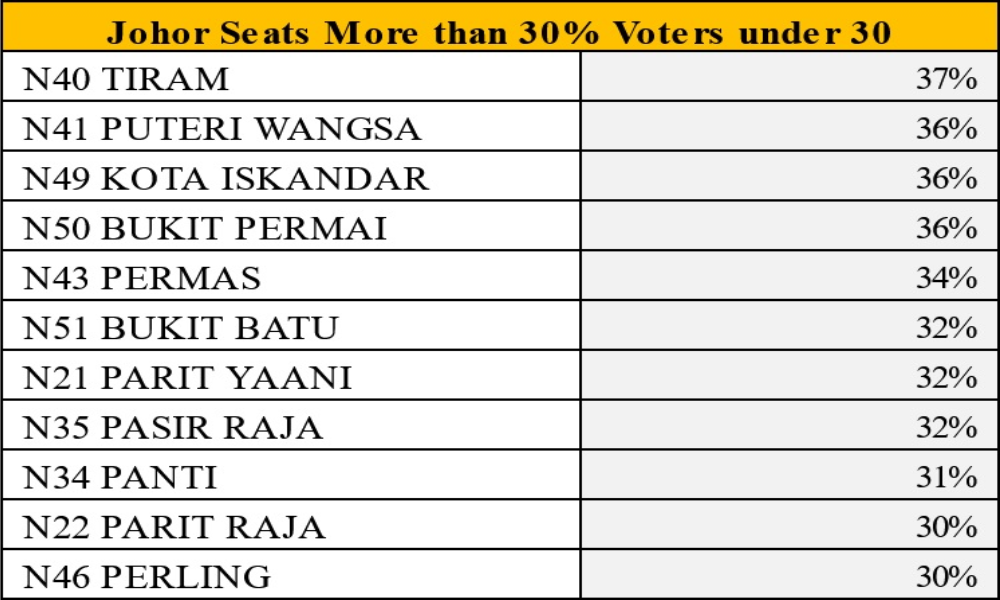
Youth Reservoir – young voters under 30, many of whom are politically disengaged, are adopting a “wait and see” approach, looking to the candidate and open to being won over. While youths have been courted through programmes and social media messaging, the lack of party loyalty and political flexibility makes this group decisive in adding uncertainty to the polls.
Voters under 30 account for 28 percent of Johor’s 2.7 million voters. Youths particularly comprise large voter shares in N40 Tiram, N41 Puteri Wangsa, N49 Kota Iskandar, and N50 Bukit Permai, all highly competitive seats. It remains to be seen where the youth reservoir will flow.
2. Party Splits - While factionalism is always a party norm, two parties are particularly split with electoral consequences.
The first is PKR, which has dominated the headlines with the emergence of Rafizi Ramli’s political vehicle Bersama. The splits extend into Johor, where parliamentarians and grassroots are divided.
While PKR’s sole seat of N51 Bukit Batu currently remains aligned with Prime Minister Anwar Ibrahim and is hoping to survive any targeted anti-federal government voter message, the party’s ground overall is fractious and fragile.
Johor has been an important political base for PKR, especially at the parliamentary level. This base is internally eroding and being externally challenged.
The other important split is that of Bersatu, which has become Berdua for some time, now with Hamzah Zainuddin’s “Reset”.
Johor will be the state where the factionalism in this party will come to a head in candidates and seat choices, especially in the troubled relationship of Bersatu with the senior partner of Perikatan Nasional, PAS.
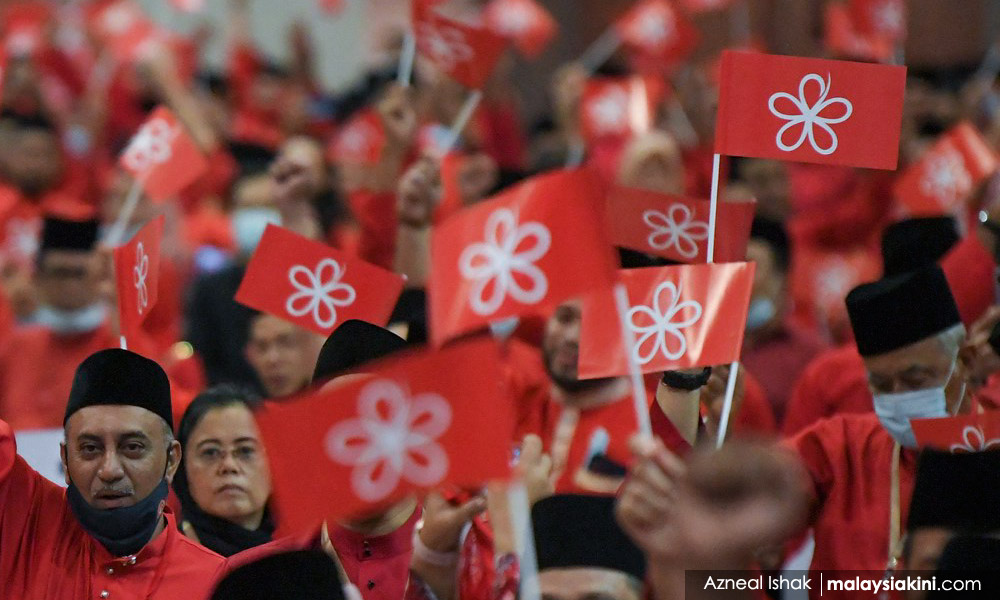
Johor was also a core Bersatu base – the party is arguably even more divided on the ground than PKR, with the bitterness of those aligned to former prime minister Muhyiddin Yassin or Hamzah evident. As such, Bersatu’s two seats – N7 Bukit Kepong and N32 Endau are highly competitive, making further factionalism there electorally decisive.
3. Non-Malay voter frustration
Finally, Johor will showcase the impact of non-Malay voter dissatisfaction, including the consequences of ignoring concerns of the Chinese communities, from SMEs and e-invoicing to religious identity.
Chinese voters comprise 36 percent of the Johor electorate, with Indians at seven percent. Significantly, both of these communities have shown strong vote swings away from Harapan in terms of reduced turnout and changes in political support in recent polls after the 15th general election.
These communities have considerable electoral power, comprising a significant 30 percent voter cohort in two-thirds (41) of Johor seats. It is only in 15 seats where there are large Malay majorities. The average share of non-Malays in seats in Johor is 44 percent, highly electorally salient.
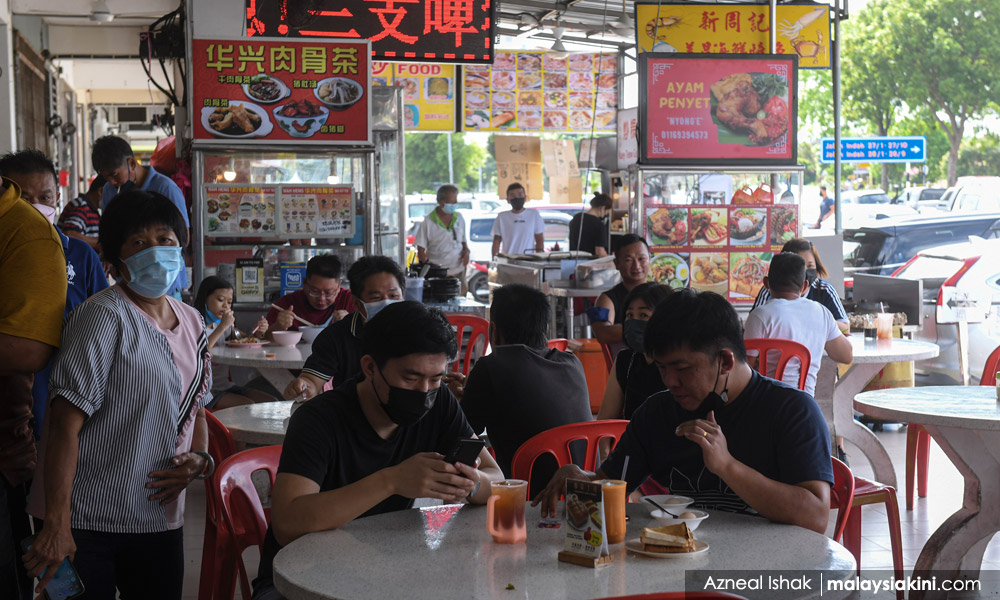
This diverse ethnic distribution speaks to the issues of Bangsa Johor – her multi-ethnic identity. It also highlights greater electoral vulnerability when government engagements and party mobilisation are perceived as narrowly focused on one community rather than more broadly.
The coalition with the most ethnic crossover has the best electoral chance to retain and gain seats in Johor. Here, campaign narratives will be important. Electoral fluidity across communities will make this election interesting to watch, adding to the competitiveness.
Madani & PAS national mojo
No question, the Johor polls will shape national politics. Madani partners federally and in other states will be pitted against each other, in what is already starting to be an “attack-each-other-in-Madani” campaign.
DAP has already made Umno/BN its punching bag, a traditional electoral repertoire, and Umno Youth has returned fire. There has been an embrace of solo distancing – making voter transferability of the 2023 state polls in ethnically diverse states elsewhere and in GE16 harder to recreate.
This will make for a more fragmented, uncertain, and competitive electoral landscape more broadly.
Minimally, the Johor polls will distract from governance as attention turns to elections. This will grow if/when other states dissolve. Individual parties and coalitions are already focusing on their mojo.
Johor PAS, for example, has been strengthening on the ground after winning N15 Maharani in the March 2022 state election and is hoping to increase their seats, capitalising on a weaker Bersatu and their active, quiet groundwork.
PN has already finalised candidates for the majority of the 56 seats and goes into the campaign with greater confidence.
For Johoreans, the opportunity to shape the state’s governance and the nation’s is arguably one of the strongest ever. This comes after Johor has already played a decisive role in shaping outcomes in 2013, 2018, and 2022.
Not only will the state choose their state government, their maju; they will also impact the mojo of all the parties and coalitions. - Mkini
BRIDGET WELSH is an honorary research associate of the University of Nottingham’s Asia Research Institute, a senior research associate at Hu Fu Centre for East Asia Democratic Studies, and a senior associate fellow at The Habibie Centre. Her writings can be found at bridgetwelsh.com.
The views expressed here are those of the author/contributor and do not necessarily represent the views of MMKtT.

No comments:
Post a Comment
Note: Only a member of this blog may post a comment.