


JOHOR POLLS | With less than 72 hours before polling day on July 11, the Johor state election has entered its final sprint.
While Pakatan Harapan's prospects appear to have stabilised, it remains the underdog, with three major variables set to determine the final outcome.
During the campaign period, the Malaysiakini team visited multiple constituencies across southern, central, and northern Johor.
The team found that while Harapan initially faced pressure from a loosening and even dissipating Chinese base at the start of the campaign, many Chinese voters have begun to show signs of support for the coalition after the first week of campaigning.
However, this resurgence is not yet enough to turn the tide of the overall battle, and BN maintains its leading advantage.
At present, the biggest suspense in the election has shifted from "who is leading" to three key questions: where the Malay votes will ultimately go, whether outstation voters will return home to vote, and whether young voters will become a force capable of changing the electoral battlefield.
In the early stages of the campaign, when Malaysiakini visited several Chinese-majority constituencies and conducted street interviews, the most common sentiment heard was dissatisfaction with Harapan.
Many Chinese voters criticised Harapan's performance over the past two years, citing disappointments with policies such as the e-Invoice and the Selangor pig farming issue.
Some voters in Mengkibol even lamented that Parti Bersama Malaysia was not contesting there, and were considering not voting at all.
Mengkibol is located under the Kluang parliamentary seat. It is a Chinese-majority constituency, about 57 percent, and a fortress for DAP.
The apparent shift
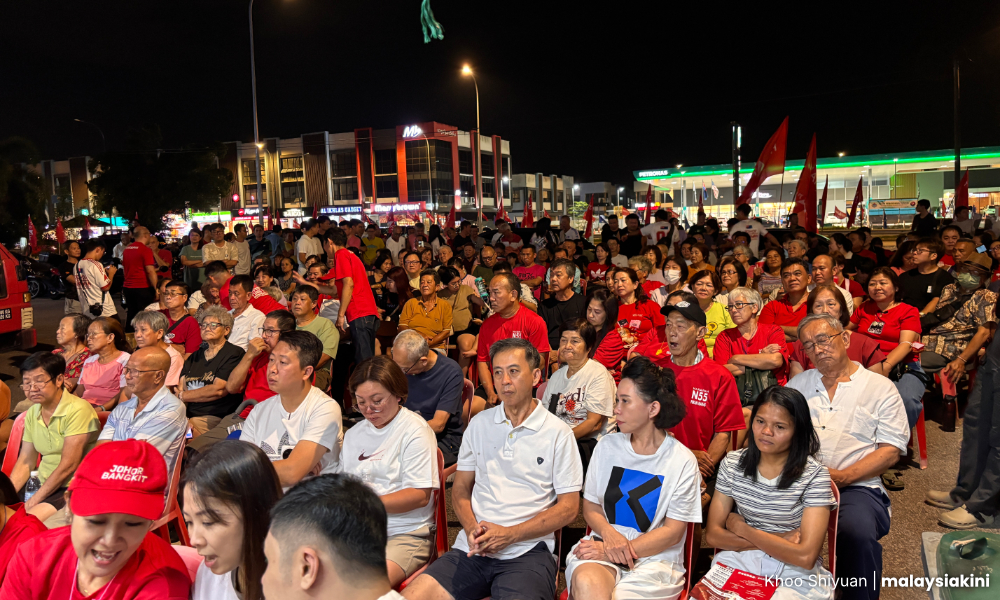
However, during the weekend when the campaign entered the halfway point, the atmosphere on the ground began to change noticeably.
Whether at morning markets, night markets, or political rallies, whenever Harapan candidates and leaders appeared, more voters began proactively asking for photos, shaking hands, and expressing support.
The crowds at political rallies also noticeably increased compared to the early days of the campaign.
The Chinese are now giving Harapan candidates a warmer response, it appears. Many have directly stated that they will support and vote for Harapan.
This shift could be due to two reasons.
First, some Johor outstation voters returned home for the weekend, swelling the crowds at event venues.

But the bigger reason is that after a week of campaigning, Harapan's continuous narrative focusing on "BN-PAS cooperation" has begun to gain traction, successfully re-mobilising a portion of the Chinese base.
However, if this strategy continues as the main campaign anchor, it may gradually lose its efficacy.
Therefore, over the next three days, the respective camps must present more policies and future visions rather than relying solely on emotional mobilisation.
This also does not mean that the disenfranchised Chinese voters have changed their minds.
The Malay votes
Although multiple opinion polls show BN holding the upper hand, the true wildcard remains the direction of the Malay votes.
Before the election, some Harapan leaders believed that if the Malay vote split, they would theoretically stand a chance to "win amid the chaos”.
However, with Perikatan Nasional withdrawing from 23 seats and PAS calling on its supporters to back BN, this assumption - which was originally built on a three-way contest for the Malay vote - is now difficult to materialise.
It has also left Bersatu supporters in many seats without a clear choice of who to vote for.
Particularly in mixed constituencies like Larkin, where Bersatu secured about a quarter of the votes in the last election but is not on the ballot this time, no one can accurately predict whether these voters will side with BN, stay at home, or swing elsewhere.

Following visits to the area, the Malaysiakini team found that even though some Bersatu supporters explicitly stated they would not support Harapan, there was no consistent answer on whether they would switch to BN.
Some indicated they remained undecided, while others leaned toward abstaining.
READ MORE: 10,000 PN 'ghost' voters will be kingmakers in JB's Malay-majority seat
Since Malay voters make up a significant proportion of most mixed constituencies in Johor, this swing is enough to decide the winner in multiple marginal seats.
Onn still popular
Nevertheless, according to a survey conducted by the Merdeka Center before nomination day, Johor BN chief and caretaker menteri besar Onn Hafiz Ghazi enjoys soaring popularity, commanding a 78 percent approval rating across all ethnic groups.
This includes a 92 percent support rating among Malays, 94 percent among Indians, and 53 percent among Chinese.

Despite this, Harapan's advantage in holding federal administrative resources has made it easier for them to reach out to Malay voters.
On July 4, Harapan held a rally in the Ulu Tebrau Felda settlement within the Puteri Wangsa constituency.
Apart from Prime Minister Anwar Ibrahim's personal attendance, former Umno man Puad Zarkashi also took the stage to assist the campaign.
About 200 people attended the event. For Harapan, which has historically found it difficult to penetrate deep into Felda settlements, such an event carries symbolic meaning in itself and reflects Harapan's active pursuit of the Malay grassroots, whom they previously found harder to reach.

Limited engagement with Indians
Aside from the Malay votes, the Indian vote is another key variable in this state election that is easily overlooked.
Many state seats in Johor are mixed constituencies. Even in seats regarded as Chinese-majority, the proportion of Indian voters generally approaches or exceeds 10 percent of the electorate.
Therefore, any shift in support from this community could alter the final results.

Harapan's campaign focus remains on locking down Chinese support while attempting to reach Malay voters, leaving its engagement with the Indian community relatively limited.
The Anwar government has previously drawn dissatisfaction from parts of the Indian community over issues such as university matriculation quotas and the demolition of Hindu temples.
Furthermore, Johor BN has historically maintained a certain level of organisational strength among the Indian grassroots.
If BN successfully consolidates its Indian support further, it could deal a blow to Harapan's incumbent seats, such as Tangkak (10.2 percent Indian), Perling (13.1 percent Indian), Johor Jaya (7.9 percent Indian), and Jementah (8.3 percent Indian).
Since the start of the campaign, BN has held fewer large-scale rallies or mega-events.
Instead, they have organised numerous campaign activities to meet party members and grassroots supporters, seemingly focusing their firepower on consolidating their core base.
Youth vote matters
Another group worthy of attention is young voters.
According to data from the Merdeka Center, there are 1.13 million voters aged between 21 and 39 in this state election, making up the largest age demographic.
Additionally, 6.1 percent of the voters are first-time voters following the implementation of the automatic voter registration policy for 18-year-olds.
These young voters exhibit ambiguous political leanings. Rather than ethnic politics, they care more about job opportunities, housing, the cost of living, and local bread-and-butter issues, rather than traditional political slogans.
After interviewing several young voters, Malaysiakini found that they generally expressed their intention to fulfil their voting duty, but many have yet to decide who to support.
Unlike in the past, they prefer to compare the policies and narratives of various political parties themselves rather than blindly following the preferences of their families.
Consequently, Harapan and BN have visibly ramped up their social media operations recently, hoping to win over young voters through TikTok and short videos, even deploying Malay influencers to court them.
PN’s low visibility
In contrast, PN's social media momentum this time around is visibly weaker, nowhere near as sharp as during the 2022 general election when it successfully attracted young Malay voters using TikTok.
As for Bersama, observations so far suggest it will be difficult for them to break the duopoly of Harapan and BN.
For Bersama, this state election is more akin to a political experiment. If they can secure 12.5 percent to 15 percent of the votes in some constituencies, they will not only save their election deposits but also prove they possess an independent base of support, gaining political bargaining chips for the future.
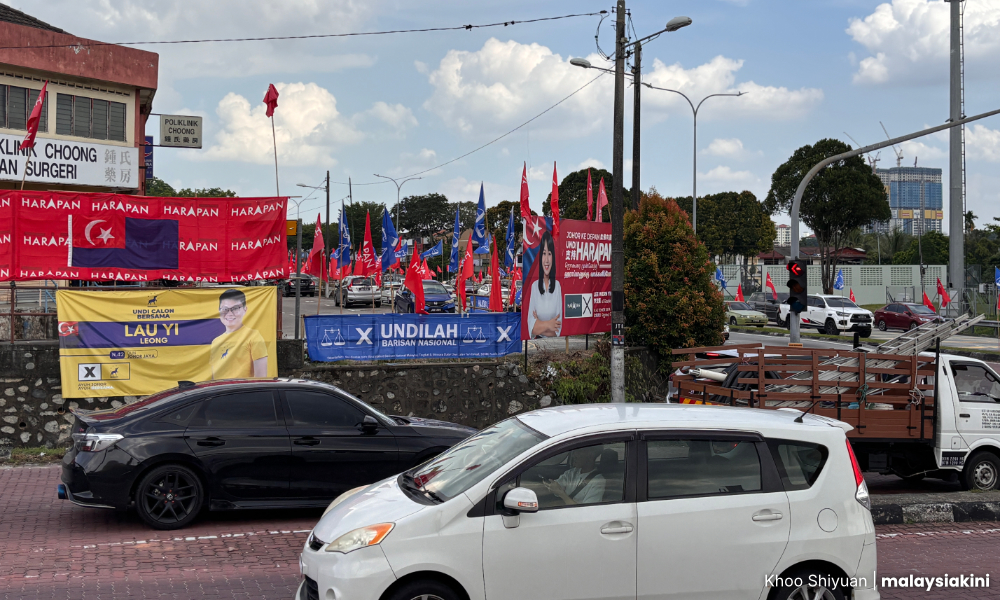
In the Johor Jaya state seat, Bersama candidate Lau Yi Leong, who has a legal background, is one of the more prominent candidates within the party, and is viewed as one of the constituencies where Bersama stands the best chance of achieving better results.

In the last state election, DAP won the seat under the Harapan banner by a razor-thin majority of just 4.06 percent or 1,922 votes.
Perhaps, to prevent Bersama from splitting the Chinese votes, DAP has started attacking Bersama in recent days.
Selangor's Seri Kembangan assemblyperson Wong Siew Ki, who is stationed in Johor Jaya to assist in campaigning, has traded barbs with Lau.
DAP organising secretary Khoo Poay Tiong and "returning" firebrand speaker and former party member Hew Kuan Yau have also slammed Bersama, with Hew even calling on voters to "discard yellow to protect red”.
With all factors considered, Harapan's more realistic goal remains defending the 12 seats it won in the last election, along with Puteri Wangsa, which was previously conceded to Muda.
Some of its original constituencies are still facing fierce competition, including mixed seats like Tangkak and Johor Jaya, while some constituencies with a higher proportion of Chinese voters remain relatively safe.

At the same time, the Perak DAP, led by Housing and Local Government Minister Nga Kor Ming, is actively taking the offensive in Yong Peng, while MCA is concentrating its firepower on attacking Harapan seats like Penggaram.
Both sides have adopted a strategy of "targeted breakthroughs" rather than waging an all-out war.
Whether it's the seats they hold or plan to expand to, if the Malay votes swing at the last minute, if outstation voter turnout exceeds expectations, and if young voters make a decisive last-minute choice, the outcome of this election could still differ from what was anticipated by the outside world at the start of the campaign. - Mkini

No comments:
Post a Comment
Note: Only a member of this blog may post a comment.