


Johoreans head to the polls in three days in a state election that will decide the composition of the state government.
While there will be national spillovers from the results, the primary impact will be what sort of mandate the state leadership will receive.
During the campaign, the incumbent leadership of the state by Umno/BN, and in particular its caretaker menteri besar Onn Hafiz Ghazi, has faced a barrage of attacks, many of these highly personalised.
Personal attacks have long been part of Malaysia’s campaign culture. That the attacks have escalated to senior leaders speaks to the intensity of the election.
Inevitably, these attacks have provoked strong reactions along partisan lines and among Johoreans broadly, many of whom see the attack on Onn Hafiz as an attack on one of their own.
Others enjoy watching the fight without appreciation of the divisive harm this sort of campaigning causes, while yet others are hoping that these attacks will yield support rather than backfire.
In this piece, I focus on Onn Hafiz’s record. Inadequate attention has been paid to the deliverables and challenges of his four-year tenure in office. They deserve more attention. After all, most importantly, this election is about the governance of Johor.
Investment, growth and jobs
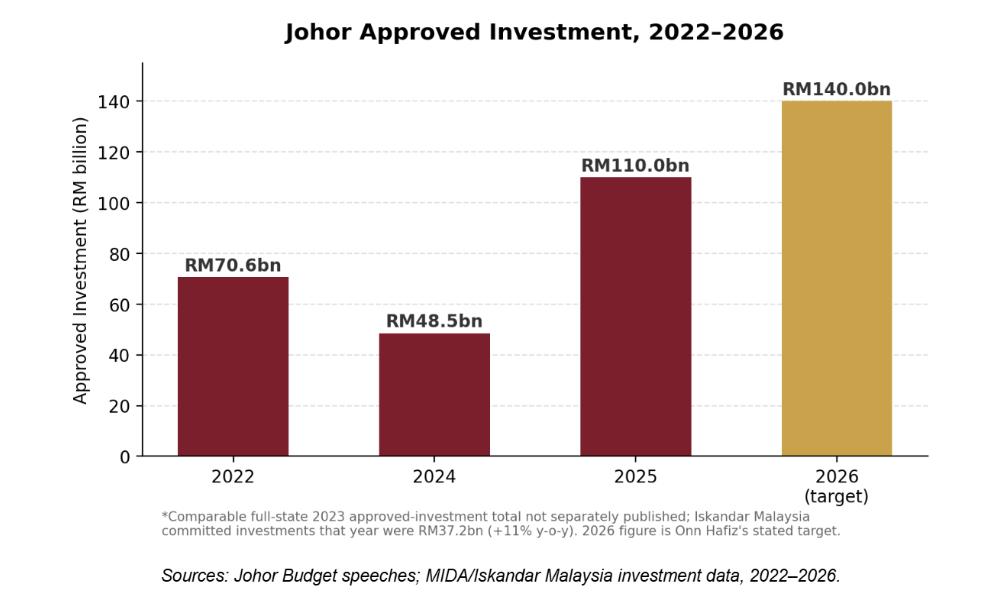
Let’s start with the economic numbers. Approved investment has been the signature metric of the Onn Hafiz administration. It rose from RM70.6 billion in 2022 (Malaysia’s highest that year, creating roughly 12,000 jobs) to a record RM110 billion in 2025 - overtaking Selangor for the first time to make Johor the country’s top investment destination, with over 24,000 jobs projected.
Onn Hafiz has set a 2026 target of RM140 billion. Investment-linked job creation doubled from roughly 12,000 (2022 approvals) to over 24,000 projected from the 2025 record.
Gross domestic product (GDP) growth reached 6.4 percent in 2024, the highest of any Malaysian state, lifting output to RM158 billion, and state revenue has grown from under RM2 billion when he took office to roughly RM2.67 billion in 2025, on course to exceed RM3 billion for the first time.
These numbers speak for themselves. Investment in Johor is dominated by data centres and digital infrastructure, alongside semiconductor and advanced manufacturing firms serving Singapore-based supply chains.
There has also been investment in property and education. While the federal government has played a pivotal role in supporting this investment, through the creation of the Johor-Singapore Special Economic Zone (JS-SEZ) (even with delays), the ability to consistently pull investment into Johor has been tied to Onn Hafiz’s leadership, with investor confidence coming from his technocratic approach and initiatives to streamline processes and build a broader ecosystem.
Political economy challenges
This investment has not come without challenges. Focus has primarily been on the data centres – with concerns raised about water and electricity supply. Land issues have also emerged, with questions about the impact on the environment and ownership rights.
Johor’s experience has drawn attention to the debates happening across the world about the impact of data centres on local economies and who is benefiting from these centres.
The concerns are real, but the solutions are not as easy to resolve. Given the expansion of data centres across Malaysia, the solutions will require a holistic approach, which is not helped by divisive attacking politics.
Onn Hafiz’s leadership has also wrestled with how to translate this investment into Johor’s local economy, especially to build the small and medium-sized businesses that are the main earners for Johoreans and to increase higher-paying jobs.
These too are issues that are national, but what is important to acknowledge is the prioritisation of these matters (across parties) in manifestoes. The BN manifesto is the most substantive in laying out a forward-oriented plan, with attention to investment capital and targets on job creation.
Johoreans acutely understand the challenge of job creation. Anyone who has observed the real strain of the commute thousands of Johoreans make daily to Singapore for livelihoods (long, rushing walk!) and on families that are separated can understand the impact on lives.
Cost-of-living realities have made the need to find better wages essential.
Bantuan Kasih Johor state assistance
Onn Hafiz’s government has been proactive in addressing the cost-of-living struggles society has faced. The Johor government’s assistance programme, Bantuan Kasih Johor (BKJ), is the fourth largest in the country, following Sarawak, Selangor and Sabah based on 2026 budgets.
These programmes are aimed at reaching those in need and are tied to the state’s fiscal capacity.
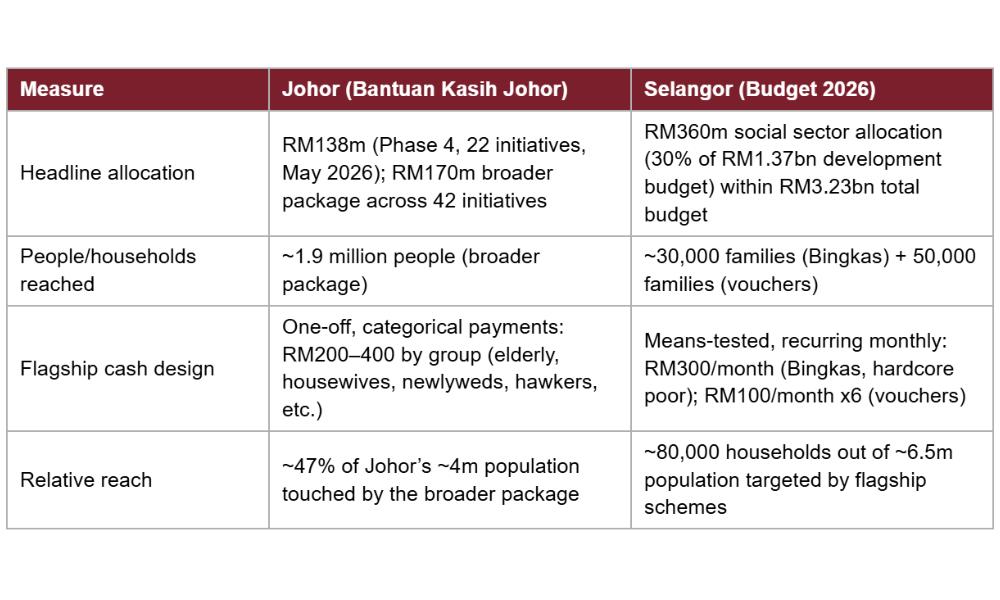
An expansion of BKJ social assistance began when Onn Hafiz took office. Phase 4 was launched in May 2026, allocated RM138 million across 22 initiatives, with categories spanning senior citizens (RM200 to 307,000 plus recipients), unemployed housewives (RM200 to 136,000), newlyweds (RM400 to 45,000 couples), hawkers (RM300 to approximately 30,000 traders), religious workers, hospital frontliners and homestay operators.
The overall May 2026 package totalled RM170 million across 42 initiatives, reaching approximately 1.9 million people - nearly half of Johor’s population.
A comparison with Selangor state, which has been similarly proactive in providing assistance in Peninsular Malaysia, is useful. What distinguishes Johor’s assistance is its breadth of coverage as opposed to its targeted focus.
Johor’s BKJ is broad-based and categorical, touching a far larger share of the state’s population through modest one-off payments, while Selangor’s flagship 2026 schemes are narrower and means-tested, but pay out monthly rather than as a single transfer.
Selangor spends more on those most in need, while Johor’s social assistance aims for more outreach. This reflects different approaches to spending.
Important housing spending
An important part of Johor's spending has been on housing. Claims that there has been a lack of attention to housing do not hold up.
There have been different approaches here too in Peninsular Malaysia, with Penang and Selangor focusing on supply-side deliverables of affordable houses and Johor focused more on demand-side assistance to support buying a house through grants up to RM7,000 for first home buyers.
Overall, government spending on housing in Johor has been high. Johor led Malaysia in the federal Housing Credit Guarantee Scheme, funding RM1.1 billion as of April 2026.
The Onn Hafiz government has also expanded support for the state housing programme, RMMJ (Rumah Mampu Milik Johor). The number of affordable houses has risen, evident across Johor on the ground, from Penawar to Kota Iskandar.
Supply in Johor is increasing, although more slowly. RMMJ has targeted 30,000 units, which is behind Penang and Selangor, who started these initiatives when they came into office over a decade ago and have focused more funding on building the houses.
Onn Hafiz’s Johor government has put a different priority on giving grants to first-time home buyers – supporting demand. Grant recipients of the Perumahan Kasih Johor cash assistance have reached 4,126 families to date and are increasing, a development before the polls.
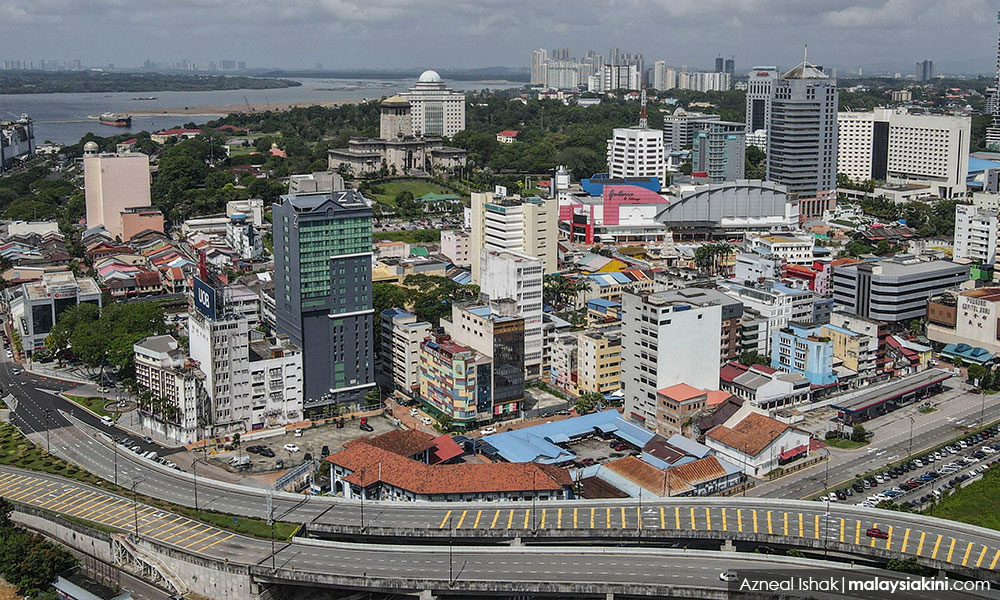
The focus has also been on creating conditions to allow for housing developments to expand, building the housing ecosystem as part of urban renewal.
There has been a prioritisation on rebuilding Johor Bahru’s city centre; the Johor Bahru Coronation Square project is the state administration’s flagship urban-regeneration initiative.
The hope is that this will generate RM9 billion in economic spin-offs and create 60,000 jobs. Anyone who has regularly visited Johor Bahru can appreciate the need for this renewal. No question, there have been housing deliverables at the state level.
Housing affordability remains a challenge ahead, nevertheless. Both BN and Pakatan Harapan acknowledge this (Perikatan Nasional has no manifesto for Johor) and have promised to increase spending on both supply and demand for housing.
The federal government also pledged greater support for housing during the campaign with RM216.44 million for funding for affordable housing projects, maintenance of stratified/strata housing, public amenities, community safety, solid waste management, and urban/rural development, all not new allocations but those drawn from the first rolling plan of the 13th Malaysia Plan that have yet to be delivered. (Moving forward, please allocate some of this funding to the shop houses that have recently burned down in the historic Buloh Kasap town.)
Housing spending is both a state and federal matter and will need more focus on all sides from both sides moving forward.
Ongoing inclusive generation change
Beyond the social issues, there has been another deliverable of his administration – a generational change in Malaysia’s leadership with greater inclusion.
Onn Hafiz’s appointment marked a generational handover: predecessor Hasni Mohammad, then 63 years old, withdrew from contention and endorsed the 42-year-old Onn Hafiz.
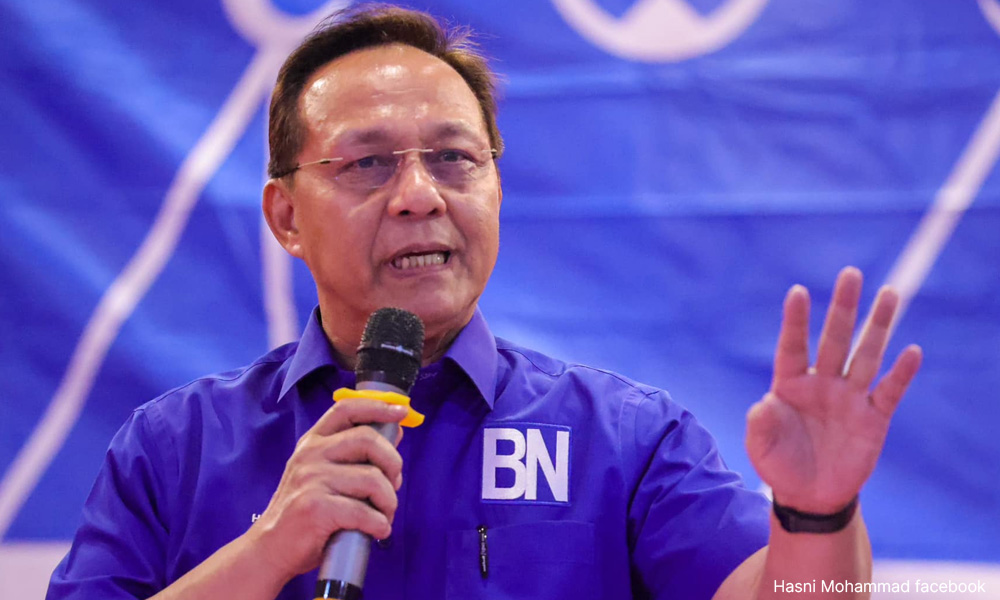
Hasni was statesmanlike in his handover and can be credited with BN’s electoral victory in the last state election.
Hasni remains one of the most popular leaders in Johor, with his own tenure being remembered for steering the state during the challenging Covid-19 crisis years. He was known for being accessible and working to resolve issues.
The work focus has extended to Onn Hafiz’s tenure, with a different composition. Onn Hafiz led one of the most inclusive exco in the country with regard to youth participation.
While some see this negatively as an ability to articulate more autonomy in governance, the youth inclusion has allowed for new energy and ideas. The youth representation has not limited the ability for the exco to introduce new policies; instead, it has enhanced it.
There has also been ethnic inclusion following traditional BN governance of earlier decades (pre-2008). What has also made Onn Hafiz’s Johor governance distinct (in recent times) is that MCA and MIC leaders have been more prominent and active in state governance, especially in working to support investment and quiet engagement with communities.
It is important to appreciate that Onn Hafiz has worked quite effectively across the ethnic divide, as this has been an attack on him during the campaign.

His statement on the DAP relationship was too strong and rightly evoked strong responses. Yet, his record in office has been quite different.
Throughout his tenure as MB, Onn Hafiz has evoked multiethnic messages, relying on the Bangsa Johor framework. His most notable direct test on ethnic tensions came in January 2023, when a viral allegation was made that an SPM workshop excluded non-Muslim students.
The handling, via then MCA exco member Ling Tian Soon, reaffirmed that schools must be places of unity and was measured - neither dismissive nor escalatory. It also led to a royal intervention that diffused tensions.
In the area of multiethnic governance, royal support boosted Onn Hafiz’s ability to navigate Malaysia’s challenging ethnic relations.
Perceptions of royal ties
Finally, a key challenge for Onn Hafiz has been perceptions of his royal ties, seen through different political lenses.
Views of the royalty in Malaysia vary widely. Ultimately, no leader in Johor – or in Malaysia as a whole – can govern without the support of the royalty. In this era of political fragmentation and difficult ethnic tensions, this support is more important than ever.
In looking at Onn Hafiz’s tenure to date, it is important to appreciate that Malaysian politics has fundamentally changed since 2018 and ties across institutions (and among political parties and coalitions) are essential for political stability and inevitably will shape governance, creating opportunities and constraints.
As Johor’s campaign winds up, questions about political realignments in alliances, pardons for Najib Abdul Razak and the role of royalty have been part of the campaign, many to use to stir emotions and trigger strong reactions along ethnic and traditional partisan lines.

Along with personal attacks, stoking fear and insecurities have long been part of Malaysia’s political campaigns.
All of these issues – political alliances, rule of law, elite power and more – while important for where Malaysia is heading in the longer term – will not be decided by how Johoreans cast their votes.
What will matter will be the leadership of the state, its mandate and its governance. In looking at the tenure of Onn Hafiz, it is easy to focus on the campaign narratives.
Yet, a closer study of his record in state leadership – in the economy, social assistance, housing and inclusion – showcases that he has been one of the best performers nationally.
Clearly, there are areas his administration can improve – in transparency, consultation and furthering the distribution of economic growth to the unevenness in Johorean society.
Importantly, his governance record shows recognition and grappling with many (although not all) of the governance challenges.
It remains to be seen whether voters will reflect on the strong deliverable record, to winnow and filter - ditampi, ditapis – or be moved by the emotive social media campaign.
BRIDGET WELSH is an honorary research associate of the University of Nottingham’s Asia Research Institute, a senior research associate at Hu Fu Centre for East Asia Democratic Studies, and a senior associate fellow at The Habibie Centre. Her writings can be found at bridgetwelsh.com.
The views expressed here are those of the author/contributor and do not necessarily represent the views of MMKtT.

No comments:
Post a Comment
Note: Only a member of this blog may post a comment.