


Political activist Roshinee Mookaiah said more than 1,400 Malaysians have signed the “Dilarang Ponteng Parlimen” petition, nearly tripling its original target of 500 signatures.
Speaking to Malaysiakini, Roshinee said the campaign, launched in mid-April, exceeded its goal by 297 percent.
The initiative is only the second known use of the parliamentary petition mechanism in Malaysia.
Following the campaign, Roshinee conducted a demographic analysis of the petition’s signatories, manually entering information from the petition forms while ensuring no identifying details were retained.
According to her analysis, Roshinee said women accounted for 825 signatures, or 55.5 percent, compared to 660 men, or 44.4 percent.
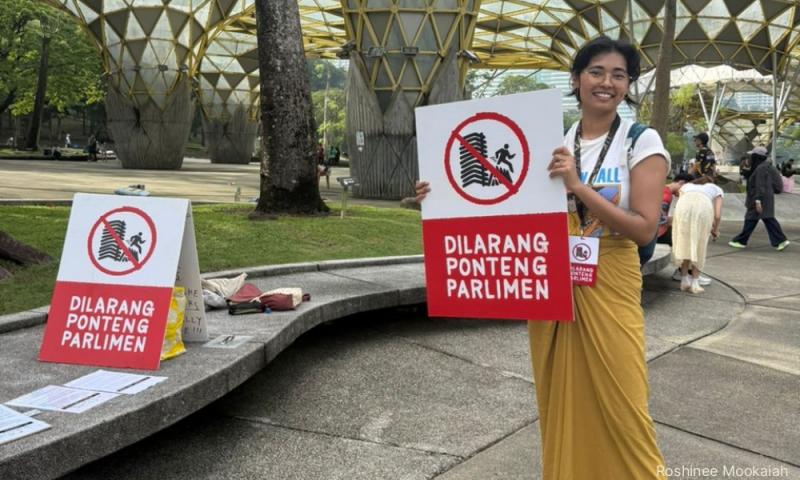
“I hypothesise this is because my online audience is predominantly women,” she said.
The data also showed that Gen Z respondents formed the largest age group, with 859 signatories or 57.8 percent. They were followed by millennials at 32.88 percent, Gen X at 6.97 percent, baby boomers at 2.14 percent, and traditionalists at 0.2 percent.
In terms of geographical distribution, Selangor recorded the highest number of signatories with 737 people, representing 49 percent of the total.
Kuala Lumpur followed with 278 signatories or 18.6 percent, while Sabah ranked third with 81 signatories or 5.43 percent.
Roshinee attributed the concentration of signatories in the Klang Valley to the petition’s paper-based format.
“Since this was a paper petition, I was geographically limited to conducting public signing sessions in the Klang Valley, where I am based.
“If Parliament adopts an online petition system in the future, it will allow more people from across the country to participate in this unique democratic process,” she said.
The petition calls for four key reforms to improve MP accountability and attendance in Parliament:
Reducing the vacancy threshold for absentee MPs by shortening the current six-month period of unexplained absence required before an MP can lose their seat.
Introducing clearer disciplinary measures and attendance rules, including formal guidelines that would allow action against MPs who are consistently absent.
Improving transparency by requiring Parliament to publish detailed records of MPs’ attendance and participation, distinguishing between mere presence and active involvement in proceedings.ADS
Ensuring public consultation before any reforms are adopted, so that decisions are not made solely by Parliament.
‘Only 10 signatures omitted’
Roshinee said she tried not to reject signatures for minor mistakes, noting that human error was inevitable in a paper-based petition process involving large-scale public participation.
She added that the parliamentary petition process remains poorly defined, with limited guidance on formatting requirements.
“We are effectively testing and learning from this process in real time,” she said.
After reviewing the submissions, Roshinee said only 10 signatories were omitted due to significant errors.
These included missing signatures, using the wrong colour pen, signing on a document other than the petition template, providing a passport number instead of an identity card number, and writing over a piece of paper pasted onto the petition form.
The petition has since been submitted to her MP, whose office subsequently forwarded it to Parliament.
Roshinee said she will only reveal her MP sometime next week, adding that the petition is now awaiting review by parliamentary officials.
Youth political participation
In the best-case scenario, she said, the petition would be approved and read out during the parliamentary sitting this month.
However, she acknowledged it could also be rejected for failing to comply with specific formatting requirements or parliamentary conventions.
Roshinee also credited parliamentary specialist Maha Balakrishnan for helping make the initiative possible.

She said Maha had long advocated for the parliamentary petition process and that the campaign would not have happened without her research and groundwork.
Roshinee said she hoped the findings would challenge perceptions about youth political participation.
“I hope this data analysis demonstrates that young people in Malaysia, particularly young women, are deeply interested in and invested in our politics,” she said.
Although she launched the campaign as a solo activist, Roshinee said its success was largely due to the efforts of a predominantly female network of friends and volunteers who helped mobilise support.
The petition was launched as a citizen-driven initiative to address absent MPs, a recurring problem that, on March 2, led to the government’s failure to pass the constitutional amendment bill limiting the prime minister’s term to 10 years. - Mkini

No comments:
Post a Comment
Note: Only a member of this blog may post a comment.