


Letter to editor
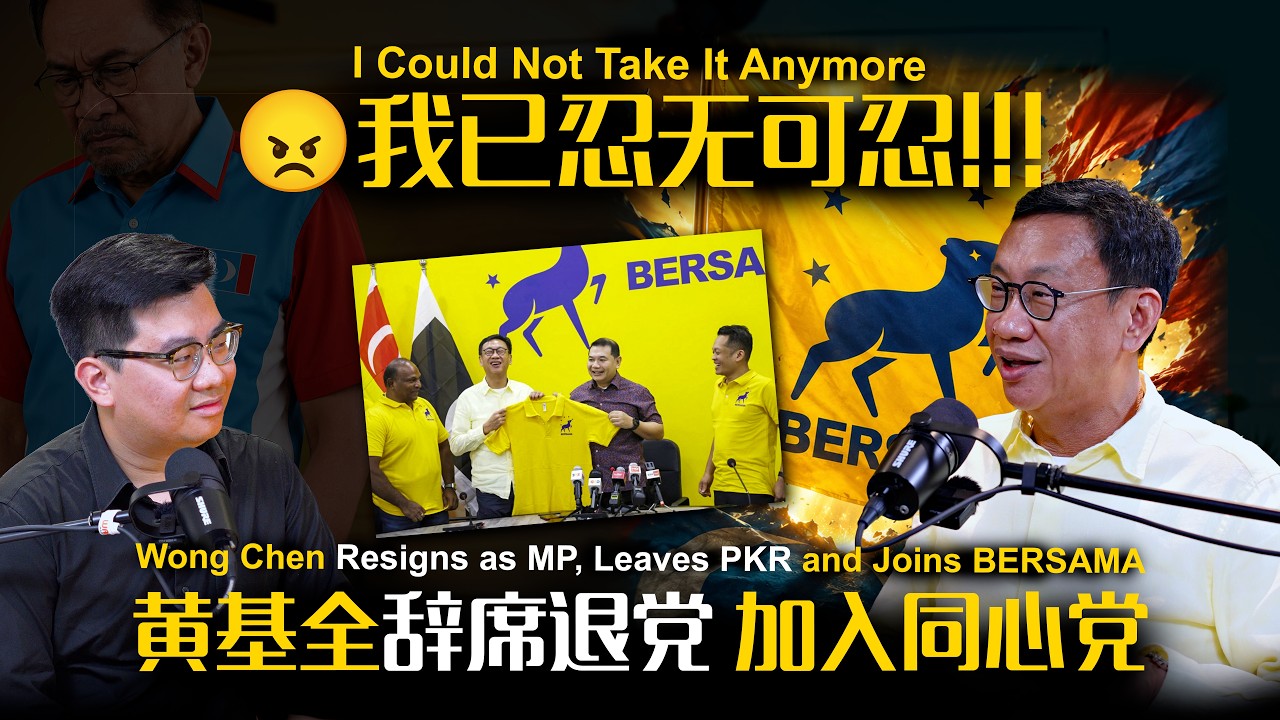
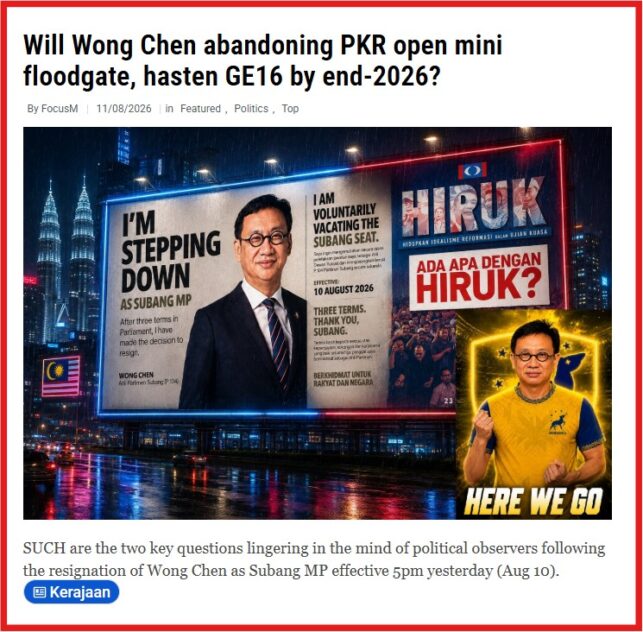
WONG Chen says he left PKR and resigned as Subang MP to “defend democracy”.
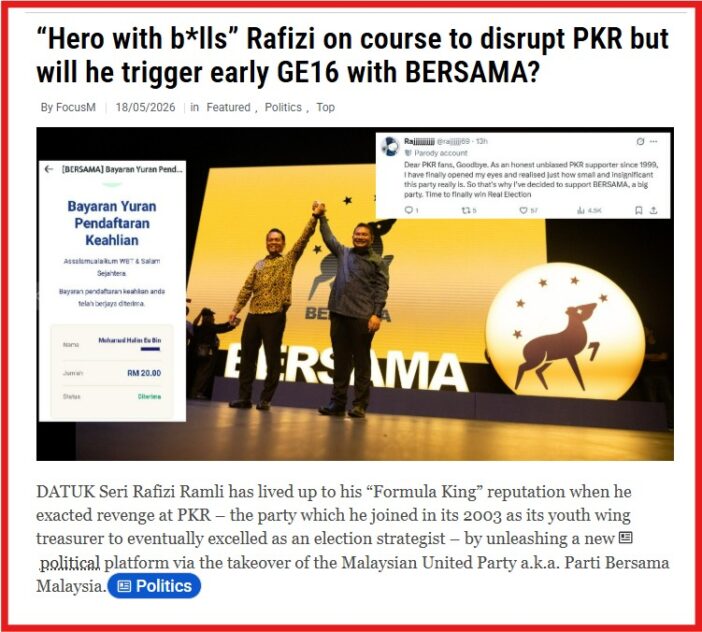
Days later, he joined BERSAMA, the party co-led by former PKR deputy president Datuk Seri Rafizi Ramli and ex-vice-president Nik Nazmi Nik Ahmad who had similarly vacated their parliamentary seats.
But what kind of defence of democracy leaves voters with no elected representative and no opportunity to choose another?
This is not principally about whether one agrees with their political beliefs, their dissatisfaction with their former party or their plans for the next phase of their political careers.
Every politician has the right to change his convictions, leave a party or oppose its leadership.
But a parliamentary seat is not personal property. It is a public trust conferred by tens of thousands of voters.
Abandoning responsibility
These MPs sought the people’s mandate at the last general election. Their constituents voted not merely for a party symbol but for an elected representative who was expected to serve them for the full parliamentary term.
By resigning after the point at which a by-election is no longer required, they leave their constituencies without elected representation until the next general election.
That makes the timing especially troubling. Whatever their stated motivations, the practical result is that the MPs are able to pursue their new political ambitions while their constituents bear the cost.
There will be no by-election. Voters will not be given the opportunity to choose a replacement.
Constituents lose their voice in Parliament, their direct representation in national debates and an important channel through which local problems are raised with the Federal Government.
That is not political courage. It is an abandonment of responsibility.
Rafizi, Nik Nazmi and Wong Chen have each contributed to Malaysian public life over many years. They have built reputations as reformists and advocates of greater political accountability.
But years of good work do not excuse a final act that contradicts the very standards they once demanded of others.
Indeed, the greater their standing, the higher the standard to which they should be held.
If an MP can voluntarily resign late in a parliamentary term, avoid a by-election and leave an entire constituency unrepresented without consequence, then there is a clear weakness in our democratic system.
‘Voters pay for MPs folly’
Parliament should examine reforms to prevent this from becoming an accepted political tactic.
An MP who resigns voluntarily for personal or political reasons during the period when no by-election will be held should face a meaningful financial penalty.
This could include a fixed statutory fine, the re-payment of a proportion of election-related public expenditure or the forfeiture of certain parliamentary benefits.
Reasonable exemptions should, of course, apply in cases involving serious illness, incapacity or other exceptional circumstances.
The purpose is not to punish genuine hardship or prevent MPs from resigning when they are no longer able to serve. It is to ensure that those who knowingly abandon their mandate for political convenience bear some personal responsibility for doing so.
The penalty must be substantial enough that resignation is not treated as a cost-free instrument of political repositioning. At present, it is the voters who pay the entire price while the politician walks away.
We frequently demand higher standards of integrity, loyalty and accountability from elected representatives. Those principles must apply not only when politicians enter office, but also when they choose to leave it.
Political convictions matter. Personal conscience matters. But so does the promise made to the electorate.
An MP is free to leave a party, sit as an independent, criticise the government or campaign for a different political cause.
What an MP should not be free to do without consequence is surrender the people’s seat at a time that denies those same people the right to elect a replacement.
Malaysia’s democracy belongs to its voters, not to its politicians. A parliamentary mandate must not be treated as something that can be discarded whenever it becomes inconvenient.
Max Lim
Subang Jaya
The views expressed are solely of the author and do not necessarily reflect those of MMKtT
- Focus Malaysia.

No comments:
Post a Comment
Note: Only a member of this blog may post a comment.