


It begins like a pub joke: “How many men does it take to change a light bulb?” The answer - three - is funny because it is absurd. Too many hands for a simple twist.
Now cross the joke with Putrajaya’s latest theatre. To investigate whether the anti-corruption chief’s shareholding has exceeded the limits set by the Public Services Department, the government appoints not one, not two, but three from the crème de la crème of the civil service.
In the joke, inefficiency is harmless. At worst, the bulb flickers a little longer. In Malaysia’s case, inefficiency is weaponised. What should be a clear, independent issue of question and answer has become a pantomime of process.
Suddenly, the joke is on us - the absurdity lies in “heavyweights” being involved in an “independent” investigation, especially with answers already in the public domain; it is no longer a laughing matter.
Only two questions must be asked, and both have already been answered in the affirmative by the media. The central figure has not denied them - MACC head honcho Azam Baki - but has been answered in a roundabout manner, including having sold the shares, with claims of “having done nothing wrong”.
The questions are straightforward:
Did Azam own 17.7 million shares in financial services company Velocity Capital Partner Berhad, which is about a 1.7 percent stake, as claimed by Bloomberg? The shares were believed to have been bought for around RM1.5 million in January last year.
Did Azam own shares in another company - Awanbiru Technology Bhd - worth over RM1 million, as reported by Malaysiakini?
Do the above contravene the clause in the Public Officers’ Conduct and Disciplinary Management Circular, available on the Public Service Department’s website?

Under Rule 17(b) of the circular, civil servants cannot purchase more than RM100,000 worth of shares in any single company, making Azam's holdings far in excess of the limit.
So, what is there to investigate? Just ask the same questions, and you would get the same answers.
Azam’s initial claim that he no longer holds shares, that his trading account is empty, and that all transactions hold no water - the rules have been breached, and his integrity has come into question.
Yet, many quarters, including Prime Minister Anwar Ibrahim, went to his defence.
“Why should I sack someone who is doing their job? Read his (Azam’s) explanation. This is a sickness,” he declared.
But isn’t Anwar the same man who has been shouting himself hoarse with his continued campaign against corruption and mismanagement?
How did it go poof?
If anything needs investigation, it is how records of Azam’s shareholding mysteriously disappeared from the Companies Commission of Malaysia (CCM).
Malaysiakini checked on Azam's shareholdings in Awanbiru Technology by accessing CCM records at 9am on Feb 11. However, eight hours later, Azam’s name is no longer on the document.
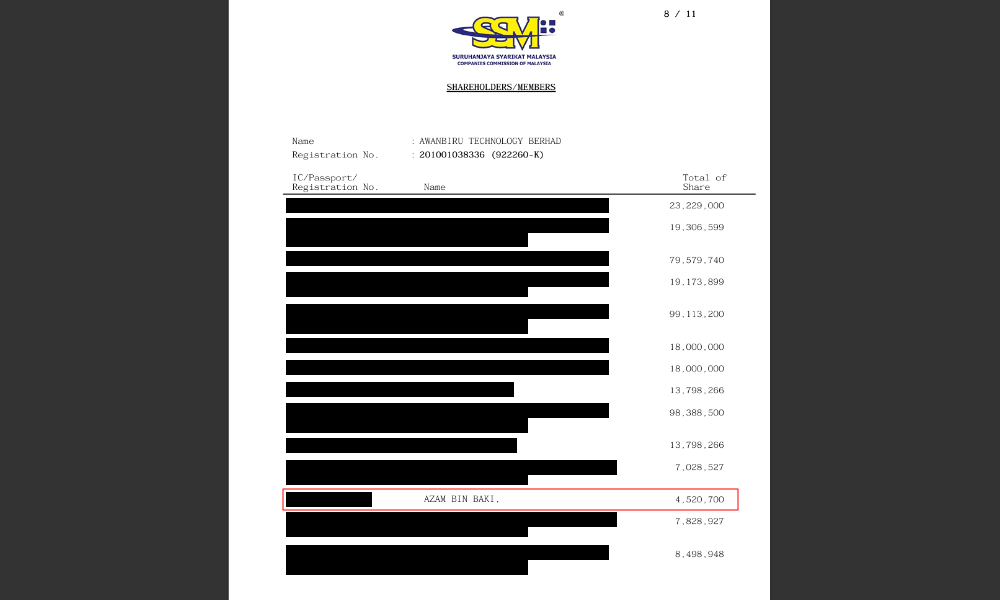
Who caused the records to “disappear”? Were hidden hands so powerful that even company records can mysteriously vanish? We need answers and clarity.
What began as a light-hearted parallel with a pub joke has spiralled into something far more troubling. The absurdity of three top civil servants investigating what is already in the public domain is not inefficiency - it is obfuscation.
The facts of Azam’s shareholdings are not disputed; the rules are clear; the breaches are glaring. Yet instead of swift accountability, we are treated to a pantomime of process, a vanishing act of records, and a chorus of political defence.
When even CCM documents can mysteriously “disappear,” the bulb joke ceases to be funny. It becomes a metaphor for a system where transparency flickers, accountability dims, and the public is left in the dark.
The real question is no longer how many civil servants it takes to investigate a shareholding. It is how many hidden hands it takes to erase the evidence.
Until that question is answered, Malaysia’s anti-corruption crusade risks becoming the cruellest joke of all - one played on us, the citizens. - Mkini
R NADESWARAN is a veteran journalist who strives to uphold the ethos of civil rights leader John Lewis: “When you see something that is not right, not fair, not just, you have to speak up. You have to say something; you have to do something.” Comments: citizen.nades22@gmail.com.
The views expressed here are those of the author/contributor and do not necessarily represent the views of MMKtT.

No comments:
Post a Comment
Note: Only a member of this blog may post a comment.