


In the corridors of power in Putrajaya and on the grand stages of international forums, the narrative of Malaysia’s “new dawn” for media freedom is frequently rehearsed.
We hear grand promises of legislative reform, the repeal of draconian laws, and a renewed commitment to the “fourth estate” as a vital pillar of democracy.
Yet, as World Press Freedom Day came and went on May 3, the reality for working journalists on the ground tells a vastly different, more chilling story.
The rhetoric of reform is increasingly clashing with a harsh procedural reality.
For those of us who navigate the frontline of investigative reporting, the experience is no longer defined by open dialogue or professional rebuttal.
Instead, it is defined by a systematic cycle of police reports, administrative silence, and the mounting financial and psychological burden of state-sanctioned intimidation.
This year, for me, that intimidation stopped being a professional hazard and became a personal invasion.
Midnight of transparency: The Turap investigation
The “Turap Inquiry” serves as a definitive case study in how the gap between governmental accountability and media engagement has widened into a chasm.
My investigation into the proposed digital system for migrant worker management, The Universal Recruitment Advance Platform (Turap), was not a pursuit of sensationalism. It was a matter of profound public interest.
Given the historical complexities and human rights implications surrounding migrant labour in Malaysia, the transparency of such a platform is paramount.
Adhering to the rigorous ethics of journalism, I provided the Human Resources Ministry with a one-month window to provide clarification, feedback, or a denial.
In the modern news cycle, thirty days is a lifetime. It is a period that allows for factual verification, internal consultation, and the formulation of a comprehensive response.
Throughout this month, the ministry maintained a wall of absolute silence.
However, we now know that this silence was not indicative of indifference. It was the quiet before the storm.
Immediately following the publication of the report by Malaysiakini, the ministry’s response was not a request for a correction, nor a letter to the editor, nor an invitation for a press conference to clarify the facts.
Instead, the state machinery was triggered. A ministry official lodged a police report against both the organisation and me.
This transition from administrative silence to criminal reporting represents a dangerous trend: the criminalisation of investigative curiosity.
April 27th: When the story comes home
The escalation reached its zenith on April 27, 2026. At 2.30pm, the sanctity of my home in Seri Serdang was breached. Two plainclothes police officers arrived with a search warrant, transforming my private residence into a site of criminal investigation.
For 45 minutes, my home was scrutinised. The warrant cited grounds to suspect that my residence was being used to “store copies” of official documents, specifically a cabinet memorandum related to the Turap system.

While no items were seized, the “raid” served its true purpose: intimidation. When the police enter a journalist’s home, they are not just looking for paper; they are sending a message to the journalist's family, neighbours, and peers.
They are signalling that personal matters are no longer private if you dare to hold power to account.
To be investigated under Section 203A of the Penal Code (unauthorised disclosure of information) and Section 233 of the Communications and Multimedia Act is to be treated as a criminal for doing one’s job.
Section 233, in particular, continues to be the state’s broad, vaguely worded provision used to categorise legitimate reporting as an “improper use of network facilities”.
The pattern of non-disclosure
My experience with Turap is not a vacuum-sealed incident; it is part of a broader, deliberate strategy of non-responsiveness.
Before this, I submitted official inquiries regarding allegations of high-level correspondence between the Malaysian and Bangladeshi governments concerning human trafficking investigations.
These are matters involving national security, international reputation, and basic human rights. To date, those inquiries remain buried under a shroud of silence.

When silence becomes an official policy, it creates a vacuum that “shadow portals” and misinformation are quick to fill.
This decay in the principles of open governance is further evidenced in the reporting surrounding sugar subsidies involving millions of public funds.
When a top ministry official suggests “off-record” that they would prefer to let a story “die a natural death” rather than provide transparency, they are not just dodging a question; they are betraying their mandate as stewards of public resources.
Civil servants are not masters of the public; they are its employees. That mandate carries the inherent responsibility to explain how resources are utilised. When questions are treated as provocations, the spirit of democracy withers.
Economics of legal bullying and Slapp
Beyond the threat of handcuffs and raids, the media faces an existential threat in the form of strategic lawsuits against public participation (Slapp).
In Malaysia, this manifests as a barrage of letters of demand claiming damages in the millions.

These lawsuits are rarely about clearing one’s name. They are a war of attrition.
Media organisations, especially independent portals with limited capital, are forced to divert massive resources toward legal defence.
This is economic punishment. Under the Defamation Act 1957, the burden of proving “justification” or “fair comment” lies heavily on the defendant.
The powerful utilise the high cost of the legal system to ensure that certain stories remain untold, effectively suing the truth into insolvency.
Rise of digital shadow warriors
Simultaneously, we are witnessing the emergence of anonymous “shadow portals”.
These platforms operate without named editors, physical addresses, or registration with the Information Department. Their sole function is the character assassination of journalists and critics.
These portals operate with a level of impunity that legitimate agencies do not have. They bypass every ethical and legal standard, yet they are often left unchecked by the same authorities who are so quick to raid the homes of accredited journalists.
When legitimate reporters are subjected to coordinated digital attacks from these anonymous sources, it distorts public discourse and creates a toxic ecosystem that undermines the Communications and Multimedia Act's very purpose.
Field censorship: Street-level suppression
The pressure has also bled into the physical workspace of journalists. The arrest of S Kalidas, a reporter for Thinathanthi in Kulim, is a stark reminder of the risks on the ground.
Despite being a registered member of the press, he was handcuffed and detained for “trespassing” while performing his duties.
Furthermore, the rise of field censorship, where police officers compel journalists to delete footage and photos at crime scenes, is a terrifying development.
When enforcement agencies act as editors, the line between law enforcement and state-controlled propaganda becomes dangerously blurred.
These actions suggest a growing anti-check-and-balance sentiment within the very agencies tasked with upholding the law.
Malaysian Media Council’s role
In conjunction with World Press Freedom Day, the Malaysian Media Council must move beyond being a symbolic entity and rise to become a robust buffer between the press and the state.
The council cannot remain silent when journalists are summoned for standard procedure interrogations or when their homes are raided.
It must:
Challenge the arbitrary use of the Penal Code against journalists.
Advocate for legislative protection against Slapp suits.
Hold the anonymous shadow portals to the same accountability standards as legitimate news organisations.
If the council fails to provide this support, the media freedom we celebrate on World Press Freedom Day will be nothing more than a hollow ritual.
We will not be silenced
The job of a journalist is not to be a cheerleader for the administration; it is to be a mirror.
Sometimes, that mirror reflects an image that those in power find unpleasant.
However, the solution is not to break the mirror or raid the home of the person holding it.
If we remain silent while our colleagues are handcuffed, while our homes are searched, or while our organisations are sued into bankruptcy, we are complicit in the erosion of our own democracy.
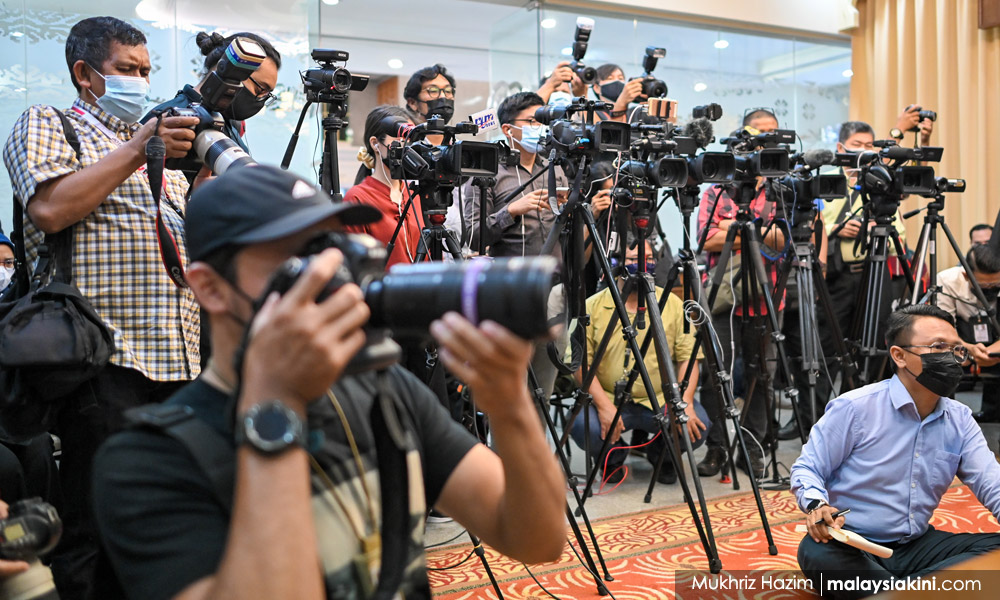
We must insist on accountability, demand transparency, and refuse to let the truth “die a natural death”.
The raid on my home on April 27 was an attempt to instil fear, but it has only served to reinforce why our work is necessary.
On this World Press Freedom Day, let the message be clear: the voice of the Malaysian people will not be muffled by search warrants or standard procedures.
We will continue to ask the questions that need to be asked, for as long as there are stories that the public has a right to know. - Mkini
B NANTHA KUMAR is a member of the Malaysiakini team.

No comments:
Post a Comment
Note: Only a member of this blog may post a comment.