


ARE WE poor because of the lack of opportunities or simply misfortune? Perhaps, shockingly, it has something to do with the fact that we are born in the wrong country.
Recently, Khazanah Research drew quite the attention with its research, stating that only 30% of profits are distributed to workers in Malaysia.
The other 70% remains in the hands of business owners. The post went on to highlight the United Kingdom, where workers receive a larger share at 49.8% or Germany at 54.7%.
The thought provoking post has since turned into a point for debate among the internet community and the comments are illuminating.
“Out of that 70%, approx half of it is wasted on bribes,” claimed @todd_58 while @law_ys2121 said Malaysian bosses are super stingy and low class, which is why they can’t compete internationally.
“Maybe we could start by giving 50% of revenues to employees in GLC companies,” said @wrongtheright, adding that this would indirectly push other private companies to increase their own percentage share for employees.
“Now, the question is, is the government willing to tell GLCs to do that?” he continued.

Also, @_akmalrodzi wondered where the data was derived, since he claimed most of the Bursa-listed companies are recording losses.
Khazanah Research replied with an extract from Bank Negara Malaysia’s publication which pointed out several vital factors.
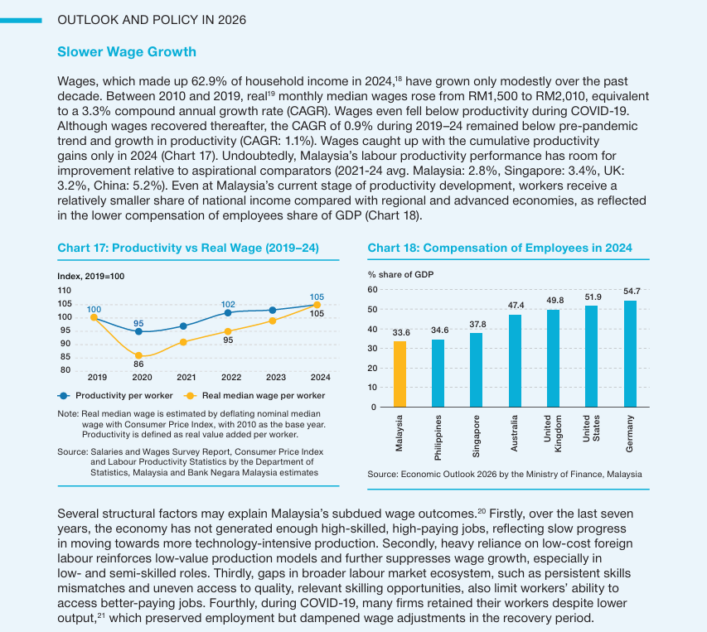
For the last seven years, the economy has not generated enough high-skilled, high-paying jobs, reflecting slow progress in moving towards more technology-intensive production, said the publication.
Among other things, heavy reliance on low-cost foreign labour reinforces low-value production models and further suppresses wage growth, especially in low- and semi-skilled roles.
Netizen @NOuniversityDeg, however, said that workers can share in the 49.8% profit when they are ready to prepare capital for the business.

“What if there’s no profit? The salary still has to be paid,” lamented @realshahr. In the end, the debate is not about punishing businesses for making profits, but whether growth can truly be called progress if workers remain stuck.
Malaysia’s wage dilemma is ultimately more than an economic statistic; it is a question of what kind of society the country wants to become. — Focus Malaysia

No comments:
Post a Comment
Note: Only a member of this blog may post a comment.