


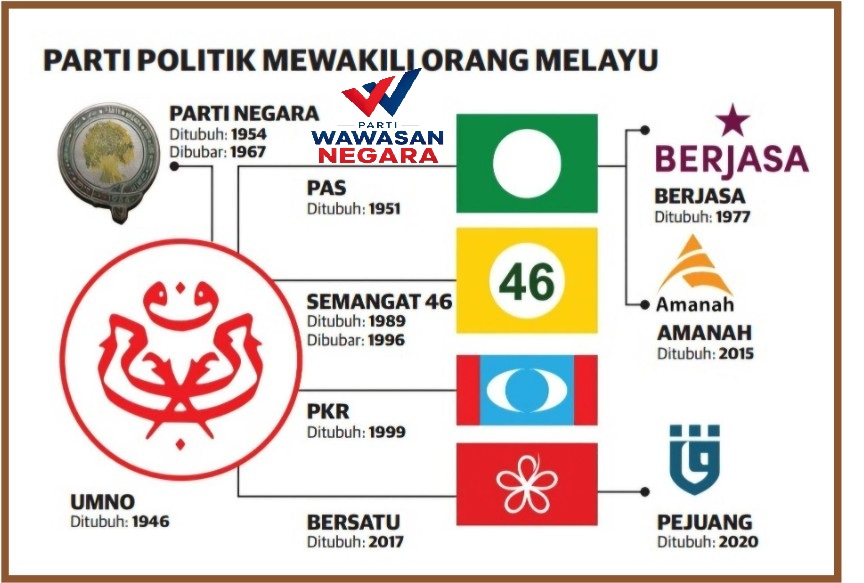
THE notion of “Malay unity” as a political objective is often presented as a necessity but in reality, it may be a political fallacy.
It is akin to chasing a dragon, an ideal that sounds appealing in theory but remains elusive in practice because political parties and leaders ultimately prioritise their own interests, ambitions and survival over any genuine racial or communal unity.
History has repeatedly shown that parties claiming to champion Malay unity frequently find themselves competing against one another for the same constituency.
Political rivalries, leadership contests, policy differences and struggles for power have consistently outweighed calls for collective racial solidarity.
If genuine Malay unity were the overriding objective, the fragmentation of Malay-based political parties would not be a recurring feature of Malaysian politics.
Editor’s Note: There are easily six to seven Malay-dominant political parties in Malaysia, namely UMNO, PAS, Bersatu, Pejuang, PKR, Amanah and Pejuang with Parti Wawasan Negara joining the fray as a vehicle for former Bersatu president Datuk Seri Hamzah Zainudin’s “Reset” movement.
Splitting votes
When the Malays became an overwhelming majority, the possibility of Malay unity will be more evasive as Malay personalities or politicians will breakaway to seek their own path or destiny for the ultimate Putrajaya chair.
Thus, there will never be perpetual unity but there will always be conflicts between Malay personalities and parties eventually.
More importantly, the premise that Malays require political unity as a matter of security is questionable.
The Malaysian constitutional framework already provides safeguards for Malay interests through the institution of the Malay Rulers acting collectively through the Conference of Rulers.
Together with constitutional provisions relating to Islam, the Malay Rulers, the Malay language and the special position of Malays and the natives of Sabah and Sarawak, there already exists a constitutional umbrella designed to protect these fundamental interests.
Seeing from another perspective, the Chinese and Indians who overwhelmingly voted for PH in the previous two national polls were not spurred by Chinese/Indian unity except that they were in unison to vote for a change as they were aghast at the blatant act of “stealing from the national coffers”.
Similarly, calling for Malay unity is merely a convenient political strategy to support the cause or interest of a particular Malay party, often by exploiting racial sentiment as if the Chinese and Indians are a threat to the Malays whether politically, socially or economically.
The truth is that the Malay masses may be united on culture, race and religion but the Malay politicians or parties will disperse the moment they have landed in Putrajaya out of selfishness and greed. Thus, Malay unity will only be possible at the preliminary stage of campaigning but not when it comes to end game.
Political slogans, self-interest
Very broadly, the constitutional order has provided continuity and protection irrespective of which political coalition or party forms the government. Malay interests are not solely dependent on the success or dominance of any particular political party.
As such, calls for Malay unity often function more as a political slogan than a practical necessity. They are frequently deployed during periods of political uncertainty, leadership challenges or electoral competition to mobilise support from the Malay majority.

The appeal to racial unity can become a convenient tool to consolidate political influence even when the underlying motivations are rooted more in party interests than in any genuine pursuit of communal cohesion.
The more important question for Malaysians today is not whether all Malays can be united under a single political banner but whether political leaders can deliver good governance, economic opportunities, institutional integrity and national unity within the framework of the Federal Constitution.
A stable and prosperous nation is ultimately strengthened not by racial uniformity but by constitutional safeguards, effective institutions and policies that benefit all citizens while respecting the rights and protections guaranteed to every community.
A lawyer by training, Datuk Seri Ti Lian Ker was a former MCA vice-president and former national unity deputy minister.
The views expressed are solely of the author and do not necessarily reflect those of MMKtT.
- Focus Malaysia.

No comments:
Post a Comment
Note: Only a member of this blog may post a comment.