


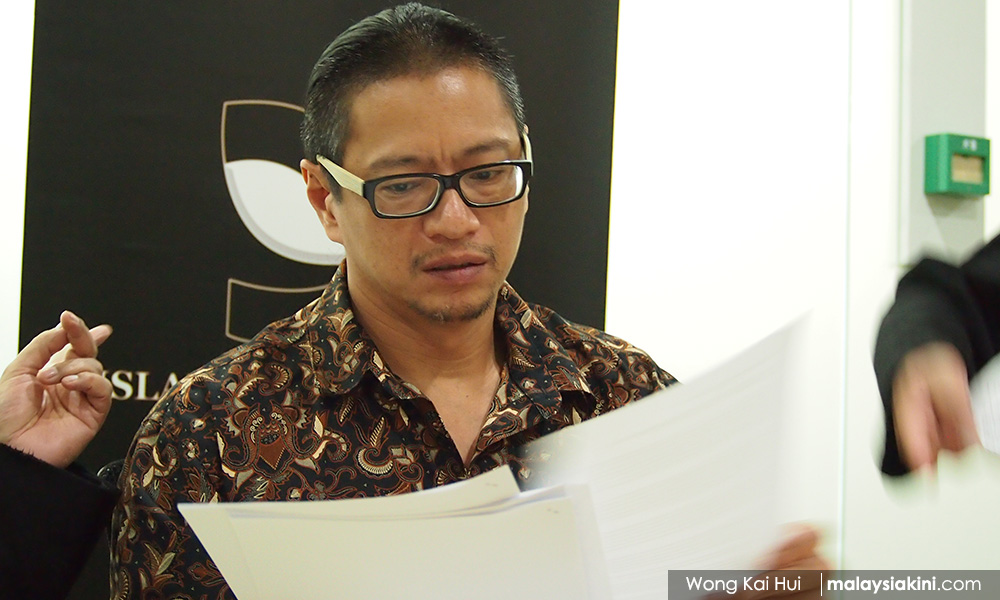
Following the arrest of Turkish journalist Mustafa Akyol, a number of academics took aim at religious authorities for seemingly expanding their jurisdiction onto the public sphere.
Although preachers in mosques and suraus are required to obtain tauliah (accreditation) from state religious authorities, speakers at public forums have never been expected to, explained Isham Pawan Ahmad of the International Islamic University Malaysia.
“But now the scope seems to have been expanded (to forums), without any justification from the authorities,” he told a press conference at the Islamic Renaissance Front (IRF) secretariat in Kuala Lumpur today.
Mustafa was detained at the airport after the Federal Territories Islamic Religious Department (Jawi) alleged he had committed an offence under Section 11 of the Syariah Criminal Offences Act 1997, which states it is an offence to “teach or profess to teach any matter relating to the religion of Islam without a tauliah.”
Mustafa had on Sept 24 given a public talk entitled "Does freedom of conscience open the floodgate to apostasy?" at the Royal Selangor Golf Club, which was organised by IRF.
Universiti Malaya's Azmi Sharom criticised the broad language of the law, specifically the word “teach.”
“What is teaching? It is not defined. Is discussion teaching? Not defined. What do you mean by ‘any matter relating to the religion of Islam’?
“For example, if you are a teacher in a law faculty and teaching Islamic law, does that mean you cannot do that without proper credentials?" he asked.
He also said that if speakers are now required to adhere to accreditation rules, religious authorities would have “extremely broad powers” to monitor all arguments related to Islam.
“This is a hindrance to intellectual discourse and an affront to both academic freedom and freedom of expression,” said Azmi.
Under Section 96 of the Administration of Islamic Law (Federal Territories) Act 1993, a religious teaching supervisory committee, comprising a chairperson and a minimum of three people with the “appropriate experience, knowledge and expertise," has the discretion to decide how accreditation is given, or withdrawn.
Hundreds oppose 'crack-down on intellectuals'
In response to Mustafa’s detention along with recent book bans by the Home Ministry, Azmi read out a statement condemning how authorities have been “cracking down on intellectuals.”
“These crackdowns are not an isolated development, but a serious and dangerous escalation in an ongoing process of thought-policing to close the minds of Malaysians, especially Muslims,” he read.
The statement urged the government and all relevant state parties to end all harassment, investigations and charges against IRF, its director Farouk Musa, as well as its past and future intellectual guests.
It also called for the lifting of book bans, the replacement of the Printing Presses and Publications Act (PPPA) 1984 replaced with a more “human rights-compliant” law, and an end to the thought-policing of academics.
The statement was signed by 63 NGOs, including Bersih, G25 and Suaram, along with 144 individuals including academics, former civil servants, writers, journalists and activists.- Mkini

No comments:
Post a Comment
Note: Only a member of this blog may post a comment.