


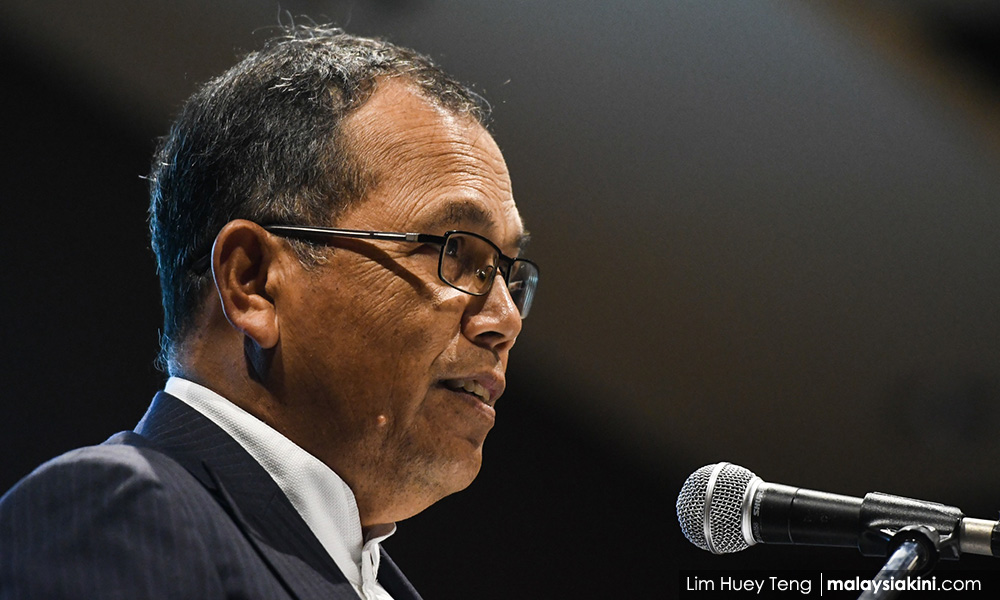
Chief Justice Md Raus Sharif said the timeline on the disposal of commercial cases shows that 96 percent of the cases filed were resolved within nine months.
Speaking at a luncheon talk organised by the Malaysian Press Institute, the top judicial officer in the country said this even surpassed that of Singapore.
"I was informed by the managing judge of the Commercial Division that 96 percent of the cases are being disposed within the timeline of nine months.
"This is a milestone in the history of the judiciary and an achievement to be proud of. Not even Singapore cases can match our performance in disposing of commercial cases. Their timeline is 18 months," Raus said.
The CJ joked that is why he needed the media “to advertise” the success of Malaysian courts.
As at Sept 30 this year, he said, there were only 818 cases pending in the commercial court. Of those, 717 were filed this year, 72 were filed last year, while only 35 are pre-2016 cases.
Raus credited his predecessor, Zaki Azmi, for transforming the judiciary to clear the backlog of cases.
He said when Zaki was appointed CJ on Oct 24, 2010, he transformed the Malaysian judiciary to what it is today, and it all began when he appointed managing judges.
Initially, Raus said Zaki formed a team, which included Zaki, former CJ Arifin Zakaria, James Foong and himself, where he was tasked with managing cases in the commercial division and appellate and special powers division.
“When I presented the numbers to Zaki he almost fainted,” he said, adding it was found that there were cases from the year 1990, which had yet to be disposed of, and there were new cases coming.
Backlog of cases cleared
Raus said this led to the formation of the New Commercial High Courts on Sept 1, 2009, with the appointment of new judges, handing new cases while the original commercial courts handled the old cases.
Postponements, he added was not allowed and as a result, the backlog of cases was cleared.
“Before the reform, it was somewhat a norm for judges to hear cases only in the morning. Zaki was fully aware of this fact, being a practitioner.
“At the end of 2012, there were only 58 cases left from the old commercial courts, out of 6,400 that were originally heard, when we started the reform program," he said.
According to Raus, the Malaysian judiciary's success is recognised by the World Bank, resulting in many judges from various countries trying to learn from Malaysia's experience.
The disposal of the cases, he added, was helped further with the implementation of the e-court project in 2009 that consisted of case management, the court recording transcription system, queue management and the e-filing system.
He said that besides determining a timeline for disposal of cases, similar timelines are also imposed at the Court of Appeal and the Federal Court, to clear the backlog.
Raus said the COA is required to hear and decide on a case within three months while the Federal Court, within six months.
When pointed out by reporters of some existing cases like the custodial death of A Kugan, where the apex court has yet to make a decision, he said he will try and push for a decision to be made.- Mkini

No comments:
Post a Comment
Note: Only a member of this blog may post a comment.