


In a recent column, I argued that our annual fixation on SPM rankings tells us far less about the quality of our schools than we often assume.
High examination scores, especially in selective institutions, reflect less about schools’ impact than external factors such as student intake and demographics.
If we care about systemic improvement, we need to understand not just where students end up, but how much progress they make along the way.
It is against this backdrop that I welcome the Education Ministry’s announcement of the Malaysian Learning Matrix (Learning Matriks), a standardised national assessment to be taken by students in Standard Four and Form 3.
Much of the initial reaction has framed it as yet another examination (a reskinned UPSR or PMR/PT3), but as far as I can tell, it mostly isn’t, though I have one important recommendation I’d like to make, below.
Properly designed and used, the Learning Matrix is a positive and necessary move.
Why it makes sense
First, the Learning Matrix acknowledges a basic social reality: high-stakes examinations are not going away. Modern societies require mechanisms for credentialing and selection.
In Malaysia, SPM continues to serve this function. Universities, employers, and scholarship bodies need broadly comparable signals, and no system of our scale and diversity can entirely dispense with them.

The problem arises when we expect every assessment to perform this role. When a single examination is made to diagnose learning, motivate students, rank schools, and decide futures all at once, it ends up doing most of these tasks poorly.
The educational costs of such overload (curriculum narrowing, excessive test preparation, and strategic learning) are well-documented and pretty much a lived experience for all students.
By positioning the Learning Matrix as a low-stakes, system-level assessment, the ministry signals an important separation of functions: SPM for certification and selection; the matrix for monitoring learning. This distinction is vital.
Second, the Learning Matrix provides something the system currently lacks: a common, standardised reference point that complements school-based assessment (SBA).
SBA has genuine strengths. It is continuous, flexible, and closely tied to everyday teaching. It allows teachers to observe learning across time, tasks and contexts, to inform teaching decisions.
However, SBA also places significant demands on schools and gives us little basis for system-level insights.
Designing assessments that are valid, reliable and psychometrically sound is a specialised task - effectively a full-time profession. Expecting every teacher, in every school, to repeatedly construct such instruments is neither realistic nor fair.

A centrally developed assessment, designed by specialists and administered systemwide in key subjects, reduces duplication of effort and improves technical quality.
It provides a shared “kayu ukur” (benchmark) that allows teachers and schools to interpret their own assessments more confidently, rather than replacing SBA and teachers’ professional discretion.
For this complementarity to work, the Learning Matrix should be used and interpreted in a criterion-referenced way, focusing on mastery of curriculum-aligned knowledge and skills rather than relative ranking.
Crucially, low-stakes, criterion-referenced assessments are, in my view, better suited to supporting learning than high-stakes ones.
When tests carry significant consequences, classrooms naturally begin to orbit the exam itself rather than the curriculum. Teaching narrows, predictable formats are prioritised, and time is diverted to rehearsal.
Students, responding rationally, focus on maximising scores rather than on building understanding. You end up with well-trained test-takers, rather than educated citizens.
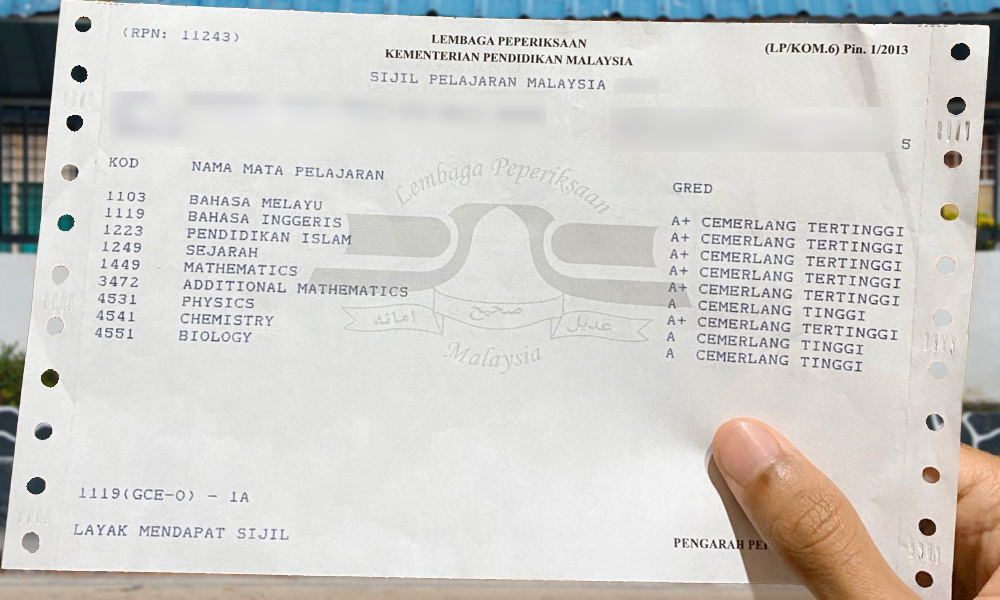
We have all seen the effects: students who can reproduce memorised essays but struggle with spontaneous communication in the target language, or who perform well on routine mathematics questions yet falter when asked to apply concepts in unfamiliar contexts.
In such cases, examination performance outpaces actual proficiency.
The timing of the Learning Matrix - in Standard 4 and Form 3, away from major selection points - reduces the incentive to students or schools to game the outcomes. It functions more like a learning health check than a gatekeeping device.
Its value lies not in sorting students, but in revealing where support is needed while there is still time to act.
Three things we must get right
None of the benefits of the Learning Matrix is automatic. Whether it strengthens or undermines learning depends on how it is designed and used.
First: do not train students for the Learning Matrix.
Once drilling begins, its diagnostic value collapses. Results reflect test familiarity, not learning. The best preparation remains good teaching aligned to the curriculum - not mock tests or prediction exercises.

Second: improve how results are reported, so scores illuminate learning rather than obscure it.
The Education Ministry’s FAQs indicate that results will be reported as numerical scores and letter grades. While administratively convenient, an aggregate score alone sits uneasily with the Learning Matrix’s diagnostic intent.
A constructive refinement would be a hybrid reporting model, pairing grades with a breakdown of achievement across learning domains and mastery levels, as seen in Cambridge Checkpoint or CEFR-aligned assessments.
Its reporting should therefore take the form of subject-specific “can-do” or mastery statements, rather than numerical scores, letter grades or percentile ranks.
Languages could be reported across reading, writing, listening and speaking; Mathematics by strands such as number sense, fractions, and problem-solving.

This prevents strengths in some areas from masking weaknesses in others and makes gaps actionable.
Getting a 60 in Mathematics may tell a student that they are performing reasonably well, albeit with room to improve; but if the student knows that the reason why they have a 60 is because they have a strong number sense, is good at fractions, but struggles with word problems and algebra, then that gives a much clearer sense of how exactly to improve.
On the other hand, once results are converted into grades, comparison becomes inevitable, and pressure follows.
Descriptive, mastery-based reporting keeps the attention on learning itself: what students can do, and what they need next.
Third: do not reward or punish schools or students based on matrix results - but use the data to support learning.
Even well-designed assessments become high-stakes once consequences are attached. Public rankings, performance targets or reputational pressures will reshape behaviour, often in unhealthy ways.
Instead, Learning Matrix data should be used close to the learner: to guide targeted interventions, inform professional development, and channel additional support to schools serving students with greater needs.
Perhaps controversially, I should add that politicians should not be tempted to use Learning Matrix outcomes as proof that they are doing a good job.

We must resist the pomp and fanfare that we associate with exam results, and instead let students get on with their learning with calm sobriety.
To paraphrase Campbell’s law, the more any quantitative social indicator is used for social decision-making, the more subject it will be to corruption pressures and the more apt it will be to distort and corrupt the very social processes it is intended to monitor.
Not UPSR or PT3 by another name
Some will still ask whether the Learning Matrix is simply UPSR or PMR by another name.
It need not be. Those exams were grade-driven and tied to progression and comparison.
If the Learning Matrix remains low-stakes, avoids external consequences and evolves towards mastery-based reporting, it is not a revival of abolished exams, but a corrective to their excesses.
A test of our mindset
Ultimately, the Learning Matrix is not just a test for students, but for us as a society.
It will reveal whether we are capable of holding two ideas at once: that high-stakes examinations have a necessary role in social life, and that learning flourishes best when it is not constantly under threat.
If we treat the matrix as just another hurdle to clear, we will recreate the problems we already know too well.
If we allow it to function as intended - a low-stakes, standardised complement to school-based assessment - it could help shift our national conversation from ranking outcomes to understanding learning.
In other words, policy alone does not decide the outcome; our collective response (with political ramifications) will too. - Mkini
TIONG NGEE DERK is a Cambridge-trained researcher who cares about improving education for the many, and not the few.
The views expressed here are those of the author/contributor and do not necessarily represent the views of MMKtT.

No comments:
Post a Comment
Note: Only a member of this blog may post a comment.