


Never in the annals of our civil service has someone so high up retired under such a cloud of ignominy, walking out thumping his chest in jubilation after three extensions.
While clerks and junior officers are marched in handcuffs to the black maria en route to prison for misfeasance in office, there was none for outgoing MACC chief Azam Baki, who departed on Tuesday with little more than bruised headlines - and a chorus of self-praise.
Prime Minister Anwar Ibrahim lauded his “courage against powerful individuals”.
Yet this is the same man who meekly claimed to have met Najib Abdul Razak’s phantom Arab donor in 2015, a defence the former prime minister himself later conceded was false.
This court exchange between Najib and 1MDB counsel Kwan Will Sen at the High Court last year puts matters in the right perspective.
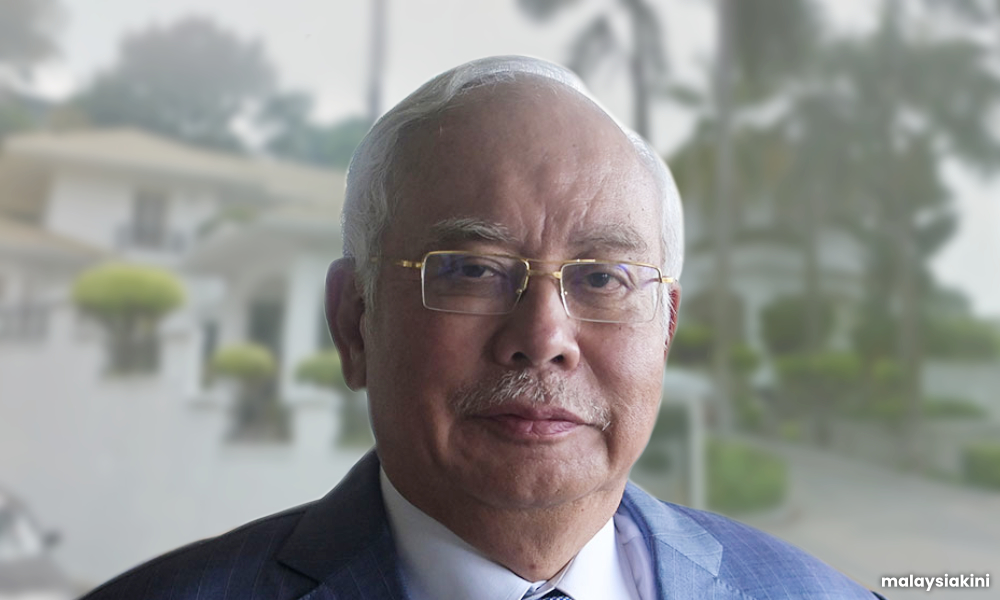
Kwan: The truth in your mind - if I can use those words - at this moment, is that the RM42 million has nothing to do with the Saudi donation?
Najib: Based on subsequent knowledge, yes.
Kwan: Your defence (Saudi donation) was rejected by all levels of the courts (in the SRC International criminal case). Is that correct?
Najib: Yes, but I have to clarify because I didn’t have the opportunity to do a full explanation at the Federal Court. That’s why in the review, one of the judges - a senior judge agreed with our position. During the review, he concluded I didn’t get a fair trial.
Kwan: All said and done, the majority finding upheld the conclusion (that the funds were not a Saudi donation). That is correct, isn’t it?
Najib: Yes, unfortunately, yes.

Najib also acknowledged that the High Court, in its 1MDB criminal trial verdict, had ruled there was no documentary evidence to support his “Saudi donation” defence.
A familiar pattern
So, Azam’s imagination, or impersonator, went uncorrected for a decade.
In December 2015, Azam said the MACC had sent a team to the West Asia region to meet with the individual who made a political donation of RM2.6 billion, which was deposited into Najib’s personal bank accounts.
However, he could not disclose further details, including the identity of the donor, as investigations were then ongoing.
But at the SRC trial in February 2020, an MACC investigator testified that officers had flown to Saudi Arabia to identify the individual known as “Prince Saud Abdulaziz Majid Al-Saud” in connection with the investigation into the RM2.6 billion.
Assistant commissioner Nasharudin Amir said the team, which comprised MACC officers Hafaz Nazar and Fikri Ab Rahim, former MACC chief commissioner Dzulkifli Ahmad, the then MACC deputy commissioner Azam, and himself, was in Riyadh, Saudi Arabia, in late November 2015.
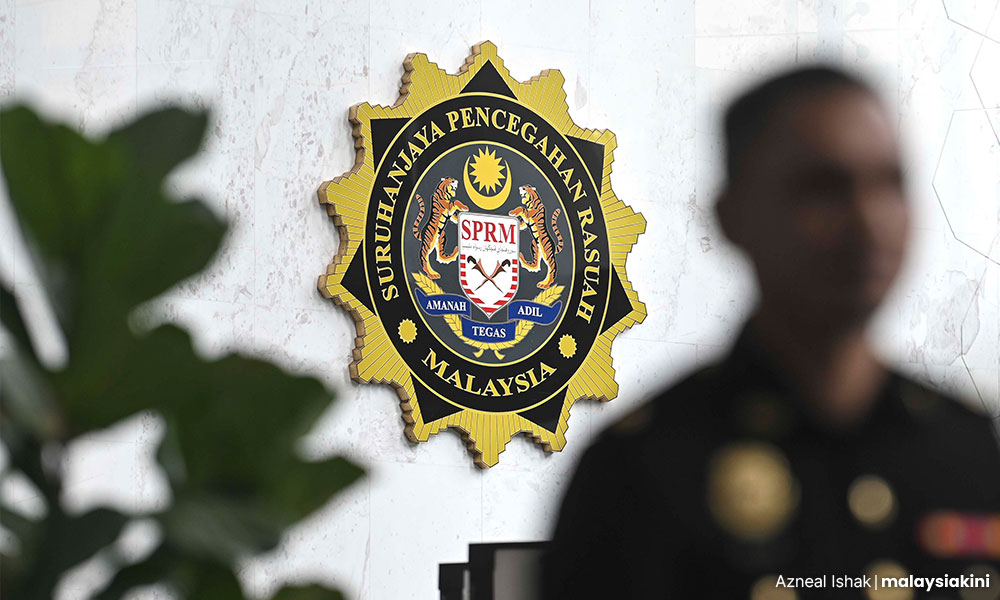
Nasharudin said the purpose of their visit was to investigate the four donation letters purportedly signed by “Prince Saud” and addressed to Najib, dated between Feb 1, 2011 and June 1, 2014.
“The statement was taken at the Palace of King Abdulaziz in Riyadh. A man known as Mohamad Abdullah Al Koman was present as the ‘prince’s representative’,” he told the court.
On whether the word “donation” was mentioned in the recorded statement, Nasharudin replied in the affirmative but added that he could not confirm if the sum was indeed a donation, as the person who gave the statement did not write the letters.
When Azam was caught in his own share-trading scandal, he first blamed his brother, then hid behind an inquiry whose findings are being held in abeyance.
Investigations into a second allegation have been completed and submitted to the chief secretary of the government, but the findings have yet to be released.
Gaslighting galore
In his farewell interview last week, Azam dismissed protesters as “problematic people” who “forgot to take their medicine.”
Dissent, in his telling, is a medical disorder. Accountability is rebranded as fixation. It is the kind of diagnosis that would make a psychiatrist blush.
When rallies drew hundreds - like the one in Bangsar four years ago that forced road closures, Azam’s arithmetic reduced them, in the most recent case, to “only 30”, most of whom he claimed were police and media.
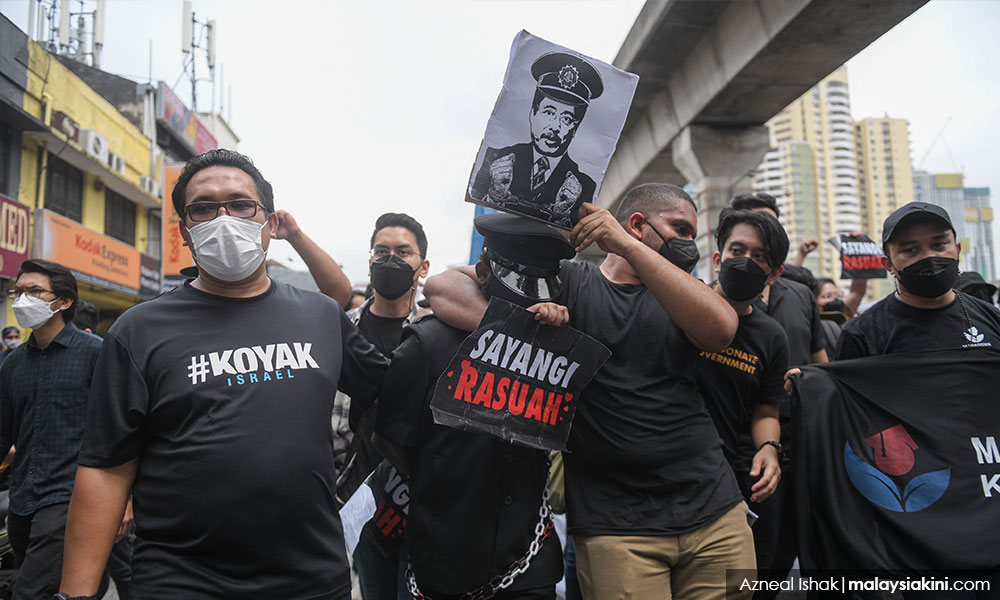
This is bureaucratic mathematics at its finest: subtract the inconvenient, add the compliant, and the ledger balances in your favour. Reality, like accountability, becomes calculable and negotiable.
He insisted that MACC is “respected worldwide”, citing memoranda with “top-class” nations. Respect, apparently, is measured not by convictions but by signatures on paper.
It is diplomacy dressed up as enforcement, then it becomes a rubber stamp masquerading as courage.
The commission’s reputation abroad is paraded as proof of integrity at home, even as domestic scandals like the Sabah mining scandal pile up like unopened case files, and claims of the “corporate mafia” operating within still remain.
Bravery, Azam reminded us, lies in arresting “top officers and politicians”. Yet when his own scandal surfaced, the findings were shelved.
Courage is best displayed when others are handcuffed, not when one’s own paperwork is under scrutiny.

The man who once claimed to have met Najib’s mythical Arab donor now claims to have met only “problematic” Malaysians.
Even his frankness about “juicy praise” betrays the irony. He admitted officers enjoy compliments but should treat criticism as constructive. Yet in the same breath, critics are dismissed as lunatics.
That is not constructive engagement; it is gaslighting with a badge. The MACC, under his watch, became less an enforcement agency than a stage where applause was mistaken for legitimacy and dissent for madness.
And then comes the pièce de résistance: “Who are we going to arrest next?” he mused, as though corruption busting were a seasonal menu.
The public demand is clear - start with the man in the mirror.
Height of absurdity
But that entrée never made the MACC’s list. Instead, the agency served up a buffet of selective prosecutions, garnished with press releases and seasoned with self-congratulation.
Azam’s narrative of courage collapsed under the weight of his own contradictions. He claimed to have prepared officers to “ignore wild allegations”, yet those allegations include his own share-trading escapades.
He boasted of “political will” enabling MACC’s success, yet political will is precisely what shielded him from consequences.
He celebrated “random encounters” with supportive citizens, as though anecdotes were evidence, while ignoring the hundreds who marched demanding his arrest.
His farewell resembled a parody of accountability: the chief who claimed to meet Najib’s phantom donor, who twice evaded questions about his share trading, who now lectures Malaysians on courage while hiding behind withheld results of inquiries.
It is the theatre of absurdity, where the dog ate his homework, his brother bought the shares, and critics forgot their medicine.
Azam exited not as a reformer but as a performer, mistaking applause for courage and criticism for madness.
His legacy is a tragicomedy of accountability: the man who gaslit dissent, rebranded scandal as bravery, and turned corruption busting into performance art.
If this is the model of “courage” celebrated by the prime minister, Malaysia’s anti-corruption crusade has been reduced to a theatre - a silent opera where the loudest applause comes from the man taking his final bow before the fat lady sings. - Mkini
R NADESWARAN is a veteran journalist who strives to uphold the ethos of civil rights leader John Lewis: “When you see something that is not right, not fair, not just, you have to speak up. You have to say something; you have to do something.” Comments: citizen.nades22@gmail.com.
The views expressed here are those of the author/contributor and do not necessarily represent the views of MMKtT.

No comments:
Post a Comment
Note: Only a member of this blog may post a comment.