


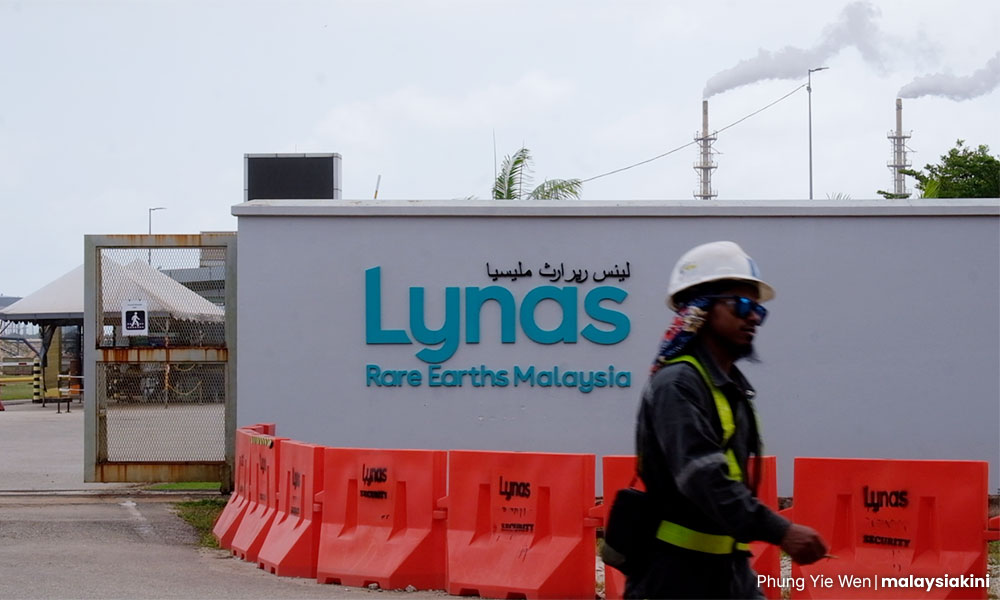
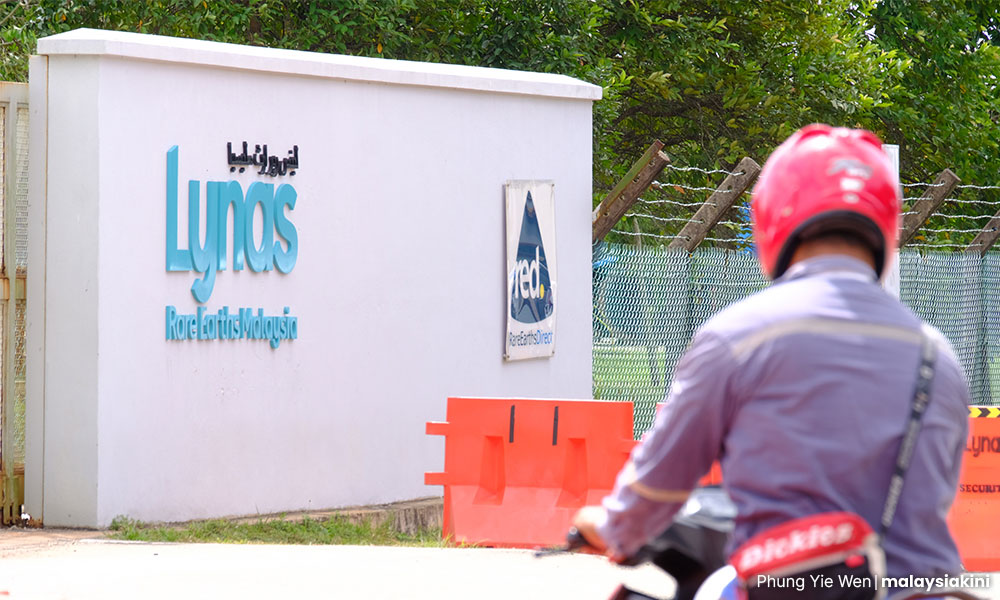
The Environment Department (DOE) has rejected the environmental impact assessment (EIA) report for the proposed expansion of Lynas Advanced Materials Plant's (Lamp) operations in Gebeng, Pahang.
The rejection was displayed on the DOE's website, which does not provide reasons for the unsuccessful EIA applications.
The website stated that the department had received the 770-page report on April 3. The EIA was displayed for public review from April 10 to May 9, while public feedback was accepted until May 24.
Malaysiakini has contacted Lynas Rare Earths for details on its next steps and the DOE for an explanation of the decision.
Lynas Malaysia Sdn Bhd’s proposal to expand Lamp's production involved an increase in lanthanide concentrate processing - from 95,000 tonnes per year to 110,000 tonnes per year.
The expansion would have also introduced a new feedstock into the rare earth refinery’s feedstock - 69,000 tonnes of mixed rare earth carbonate per year that had already undergone processing at Lynas’ facilities in Kalgoorlie, Australia.
According to the EIA, the proposal would have resulted in a 16 percent increase in radioactive water leach purification (WLP) residue, or a total of 2.55 million metric tonnes of WLP by March 2031.
This marks an increase of over 140,000 metric tonnes. Without the expansion, the total WLP waste generated would have reached 2.41 million metric tonnes.
The company also expected to transition to thorium extraction in March 2031 to eliminate the generation of WLP residue, with the report saying that the process will generate two “valuable” by-products: non-radioactive iron phosphate for fertilisers and a thorium-rich product.
Criticism by NGOs
Lynas' activities have been greeted with controversy in Malaysia due to concerns from environmentalists over the local storage of radioactive waste, as they fear long-term risks to health and the environment, particularly when it comes to radiological contamination.
There is also scepticism as to the feasibility of thorium extraction, with Greenpeace Malaysia and Save Malaysia Stop Lynas asserting in a joint statement that the process is “economically and technically impractical” because WLP residue contains only 1,758 parts per million thorium on average.
The Malaysian Consultative Council for Islamic Organisation (Mapim) further questioned the "double standard" of exporting hazardous waste to developing countries.
Other concerns centre around Malaysia’s complicity in military activities linked to violations of international humanitarian law, with pro-Palestine advocates pointing to Lynas’ deal with the US government to supply critical minerals for its defence industry.
Independent scientific reviews
In response to criticisms, a Lynas spokesperson told Malaysiakini that Lamp has been the subject of four independent scientific reviews, which found that operations are low-risk, as well as compliant with regulations and international best practices.
The spokesperson said the plant operates under strict safety and environmental management requirements, which are enforced by the appropriate regulators, adding that regular monitoring is undertaken by Lynas, independent experts, and regulators to ensure compliance.
In February last year, Lynas highlighted its handling of waste and by-product management, stressing its transparency in appointing Gading Senggara Sdn Bhd as the contractor for its PDF for WLP residue.
The company also pointed to statements from the Pahang DOE, which it said found that water leaving the Gebeng Industrial Estate is of higher quality than water entering the area.
On its website, Lynas describes its plant in Malaysia as a “state-of-the-art, environmentally responsible rare earths processing facility”.
“Environmental monitoring carried out by Lynas and regulatory authorities (air, water, ambient air) since Lynas Malaysia commenced operation in 2012 has shown there is no environmental impact of Lynas Malaysia’s operation on the public and the environment,” it said.
It added that monitoring carried out by the company, as well as regulatory authorities, since operations began in 2012, has found no impacts on the public and the environment. - Mkini

No comments:
Post a Comment
Note: Only a member of this blog may post a comment.