


The Centre for Independent Journalism (CIJ) Malaysia has launched its annual report on Malaysia’s media landscape - “The Price of Truth: Economic Rights of Journalists in Malaysia”.
This is in conjunction with the Media Solidarity Festival, co-organised by CIJ, Gerakan Media Medeka (Geramm), and the Malaysian Media Council to celebrate World Press Freedom Day.
This report serves as an opportunity to remind the public of the contributions and struggles of media workers who serve to inform the public and uphold the fourth estate of democracy.
This year’s report focuses on the economic rights of journalists, serving as a lens to view how the media landscape in Malaysia undergoes various issues ranging from political, economic, social, technological, and legal, spotlighting the precarious work conditions and decline of security for members of the media.
As we see how the economic impact directly shapes the journalists’ ability to report independently, ethically, and safely, we also see how it reflects the growing threat to our overall media environment and the decline in public trust in the quality of journalism.
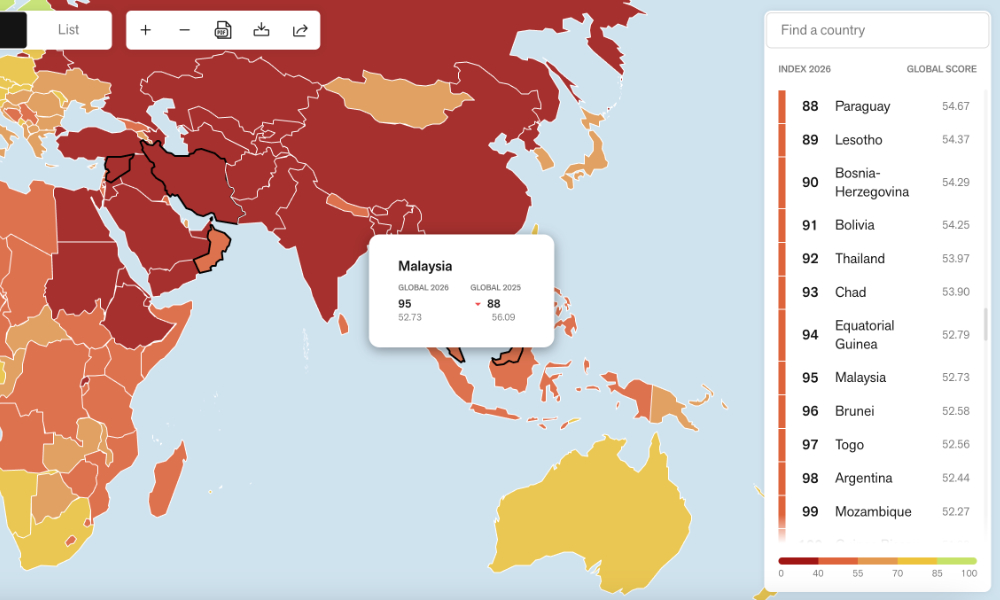
The deterioration of Malaysia’s media ecosystem and press freedom is reflected in the recent drop in its score in the recent Press Freedom Index by Reporters without Borders (RSF): from 88 to 95 globally. We also saw a drop in the economic indicator, from a score of 48.57 last year to 40.28 this year.
As such, CIJ’s report delves into this growing problem by highlighting key areas that most notably contribute to the economic decline of journalists.
Economic Constraints
One of the most salient issues plaguing journalists today that threatens their job security is the economic unsustainability within the media ecosystem.
Global media, particularly legacy media, in the last decade have already been facing many barriers in coping with the shift from print to digital media. The media is now faced with the need to discover innovative ways to remain relevant in this digital age.
This financial burden on media companies, as a result of this transition, as well as the decline in advertising revenue, has further impacted the economic rights of journalists.
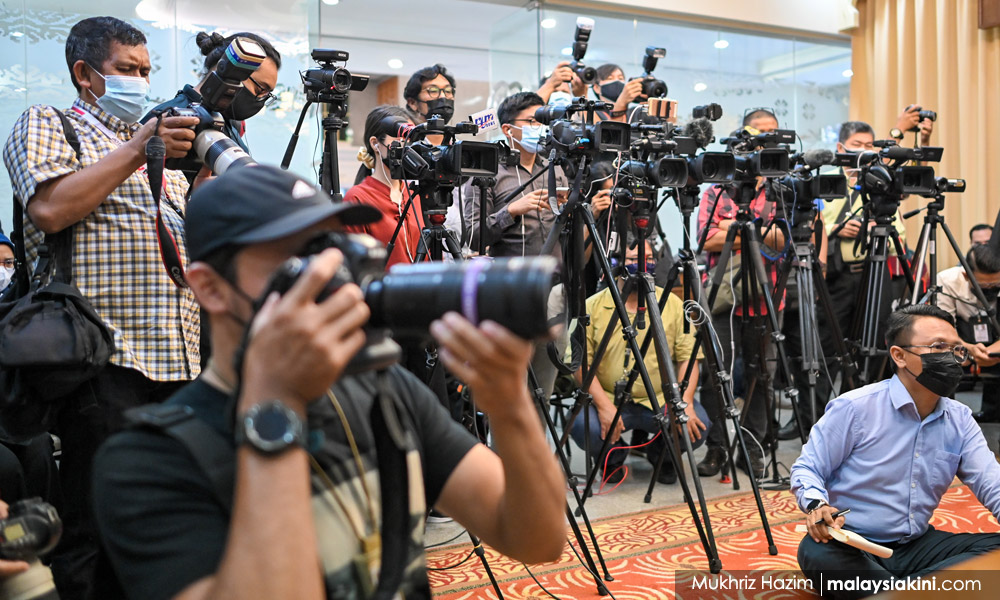
Media workers experience consistent economic pressures and sustainability challenges in the form of low wages, severe job insecurity, intimidation and harassment both within newsrooms and out in the field, as well as unsustainably high-pressure working environments.
This is also not to mention various new media outlets, algorithmic biases, mis/disinformation and artificial intelligence (AI) now competing with legacy media.
In recent years, AI and technological advancements have even become a focal point in the way the media operates. AI now plays a significant role in the production and dissemination of news content.
Locally, newsrooms often utilise generative and agentic AI for the production of content across various mediums (e.g. video, audio, pictures, and written content), as well as to streamline workflow and ease processes within newsrooms. This further creates even more job insecurity for journalists.
The report highlights the vicious cycle impacting the economic rights and sustainable livelihood of media practitioners, including:
1) Media capture through the ownership structures centred in control by oligarchs and their political leaning;
2) Persistently low and stagnant wages, with some experienced journalists still earning as low as RM2,000 monthly;
3) Reliance on contract workers, freelancers, and stringers without adequate social protection and institutional support;
4) Weak career development pathways;
5) Economic cost of legal intimidation and harassment, including police investigations, Slapp (Strategic Lawsuit Against Public Participation), and regulatory controls;
6) Disproportionate impact on women and gender non-binary media workers;
7) Lack of bargaining power to compel revenue sharing and requiring powerful big tech players such as Meta, Google, and ByteDance, among others, to pay for the use and aggregation of news media content.
Legal and political
CIJ continues to see similar issues within the legal environment that continuously undermine not only the economic rights of journalists, but also press freedom in Malaysia.
On an individual level, journalists and editors are often compelled to self-censor due to political and legal pressures by state authorities, enforced through prevailing restrictive laws such as the Communications and Multimedia Act 1998, Printing Presses and Publications Act 1984, Official Secrets Act 1972, Sedition Act 1948, as well as Sections 500, 504, and 505 of the Penal Code.
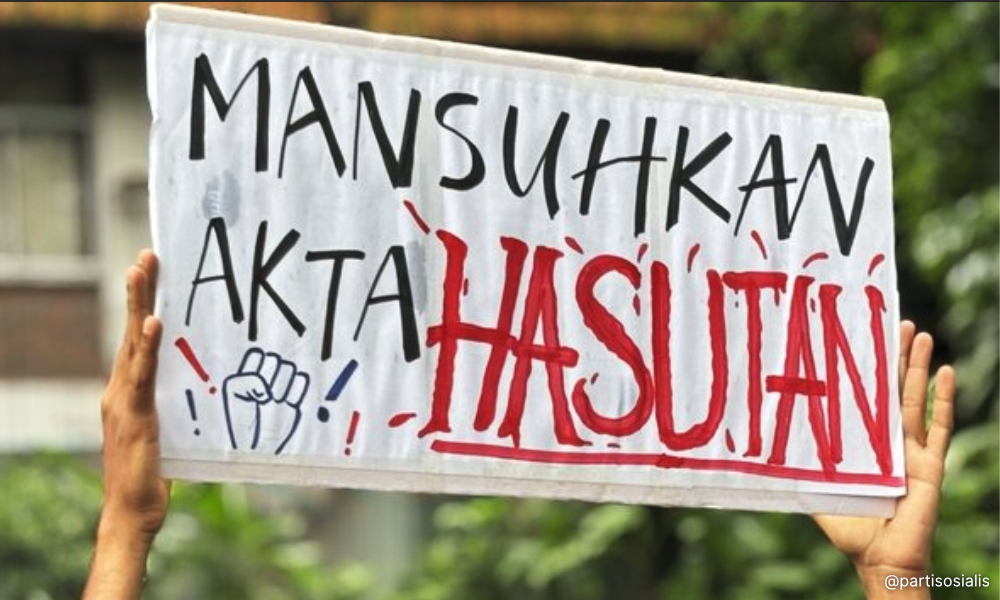
Despite these challenges, positive developments such as the establishment of the Malaysian Media Council, as well as the long-anticipated Freedom of Information Bill, expected to be tabled soon, mark a welcome progression in enabling press freedom and a culture of openness, transparency, and accountability.
The launch of the RM30 million Dana Inovasi Media as a public funding initiative may be construed as a positive step towards enhancing media sustainability.
Sabah and Sarawak
This year, CIJ also pays particular attention to the intersectional issues faced by media workers in Sabah and Sarawak, who bring a unique perspective to our Malaysian information ecosystem and yet have long remained underrepresented in the larger local media ecosystem.
In these special features, we draw attention to the testimonies of journalists in Sabah and Sarawak to highlight their lived realities and provide further credibility to their plights.
This further gives key insight into the political and economic environment that most affects journalists in East Malaysia, intersecting with various other issues.
Recommendations
CIJ continues to emphasise that meaningful reform must go beyond current pledges to reform legal frameworks, and must include sustainable and viable business models for media, effective protections for labour rights, and adequate safeguards to guarantee editorial independence.
The report makes the following recommendations:
1. Recommendations to the state
● Public funding initiatives such as the Dana Inovasi Media and other funds using taxpayers’ contributions should be institutionalised through independent and transparent governance structures to avoid political control.
Formalise revenue-sharing from global tech giants to domestic media as a priority sustainability initiative.
● The Madani government should undertake comprehensive legal and policy reforms to strengthen the economic protection of media practitioners. This includes:
- Immediately halting the use of repressive laws such as the Printing Presses and Publications Act (PPPA) 1984, Official Secrets Act (OSA) 1972, Sedition Act 1948, and Section 233 of the Communications and Multimedia Act (CMA) 1998.
- Adopt anti-Slapp guidelines.
- Amend legislation addressing labour rights, such as the Employment Act 1955, to provide clearer protection for non-traditional media workers.
● Ratify the International Covenant on Civil and Political Rights (ICCPR) and the International Covenant on Economic, Social and Cultural Rights (ICESCR), as well as strengthen implementation of obligations under the Convention on the Elimination of All Forms of Discrimination Against Women and other international frameworks relating to labour rights and media freedom.
2. Recommendations to media organisations
● Media organisations should adopt fair and equal labour and contractual practices that prioritise the non-discrimination and long-term sustainability of journalists
● Media organisations should also invest in occupational safety, adequate sexual and reproductive health rights (SRHR) guarantees, and mental health support, as well as provide adequate legal support.
● Internal grievance mechanisms should be established or strengthened to address workplace discrimination, harassment, and gender inequality.

● Media organisations should develop sustainable business models, without undermining the labour rights of their employees, and invest in training, digital upskilling, as well as AI literacy and ethical use.
3. Recommendations to the Malaysian Media Council
● The Malaysian Media Council (MMC) should support the development of ethical standards safeguarding the economic rights of media practitioners.
● The MMC should create awareness of its grievance mechanism
● Collaborate with civil society organisations and lawyer networks to establish legal support and emergency assistance funds to support journalists facing Slapps, arbitrary dismissal, or retaliatory legal action.
● MMC should collaborate with NUJM (National Union of Journalists Malaysia), civil society organisations, and academic institutions to conduct regular studies on newsroom work conditions, media sustainability, wage trends, and digital labour practices.
Openness, transparency, and accountability
Despite the deterioration of Malaysia’s media freedom, we hope that the overall landscape can be taken as an opportunity to strengthen institutions that serve to buttress the fourth pillar of democracy, as an extension of democracy itself.
We hope to take advantage of improving technological expertise and growing institutional bodies to improve the conditions for an important demographic, as well as to ensure that the rights of all to be informed and have discourse are respected to the utmost.
The full report is available here. - Mkini
The CENTRE FOR INDEPENDENT JOURNALISM is a non-profit organisation that aspires for a society that is democratic, just, and free, where all people enjoy free media and the freedom to express, seek, and impart information.
The views expressed here are those of the author/contributor and do not necessarily represent the views of MMKtT.

No comments:
Post a Comment
Note: Only a member of this blog may post a comment.