


A Seremban school noise dispute and traffic mayhem highlight wider gaps in urban planning, education policy, and the lack of clear rules governing how schools and neighbourhoods share space.

The dispute between St Paul’s primary school in Seremban and nearby residents is not driven by hostility or neglect.
It is shaped instead by proximity, ambiguity, and the absence of enforceable boundaries.
In Taman Bukit Kaya and Taman Labu, daily routines have become harder to predict.
Residents point to loud public address announcements, school celebrations that spill beyond the compound, and routine activity noise that reaches nearby homes.
Indiscriminate parking and poor traffic control add to that strain. Cars line narrow residential roads during school peak hours while driveways and back lanes are often blocked.
The disruption may appear minor in isolation, yet residents say repetition has turned it into a daily burden that affects movement, access, and patience.
Multiple complaints have been submitted to the school and the education department over recent months. Some residents have also shared video and audio recordings showing school-related announcements and activity noise carrying into homes.
They stress a consistent point: schooling itself is not the issue, but repetition and scale of disruption are.
The school presents a different account. It says adjustments have already been made, including reduced public address volume, inward-facing speakers, and tighter control of announcements after discussions with education authorities.
Communication channels with residents remain open, and further refinements continue where possible.
Both sides describe effort. Both sides describe frustration. That shared strain has turned a practical issue into a persistent civic tension.
At the centre of disagreement sits a town hall session held last year with education officials present.
Residents maintain the session produced clear limits on public address use, including microphones restricted to Monday assemblies and official school programmes.
That understanding, they say, was intended to balance school operations with residential peace.
The school’s board of managers describe a different outcome. No formal agreement was signed, only a mutual understanding shaped by advice from the Negeri Sembilan education department.
That distinction between agreement and understanding now defines the dispute.
The school also highlights its long presence in the area. It has operated since 1979 and serves more than 800 pupils.
Public address systems, it argues, remain essential for discipline, safety, and coordination.
Complete restriction, from this perspective, is not practical.
Residents do not demand silence. They seek predictability and restraint.
The concern lies less in isolated incidents than in recurrence, especially when earlier assurances appear only partially reflected in daily practice.
This tension is not new. In 2024, objections arose over commercial use of the school hall, later halted following intervention by the city council.
While that episode involved different circumstances, it still shapes how some residents interpret current assurances.
The present dispute, however, sits within normal school operations. That makes it less about enforcement and more about boundaries that were never clearly defined.
The governance gap
The school acknowledges there are no specific guidelines governing public address systems in residential areas.
Schools operate instead under broad expectations of consideration while managing large student populations.
That absence of clear standards leaves disputes dependent on goodwill, informal negotiation, and periodic mediation rather than enforceable rules.
The board of managers describes its approach as one of coexistence. It says efforts have consistently focused on reducing disruption and maintaining harmony with surrounding residents.
Informal communication channels, including a residents’ chat group and school outreach events, form part of that effort.
Yet communication alone cannot define limits. It manages relationships but does not set thresholds. That gap leaves interpretation open on both sides.
Urban planning deepens the problem.
Many Malaysian schools predate surrounding housing density. Over time, residential development has grown around them.
Roads that once carried light traffic now absorb daily school flows. Residential streets have become informal drop-off and pick-up zones.
Haphazard parking illustrates this shift most clearly. It is not a single incident but a repeated pressure point.
Each occurrence may seem small, yet accumulation turns it into structural friction.
Even minor disruptions become entrenched when they repeat daily.
Education authorities say they are working to resolve the matter quickly. That commitment is important, yet it also highlights how often such disputes rely on reactive intervention rather than preventive design.
For now, both sides remain in a cycle of adjustment. Operational changes continue at the school. Complaints continue from nearby homes where disturbance is still felt.
With classes reopening on June 8 after the school holidays, some residents say they are bracing for the return of familiar routines.
The expectation is not confrontation, but repetition.
That expectation reflects a deeper issue: uncertainty over whether anything fundamentally changes between cycles of complaint and response.
In the end, this row reflects crowded proximity, unclear expectations, and the absence of firm, enforceable limits.
Until those boundaries are defined more clearly through policy, planning, or formalised standards, Seremban will remain a preview of a wider urban reality where learning institutions and residential life are forced into constant negotiation.
The real issue is not what is heard across the fence, but what remains undefined on either side of it. - FMT
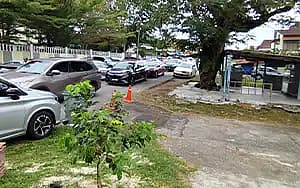
Bumper-to-bumper traffic builds outside St Paul’s primary school in Seremban, where peak hours spill into nearby residential streets, placing daily strain on surrounding homes. (Nor Ariffin Abdullah pic)
The views expressed are those of the writer and do not necessarily reflect those of MMKtT.

No comments:
Post a Comment
Note: Only a member of this blog may post a comment.