


The investigation into the Labour Recalibration Programme (RTK) syndicate, better known as the “legalisation syndicate”, has allegedly been classified as no further action (NFA).
Three sources - from the MACC, the industry, and the Immigration Department - claimed that the decision had been made, but the date and reasons were not disclosed to Malaysiakini.
However, the Attorney-General’s Chambers (AGC) has so far neither denied nor confirmed the allegation, despite initially promising to respond to the portal’s questions.
On May 11, an AGC officer informed Malaysiakini that they were preparing a response to the queries.
But until today - more than three weeks later - no reply has been provided regarding the status of action against the syndicate allegedly involving insiders within the Immigration Department.
The questions were initially sent to the AGC on May 5.
On Nov 25, 2025, a MACC source told Malaysiakini that 11 officers from the Immigration Department had been arrested in connection with the syndicate.
Malaysiakini’s attempts to obtain an official comment from the department, beyond the confirmation of arrests, have also been unsuccessful.
“MACC arrested the (Immigration Department) officers. We are not involved.
“We leave it to MACC to take any action,” said an officer from the office of the department’s director-general, who declined to be named.
Legalising undocumented migrants
The legalisation programme had aimed at recruiting foreign workers who had overstayed or did not possess valid work permits.
RTK 1.0 was first implemented on Dec 28, 2020, as a special programme to legalise undocumented migrants. RTK 2.0 was later introduced on Jan 27, 2023, and ran until Dec 31, 2023.
According to media reports, within just the first seven months of RTK 2.0, a total of 720,099 undocumented migrants registered, involving 51,753 employers.
The recalibration fee for RTK 2.0 was RM1,500 per worker, while levy costs ranged between RM640 and RM1,850 depending on the sector, along with a RM60 pass fee and RM125 processing fee.
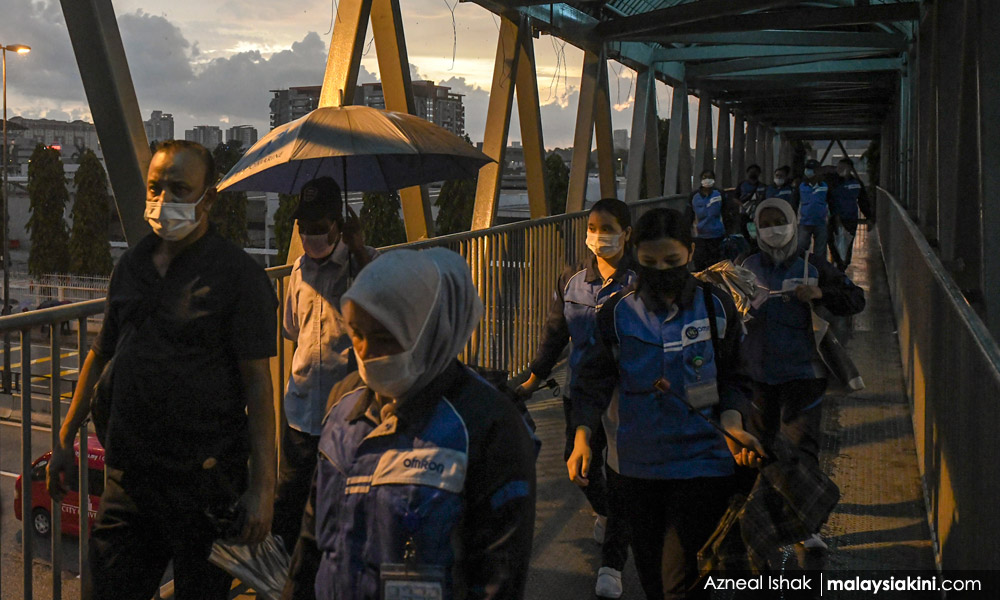
However, allegations emerged from several local agents and foreign nationals claiming that certain parties had made millions of ringgit in profits.
Several local agents and foreign nationals alleged that they paid an additional RM3,000 to immigration officers for each application.
Some local agents and foreign nationals also revealed that they paid immigration officers for expedited approvals, including fingerprint processing, queue numbers, and temporary pass stickers.
A Malaysiakini report also exposed allegations that one department officer - who was among those arrested - had allegedly earned millions of ringgit from the syndicate and invested the money in a nasi kandar restaurant business in the Klang Valley. - Mkini

No comments:
Post a Comment
Note: Only a member of this blog may post a comment.