



AS public discussion intensifies around the role of e-commerce platforms in Malaysia, including questions about costs, fairness and sustainability, it is timely to recognise that e-commerce today is no longer a simple buyer-seller interaction.
It has evolved into a complex ecosystem comprising platforms, logistics providers, payment systems, regulators, seller and consumers – all working together to enable digital trade at scale.
This ecosystem perspective is increasingly important as online business becomes embedded in daily life and national economic activity.
Beyond competitive pricing, consumers now expect reliability, delivery in speed, secure payments, data protection and dispute resolution. These expectations require continuous investment across the entire value chain.
According to data from the Department of Statistics Malaysia (DOSM), Malaysia’s e-commerce sector recorded RM937.5 bil in revenue during the 9M 2025 period.
Insert DOS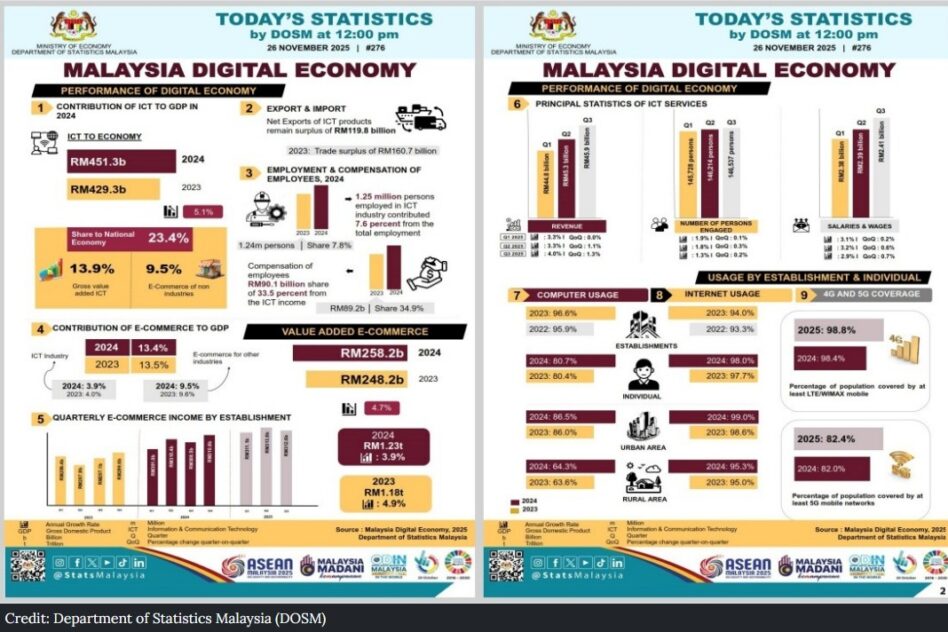
Total e-commerce expenditure also expanded, driven by higher participation from both businesses and consumers. This continued growth reflects not only rising online sales but also increasing reliance on digital platforms for goods, services and everyday payments.
As these expectations intensify and the economics of online selling evolve, industry stakeholders are increasingly calling for a more pragmatic conversation on how Malaysia will be able to sustain growth in e-commerce in its next phase, taking into consideration the needs of all stakeholders.
Genuine investment vital
Malaysia’s e-commerce ecosystem is no longer in its infancy. What began with adoption-drive incentives has now evolved into an essential economic infrastructure serving consumers and MSMEs (micro small medium enterprises) across multiple generations with rising demands for reliability, speed, safety and trust.”
Long-term sustainability requires continued ecosystem investment to further strengthen the industry’s infrastructure alongside targeted support.

Meeting today’s market demands – from robust logistics networks and secure digital payments to advanced platform reliability and marketplace safety – involves on-going structural costs that cannot be sustained solely through broad-based subsidies designed for an earlier stage of growth.
This underscores the need for shared responsibility of contributions across the ecosystem spanning public sector enablement, private-sector infrastructure investment and MSME capability-building to support sustainable growth that will ultimately benefits sellers and buyers alike.
Against this backdrop, the conversation needs to move beyond fees alone to focus on outcomes.
The more important question is whether the e-commerce ecosystem is delivering greater reliability, stronger trust and more sustainable growth for MSMEs and consumers alike.

Framing the discussion solely around cost, risks overlooking the value created through improved infrastructure, service quality and long-term competitiveness.
Policymakers, industry leaders and MSMEs alike have highlighted the fundamental shift in Malaysia’s digital landscape.
With the digital economy moving into a more mature growth phase, the emphasis must increasingly be on capability building. This includes strengthening digital skills, productivity, brand development and business resilience among MSME so they can better compete in a digital-first economy.
Support remains important but long-term competitiveness will depend on upskilling and innovation, thus enabling MSMEs to fully leverage digital e-commerce opportunities.
It is time to align incentives and policies with this next chapter of growth, one that enables continued investment in infrastructure, tools and capabilities that uplift all market participants.
Pankaj Kumar is managing director of socio-economy think tank Datametrics Research and Information Centre Sdn Bhd.
The views expressed are solely of the author and do not necessarily reflect those of MMKtT.
- Focus Malaysia.

No comments:
Post a Comment
Note: Only a member of this blog may post a comment.